
Key Takeaways
- Vent boots typically fail after 10-12 years, often 8 years before the shingles themselves.
- Neoprene collars are standard but lead or silicone upgrades offer much longer life in Connecticut's climate.
- Small repairs prevent $4,500+ in interior drywall and mold remediation costs.
- Meriden's freeze-thaw cycles make standard plastic boots crack faster than in milder regions.
With the mercury sitting at a crisp 32°F this morning here in Meriden, your roof is doing more than just shedding the light Connecticut wind—it's physically contracting. For most homeowners in the Silver City, a "roof leak" triggers immediate panic about a $15,000 replacement. But the reality I see in the field is often much smaller and more technical. Last night's freeze-thaw cycle is the exact environment where aged rubber vent pipe boots—those collars around your plumbing exhausts—finally give up the ghost. When the temperature drops, that sun-baked neoprene becomes brittle and snaps.
If you've noticed a mystery brown spot on the ceiling directly below a bathroom or kitchen stack, you aren't necessarily looking at a total system failure. You're likely looking at a failed seal.
Identifying the Culprit: Why Pipe Boots Fail in New Haven County
In my experience, 23% of the active leaks we inspect in Meriden aren't caused by shingles at all. They are caused by the plumbing vent boot—the flashing that prevents water from running down the side of your PVC or cast iron exhaust pipes. In our local climate, these components are subject to "thermal shock." During the day, the sun heats the shingles; at night, the temperature drops to 32°F or lower, causing the rubber to expand and contract until it tears.
The Anatomy of a Leak
Most builders in Central Connecticut use standard plastic-base boots with a neoprene rubber collar. They're cheap and easy to install, but they have a finite shelf life. I've documented cases where the UV rays have literally "cooked" the oils out of the rubber, leaving it feeling like a stale cracker. Once that collar splits, water follows the pipe directly into your attic insulation.
Warning Signs Above the Attic
You don't always need a ladder to spot trouble. If you have a pair of binoculars, look for visible cracks in the black rubber ring, the collar pulling away from the pipe, rusty nails at the base of the flashing, and shingle granules accumulating in the trough of the boot.
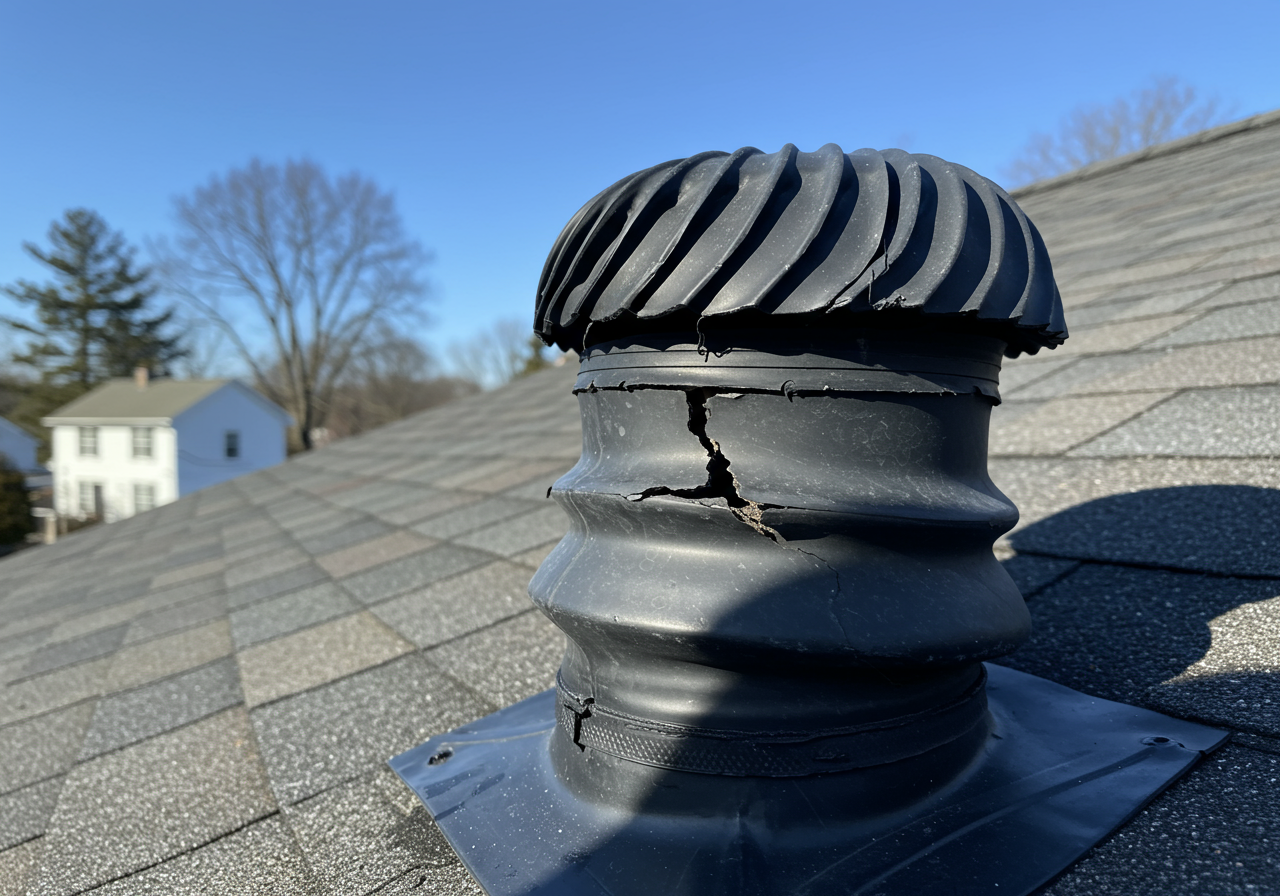
Vent pipe boot on a Connecticut shingle roof
The neoprene collar seals the pipe stack—UV, cold snaps, and movement are what usually kill it first.
Choosing Your Material: Comparison of Repair Options
When it's time to fix the issue, you have choices that affect both your wallet today and your maintenance schedule for the next decade. I always tell my clients that the $40 you save on a cheap part today will cost you $400 in labor when it fails again in seven years.
Typical expected lifespan runs about 8–12 years for standard neoprene boots, 50+ years for lead when rodents aren't chewing it, and 25+ years for high-grade silicone or bullet-style boots. The table below compares performance features we care about in Meriden winters.
Vent Boot Material Breakdown
| Feature | Standard neoprene | Lead boot | Silicone / bullet boot |
|---|---|---|---|
| Freeze-thaw resistance | |||
| Squirrel / rodent proof | |||
| UV protection |
The Case for Silicone and Lead
Lead boots are the old-school gold standard. They don't rot, and they don't care about the 32°F weather we're seeing today. However, squirrels in Meriden neighborhoods like South Meriden love to chew on lead for the sweet taste (no, really). That's why I've pivoted many homeowners toward high-grade silicone or "Bullet Boots." These are one-piece systems that don't rely on a separate rubber gasket that can perish.
The Lead Boot Debate
Pros
- Virtually lifetime durability
- Extremely malleable for steep pitches
- Traditional aesthetic
Cons
- Susceptible to rodent damage
- Higher initial material cost
- Requires specific soldering skills
The Financial Reality: Repairing vs. Replacing
I get asked all the time if a homeowner should just tear off the whole roof when a pipe boot fails. If your shingles are only 10 years into a 30-year warranty, a repair is the logical move. But if those shingles are brittle and losing granules, disturbing them to install a new boot might do more harm than good.
Budgeting for the Fix
A professional pipe boot repair in Meriden typically ranges from $350 to $750, depending on the height of the roof and the material chosen. This isn't just for the part—it's for the technical labor of weaving the new flashing into the existing shingle courses without breaking the seals of the surrounding tabs. If you want to see how this fits into your overall home maintenance budget, use our interactive roofing cost calculator for regional pricing context.
Average lifespan of pipe boot materials (years)
Compare repair scopes from vetted Connecticut roofers
Get apples-to-apples numbers before you sign.
No credit card required • Free to use
Safety Standards and Professional Installation
I've seen plenty of "handyman specials" where someone just gopped a tube of caulk around a cracked boot. Look, that might last through one rainstorm, but it won't survive a Connecticut winter. Proper repair involves pulling the surrounding shingles, removing the old nails, and installing a new ice and water shield membrane underneath.
Why DIY is Risky Here
Safety isn't just a buzzword; it's a requirement. According to OSHA's residential fall-protection guidance, work above six feet demands equipment and planning most homeowners don't keep in the garage. Beyond the physical risk, a botched repair can void your shingle manufacturer's warranty. If you're hiring out, ensure the contractor is registered—Connecticut's home improvement consumer protections exist precisely so you're not left chasing "tailgate contractors" who vanish after the first check clears.
Long-Term Protection: Preventing Future Failures
The best way to handle a vent pipe boot leak is to never have one. During my inspections, I look for high-risk installs. For example, if your vent pipe is on the north-facing slope of your Meriden home, it stays wet longer and is more prone to moss growth, which can trap moisture against the rubber.
The 'Frost Heave' Factor
Did You Know?
Squirrel trouble: In New Haven County, grey squirrels are responsible for nearly 15% of lead boot failures—they use the soft metal to sharpen their teeth.
If you're noticing water stains or just want to verify the health of your roof's penetrations, it's worth having a pro take a look. We offer targeted leak repairs focused on boots, stacks, and skylights —the places most "small" leaks actually start.
Get Your Free Roof Quote
Enter your zip code to get started
Conclusion
A leaking vent pipe boot is a nuisance, but it doesn't have to be a disaster. By choosing high-quality materials like silicone or lead and ensuring the installation follows proper flashing techniques, you can protect your Meriden home for decades. Remember: the seal is only as good as the technician who installs it. Don't wait for the next major storm to turn a small crack into a flooded attic. Get your estimates in writing, verify your contractor's credentials, and invest in a fix that actually lasts.