Key Takeaways
- Typical town permit math in Glastonbury scales roughly with job value-about $13.12 per $1,000-which should match your paperwork, not vague 'miscellaneous' fees.
- When you pull your own homeowner permit in Connecticut, you're effectively acting as general contractor-liability shifts to you.
- The 2022 Connecticut State Building Code still governs Ice barrier details in 2026; that 24-inch interior rule catches many Hartford County installs.
- An open or missing permit hurts sales and insurance defenses as much as no permit-quiet problems until the title search arrives.
"If a contractor tells you that skipping the permit will save you $300, they aren't saving you money—they're selling you a liability policy you never signed up for."
He's right. In Glastonbury, the paperwork isn't just bureaucracy; it's your only leverage when a crew disappears or the roof leaks after the first spring thunderstorm. I've seen too many neighbors near Hebron Avenue try to cut corners, only to face a "stop-work" order that turns a three-day project into a three-week headache. May 2026 is a busy month for roofing in Hartford County, and the town hall is watching. Let's look at the actual math of what a permit costs and why that line item on your quote is non-negotiable.
The True Cost of a Glastonbury Building Permit
I've had homeowners call me fuming because they saw a $250 "Permit Fee" on their estimate and thought the contractor was pocketing the change. Let's look at the receipts. In Glastonbury, permit fees are typically scaled based on the total value of the job. You're looking at roughly $13.12 for every $1,000 of the project cost. If you're replacing a standard architectural shingle roof for $16,400, your base permit fee is about $215. Add in the State of Connecticut Education fee (usually $0.26 per $1,000), and you're at $220.
I once helped a couple on Main Street who were quoted $500 for a permit. When we looked at the town's fee schedule, the contractor was clearly padding the bill by over 100%. I told them to demand a line-item breakdown. A reputable pro will charge you exactly what the town charges, perhaps with a small, transparent service fee for the time spent at Town Hall. If the numbers don't add up, your contractor is starting the relationship with a lie.
Why "Homeowner Pulled" Permits Are a Massive Red Flag
Here is the most dangerous sentence in the roofing industry: "It'll be faster if you just pull the permit as the homeowner." If a contractor says this to you, show them the door. When you pull the permit yourself, you are telling the Town of Glastonbury that you are the one responsible for the work. You are the general contractor. If a worker falls off your roof or the shingles aren't nailed to code, the liability sits squarely on your shoulders.
I remember a case in 2024 where a homeowner pulled their own permit to "save time." The crew didn't install the flashing correctly, leading to a massive leak in the kitchen. Because the homeowner had signed the permit, the contractor argued they were just "laborers" following the owner's lead. It was a mess. Before you sign anything, you should verify your contractor's license in writing and insist that their name-not yours-is on that permit. It's the only way to ensure their insurance is the one on the hook if things go sideways.
Local Glastonbury Codes Every Owner Should Know
Connecticut doesn't play around when it comes to snow and ice. According to the International Code Council Digital Building Codes, specifically the 2022 Connecticut State Building Code (which we are still adhering to in 2026), your roof must have an ice barrier. In Glastonbury, this means an ice and water shield must extend from the eave's edge to a point at least 24 inches inside the exterior wall line.
I've walked onto job sites where the crew was only running a single 36-inch strip because it was "standard." In many Glastonbury homes with deep overhangs, that single strip isn't enough to meet the 24-inch interior requirement. Without a permit and a subsequent inspection, who is checking that? No one. You'll only find out it was done wrong when an ice dam forms next February and starts dripping through your ceiling. Don't just take the contractor's word for it-ask to see the ice shield layout before the shingles go down.
Inspection reality check
The Hidden Financial Risk of Unpermitted Roofs
You might think you've "beaten the system" by skipping the permit, but the bill usually comes due when you try to sell your home. I've seen real estate deals in the Buttonball neighborhood fall apart in 48 hours because a title search or home inspection revealed a new roof with no permit on file. The buyer's bank won't finance a house with unpermitted structural work. Suddenly, you're paying for a retroactive permit, which often involves a 2x or 3x penalty fee and potentially tearing up a section of the roof so an inspector can see the underlayment.
Furthermore, your insurance company is looking for any reason to deny a claim. If a hurricane-force wind rips shingles off your unpermitted roof, they can argue the installation was never "legal" or verified to meet wind-speed ratings. The Better Business Bureau Roofing HQ warns that unpermitted work is a top reason for contract disputes. If you want reassurance from people who went first, browse firsthand stories from Connecticut homeowners who insisted on paperwork and accountability.
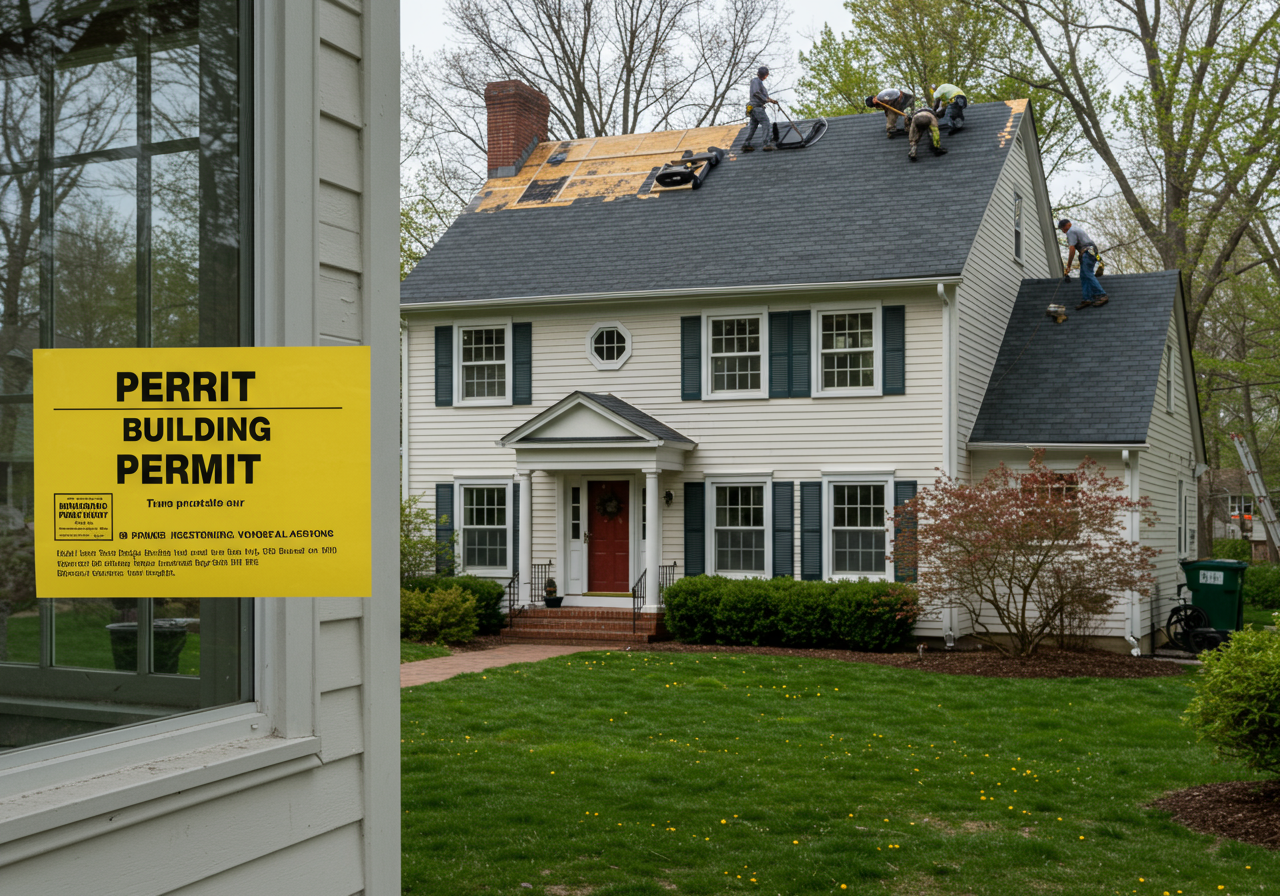
When skipping the permit hurts resale
Buyer financing and insurer reviews often hinge on closed permits—not just shingles that look fresh from the curb.
How to Spot Permit Padding on Your Quote
I want you to look at your roofing estimate like a forensic accountant. A "Permit" line item should be just that-the permit. It shouldn't be lumped into "Materials and Overhead" or "Miscellaneous Fees." If a contractor is being vague, it's often because they aren't planning on pulling one at all, or they're overcharging you.
I always suggest homeowners open our roofing cost and permit explainers for Connecticut whenever a quote lands in their inbox—you'll quickly see how permit dollars line up with disposal, labor, and material sections. If your contractor quotes you $800 for a permit on a $12,000 roof, they are taking you for a ride. The math is simple: (Project Cost / 1,000) * 13.12. Anything significantly higher than that needs a very good explanation, like an engineering sub-review for a complex structural change.
Glastonbury Roof Permit vs. Unpermitted Risks
Illustrative relative costs—exact penalties vary by scope and insurer response.
Step-by-Step Permit Process for 2026
The process in Glastonbury has moved mostly online now, which is a blessing. It used to involve three trips to the town hall; now, a pro can handle it from their truck. But you still need to know the milestones so you can track progress.
Application packet
Contractor submits the application with their current CT license and proof of workers' comp insurance.
Plan review
The Building Department reviews the plans to ensure wind load and ice dam specs meet the 2022 CT State Code.
Permit issuance + posting
The permit is issued and must be posted on-site (usually in a window) before the first shingle is removed.
Mid-work verification
Some inspectors stop by to see the underlayment before it's covered.
Final inspection closure
Once the job is done, the contractor must call for a final walkthrough to close the permit.
I once worked with a homeowner who thought the job was "done" when the crew drove away. Two years later, they found out the permit was still "open" because the contractor never called for the final inspection. That "open" status is just as bad as "no permit" when it comes to selling your home. Always ask for a copy of the closed permit before you hand over the final check.
Final Inspection: The Signature You Actually Need
The final inspection is your safety net. It is a third-party expert (the town inspector) verifying that the work you paid for actually happened. They'll check the drip edge, the chimney flashing, and the ventilation. In May, with the Connecticut rain starting to pick up, you want that peace of mind.
If you're worried about whether you're getting a fair shake on these costs, you don't have to guess. Use a service that vets the pros for you. Finding a contractor who respects the law is the first step to finding one who respects your home.
Worried about permit paperwork in Glastonbury?
Get matched with a licensed crew that files, posts, and closes permits—the way Hartford County expects in 2026.
No credit card required • Free to use
Get Your Free Roof Quote
Enter your zip code to get started
FAQ

About Dana Jackson
Verified ExpertDana Jackson is a Homeowner Advocate & Cost Analyst who helps Connecticut families navigate the financial aspects of roofing projects. She specializes in finding the best value and avoiding common pricing pitfalls.