
Key Takeaways
- The High-Nail Trap: Standard 4-nail patterns often fail in high winds; New Britain homes require a 6-nail 'hurricane' pattern for true security.
- Edge Vulnerability: 67% of roof failures during storms start at the perimeter where drip edges are improperly fastened.
- Sealant Bonding: Shingles installed in late autumn or winter may not 'seal' properly until the first warm stretch, leaving them vulnerable to wind-lift.
- Hardware Essentials: Retrofitting hurricane straps to rafters can increase a roof's uplift resistance by over 400 lbs per connection point.
Two years ago, I stood on a driveway in the Belvidere neighborhood of New Britain, looking at a roof that was only thirty-six months old. The homeowner, a retired engineer, was baffled. He'd paid for "high-wind shingles," yet after a particularly nasty gust moved through Hartford County, he had three squares of asphalt sitting in his azaleas. When I climbed up there and pulled a few tabs back, the culprit was glaringly obvious. It wasn't the shingle brand; it was the physics of the installation.
The contractor had used a standard four-nail pattern and placed the fasteners about an inch too high. In normal New England weather, that roof stays put. But during the high-pressure uplift of a tropical event? That "standard" install is essentially a kite. This is the reality for thousands of homes across the Hardware City—they are built to code, but not built for the extremes we're increasingly seeing.
The Secret Geometry of Shingle Fastening
Look, a shingle is only as strong as the steel holding it down. Most manufacturers, like GAF or Owens Corning, provide a "strike zone" for nails. If a roofer misses that line by even half an inch, the wind-warranty is effectively voided. In New Britain, where the wind can whip off the ridges and tunnel through residential streets, "close enough" doesn't cut it.
The 6-Nail Difference
On a standard 30-year architectural shingle, a four-nail pattern is the baseline. But for hurricane-level resistance, we move to a six-nail pattern. This isn't just about adding more metal; it's about distributed load. When I'm inspecting a job, I look for nails driven flush—not "sunken" (which cuts the shingle) and not "proud" (which prevents the shingle above from sealing).
Why High-Nailing is the Silent Killer
"High-nailing" happens when a crew moves too fast and fires the nail gun above the reinforced common bond area. When a storm hits, the wind gets under the shingle. If the nail is too high, it acts as a pivot point rather than an anchor, and the shingle simply zips right off the fastener. If you're worried about past work, seeing what other CT homeowners experienced with different contractors can often reveal who cuts corners on these technical details.
The Perimeter Problem: Why Edges Peel First
Think of your roof like a tablecloth. If the wind gets under the edge, the whole thing flies off. In roofing, that "edge" is your drip edge and your starter strip. I've seen $25,000 roofs fail because a contractor saved $200 on cheap edge metal.
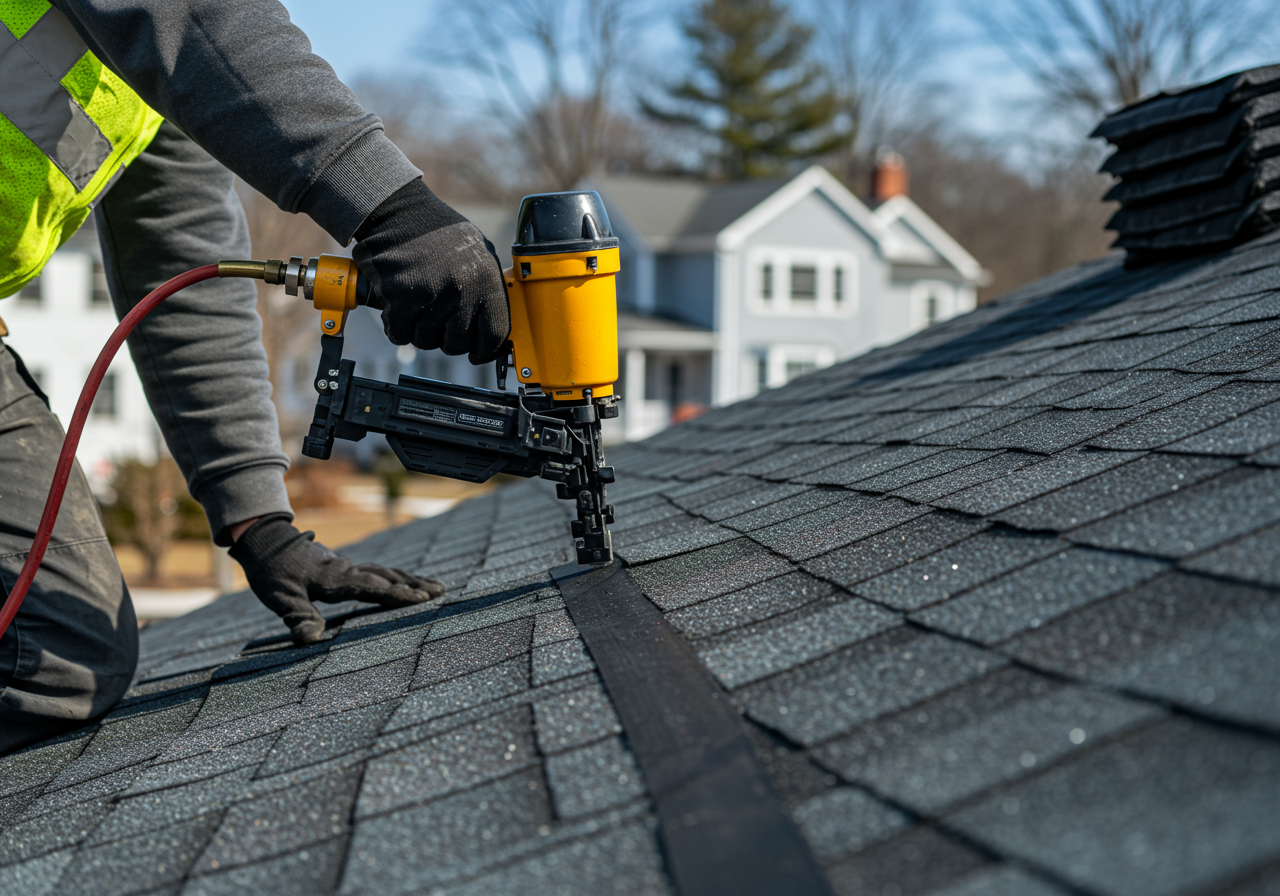
Hurricane-resistant roof installation in New Britain
Proper perimeter fastening and heavy-gauge drip edge are critical for wind resistance in Hartford County.
The Role of Drip Edge and T-Style Guards
In New Britain, we see a lot of "D-style" drip edge, which is fine for rain but mediocre for wind. I prefer a heavy-gauge T-style edge that is fastened every 4 inches, rather than the standard 12 inches. According to the NWS Historical Storm Events Database, Hartford County sees localized wind bursts that can easily exceed 60 mph. At those speeds, an improperly secured edge metal will vibrate, loosen, and eventually peel back, taking the first three rows of shingles with it.
Standard vs. Hurricane-Ready Perimeter
| Feature | Standard Build | Hurricane Spec |
|---|---|---|
| Nail Spacing | ||
| Starter Strip | ||
| Metal Gauge | ||
| Uplift Resistance |
Starter Shingles: The Unsung Heroes
You can't just flip a regular shingle upside down and call it a "starter." True starter shingles have a factory-applied adhesive strip at the very bottom edge. This creates a thermal bond with the first row of shingles. Without this, the wind can lift the very first layer, creating a domino effect that strips the entire slope.
Structural Anchoring and the "Whole House" Connection
Many New Britain homes were built in the 1940s and 50s. Back then, we didn't use hurricane straps; we used "toenailing"—driving a few nails at an angle through the rafter into the top of the wall. It's a weak connection. If a hurricane-force wind creates enough lift, it doesn't just take the shingles; it can actually lift the roof structure off the walls.
Retrofitting Hurricane Straps
If your attic is unfinished, adding galvanized steel hurricane straps is one of the highest-ROI moves you can make. These straps wrap over the rafter and nail into the wall studs. It changes the roof from a "lid" sitting on a box into a single, integrated unit.
Check Your Attic
The Importance of Decking Attachment
Before the shingles even go on, the plywood (decking) needs to be secured. Code usually requires nails every 6 inches on the edges. For high-wind zones, I push for 8d ring-shank nails. These have "teeth" that grip the wood, making them nearly impossible to pull out. If you're currently dealing with a roof that's already failing, you might need emergency roofing services to stabilize the structure before the next big blow.
The "Sealant Trap" in New England Winters
Since it's January 2026, we need to talk about temperature. Shingles have a strip of "asphaltic sealant" that needs solar heat to melt and bond to the layer below. In a Connecticut winter, that sealant is hard as a rock.
Did You Know?
Did you know that shingles installed in temperatures below 40°F may not seal until the following April? If a major wind storm hits in February, your 'new' roof could be at risk because the shingles haven't actually stuck together yet.
Hand-Sealing: The Pro Move
When my crews install in cold weather, we don't just "hope" for a warm day. We use a tube of roofing cement (like flashing cement) and apply two one-inch dabs under every tab. This provides a temporary mechanical bond until the sun can do its job in the spring. It's tedious, and many "blow-and-go" contractors won't do it. This is why I always tell homeowners to verify their contractor's license and ask specifically about cold-weather bonding procedures.
Contractor Safety and Standards
When these high-wind installs are happening, the pitch of the roof doesn't change, but the stakes do. I've seen crews skipping the hand-sealing because they're rushing to get off a cold roof. Always ensure your team is following OSHA fall protection standards. A crew that cares about their own safety usually cares about the safety of your shingles, too.
"A roof is a system of thousands of parts. If the $0.05 fasteners aren't placed with surgical precision, the $15,000 in materials is just expensive trash waiting for a storm."
Summary of Actionable Steps
Preparing for a hurricane in New Britain isn't about buying the most expensive shingle; it's about the technicalities of the "attachment chain."
- Verify that your quote specifies a 6-nail pattern.
- Insist on heavy-gauge drip edge fastened at 4-inch intervals.
- Ensure your contractor uses dedicated starter shingles, not scraps.
- If your home is pre-1970, ask about retrofitting hurricane straps in the attic.
If you want to make sure you're getting a crew that understands these New Britain-specific requirements, finding a contractor who actually shows up and knows the local building nuances is half the battle. Be sure to check Connecticut's consumer protection laws to ensure your contract includes the necessary warranties for wind resistance.
Get Your Free Roof Quote
Enter your zip code to get started