Most Wilton homeowners assume a few missing shingles after a heavy February gust are just a cosmetic nuisance that can wait until the spring thaw. Here is the reality: a single "shingle tab" lifted by the wind acts like a door hinge, breaking the seal on every surrounding piece and inviting water to rot your decking long before you see a drip in the attic. In Fairfield County, where we deal with high-value properties and mature trees along roads like Nod Hill, a "minor" wind issue is rarely just minor. If you ignore the signs now, you aren't just delaying a repair; you are actively auditioning for a $22,000 replacement later this year.
Key Takeaways
- Creased Shingles are Failures: A shingle doesn't have to be missing to be broken; a dark horizontal line across the top means the fiberglass mat is fractured.
- The $1,500 Threshold: If your repair estimate exceeds $1,500 for a single slope, it is time to run the math on a full replacement to protect your ROI.
- Verify the Seal: Any repair in February must involve hand-sealing with roofing cement because the sun isn't warm enough to activate the shingle's self-sealing strip.
- Documentation is Currency: Photographing damage immediately is the difference between a 'denied' claim and a fully funded restoration.
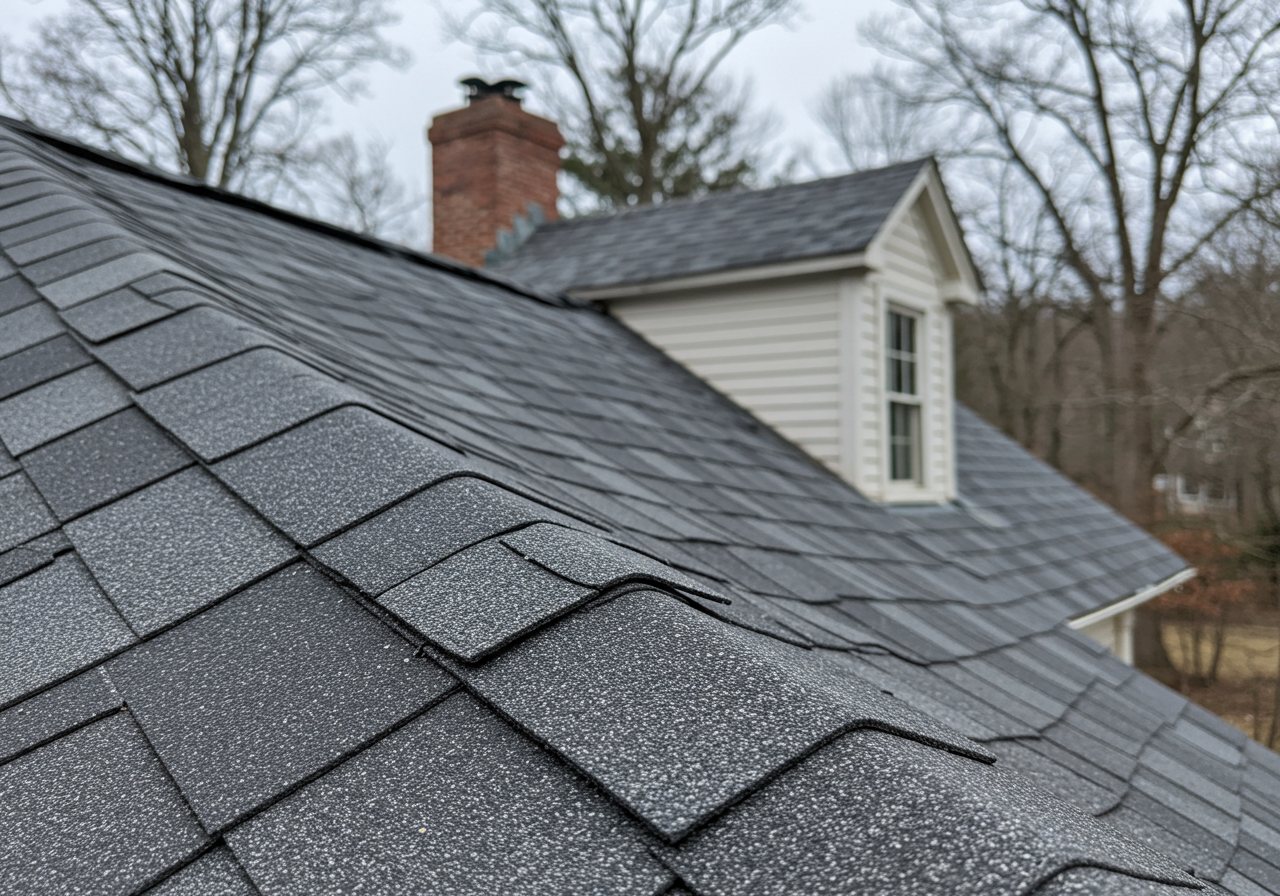
Wind Damage Assessment
Identifying creased shingles and seal failure on a Wilton roof after high winds
Identifying the "Silent" Wind Damage on Wilton Roofs
When I'm out near Wilton Center looking at a colonial that's taken a beating, I don't just look for what's gone. I look for what's loose. High winds create "uplift," which works like a crowbar on your shingles. You might see a shingle that looks perfectly flat today, but the seal is gone. Once that seal is broken, the next breeze turns it into a sail.
I remember a homeowner on Belden Hill who told me his roof was "fine" because he didn't see any cedar shakes on the lawn. But when we got a ladder up there, we found 14 "creased" shingles. The wind had folded them back and then laid them back down. The internal fiberglass was snapped. To the untrained eye, it looked okay. To a cost analyst, it looked like a $2,840 interior drywall repair waiting to happen.
If you're seeing granules piling up in your gutters—looking like coarse black sand—that's a major red flag. It means the wind has vibrated the shingles so much that the protective coating is falling off. Without those granules, the sun will bake the asphalt and cause a leak within months. If you're worried about the immediate integrity of your home, getting an expert eyes-on assessment is the only way to catch these silent failures before the next storm hits.
The Cost Breakdown: Patching vs. Performance
Here is where homeowners get taken for a ride. A contractor might quote you $450 to "swap out a few shingles." Sounds like a bargain, right? But if your roof is 17 years old, those new shingles won't match, and more importantly, the surrounding shingles are likely too brittle to survive the repair process. Every time a roofer lifts an old shingle to nail a new one underneath, they risk breaking the seal on the "good" ones.
I always tell people to look at the "price per square foot" of the repair versus the total value. If you are spending $900 every year to patch a roof that is nearing the end of its life, you are throwing money into a Cannondale-sized hole.
Repair vs. Replacement Decision Matrix
| Feature | Minor Repair | Full Replacement |
|---|---|---|
| Lower Upfront Cost | ||
| Long-Term Life Extension | ||
| Lifetime Warranty Coverage | ||
| Insurance Likely to Pay | ||
| Increases Home Value |
The comparison chart above shows the reality: repairs are cheaper upfront but offer minimal warranty protection. A full replacement costs more initially but provides lifetime manufacturer coverage and increases your home's value. When you're looking at repair costs approaching $1,500, it's time to calculate your potential roofing costs for a full replacement to see if the math makes sense.
Spotting "Storm Chasers" and Insurance Scams
February in Wilton often brings out the "tailgate contractors." These guys show up in unmarked trucks after a windstorm, offering "free roofs" through insurance. Let me be clear: there is no such thing as a free roof. If a contractor offers to "cover your deductible," they are asking you to participate in insurance fraud.
According to FEMA's residential roofing guides, proper attachment and high-wind rated shingles are the only things that actually protect a home in the long run. A storm chaser isn't going to follow those specs; they're going to use the cheapest 3-tab shingle they can find and disappear before the first spring rain.
When you're interviewing someone, ask for their "line-item breakdown." If they won't show you the cost of the ice and water shield versus the ridge vent, they're hiding something. I've seen quotes where the "permit fee" was marked up 400%. In Wilton, permit fees are public knowledge—don't let them pad the bill with $500 for a $100 filing.
Dana's Advocacy Tip
The Wilton "Gold Coast" Material Standard
In our part of Connecticut, the "standard" shingle isn't enough. We have high wind loads and a lot of shade, which leads to algae and moss. If you are doing a repair or a full replacement, you need to insist on shingles rated for at least 110 mph winds.
"A $18,000 roof that lasts 30 years costs you $600 a year. A $14,000 roof that fails in 10 years costs you $1,400 a year. Cheap is almost always more expensive."
For those with larger estates on the Ridgefield line, you might be looking at luxury designer shingles. These are thicker and handle wind much better than the standard architectural variety. If you're trying to figure out if your budget allows for an upgrade, calculating your potential roofing costs based on local Wilton material prices is the smartest first step you can take.
Negotiation Scripts: How to Talk to Your Contractor
Don't just ask "How much?" Ask "How exactly?" Use these phrases to let them know you've done your homework:
- "Can you show me the OSHA-compliant safety setup your crew will use for this pitch?"
- "I want to see the manufacturer's high-wind installation pattern on the contract—are you using 4 nails or 6?"
- "Will you be providing a 'lien waiver' from your material supplier once I make the final payment?"
If they stammer or get defensive, they aren't the pro for you. A real Wilton roofer knows that our residents expect transparency and high-grade work.
Inspect your attic
Check for daylight or water stains after a wind event. Look for any signs of moisture intrusion.
Walk the perimeter
Use binoculars to check for 'lifted' or 'creased' shingles from ground level before climbing.
Document everything
Take date-stamped photos before touching anything. This documentation is crucial for insurance claims.
Get a professional estimate
Include a full attic ventilation check in the estimate to ensure comprehensive assessment.
Compare costs
Compare the repair cost against the age of your roof to determine if replacement is more cost-effective.
Final Verdict: Protect Your Investment
Wind damage is deceptive. It's not always a tree through the roof; sometimes it's just a tiny gap that lets February's damp air into your plywood. If your roof is over 15 years old and you're seeing shingles in the yard, don't just patch the problem. When the cost of a new roof system is balanced against the rising insurance premiums and potential for mold, the replacement often wins the "math war."
Don't wait for the ceiling to sag. Get your numbers on paper, check the licenses, and make sure whoever climbs onto your roof is treating it like the multi-million dollar asset it protects.
If you're looking for help navigating the local grant and loan options for these types of critical repairs, USA.gov's home repair portal offers updated 2026 resources for Connecticut residents facing unexpected storm costs.
Get Your Free Roof Quote
Enter your zip code to get started
FAQ

About Dana Jackson
Verified ExpertDana Jackson is a Homeowner Advocate & Cost Analyst who helps Connecticut families navigate the financial aspects of roofing projects. She specializes in finding the best value and avoiding common pricing pitfalls.