
Have you ever spent a sleepless night in your living room, listening to the rafters groan while a heavy, wet May nor'easter dumps eight inches of "heart attack" snow on your shingles? In New London, where our coastal humidity turns fluffy flakes into leaden slush within hours, that sound isn't just your house "settling"—it's the audible protest of a structure reaching its mechanical limit. Most homeowners I talk to near Ocean Avenue or over by Mitchell College assume their roof is an immovable object, but the reality is that wood is a flexible medium. When you add 3,400 pounds of frozen weight to a standard 1,500-square-foot ranch, something has to give.
Key Takeaways
- Wet snow in New London can weigh up to 21 pounds per cubic foot, significantly increasing structural stress.
- Interior warning signs like "stuck" doors or new drywall cracks often signal a roof deck under extreme pressure.
- Pitch is your best friend; roofs with a 6:12 slope shed weight 40% more effectively than flatter 3:12 designs.
- Proper ventilation and 6-foot ice and water shield barriers are the primary defenses against secondary snow damage.
The Hidden Physics of New London Snow Weight
Here's the thing: snow isn't just snow. I've spent decades measuring the density of what falls in New London County, and the "salt-air slush" we get is a different beast entirely compared to the dry powder they see in the Berkshires. A foot of light, dry snow might only put 3 pounds of pressure per square foot on your shingles. But take that same foot of snow after it's been rained on or sat in 34-degree humidity, and you're looking at upwards of 21 pounds per square foot.
I remember an inspection on a beautiful Victorian near Pequot Avenue. The owner was convinced they had a leak because the front door wouldn't latch. I went into the attic and found the ridge beam—a massive 2x12—had deflected nearly 1.4 inches. That wasn't a leak; it was the house literally compressing under the weight of a February accumulation that hadn't been cleared.
Weight of Snow Types (lbs per Cubic Foot)
Understanding Your Roof's "Yield Point"
Most modern Connecticut homes are engineered to handle a "ground snow load" of about 30 to 40 pounds per square foot (psf). However, older homes—the kind that give New London its character—were often built before these rigorous codes existed. If your rafters are 2x6s spaced 24 inches on center (a common find in pre-war builds), your "yield point" is much lower than you think.
Worried about snow load on your roof?
Compare quotes from vetted pros who understand Connecticut coastal weather.
No credit card required • Free to use
Identifying Stress Fractures Before the Snap
Look, you don't need a degree in structural engineering to know when your roof is screaming for help. I tell my clients to look for the "inside-out" symptoms. When a roof deck is under extreme stress, it pushes down on the exterior walls and, more importantly, the interior partitions.
One case study that stays with me involved a modular home in the South End. The homeowners noticed a hairline crack appearing in the drywall tape where the wall met the ceiling. By the time I arrived, the crack had widened to 1/8th of an inch. We found that the snow had drifted into a "valley" (where two roof planes meet), creating a localized load of nearly 60 psf—nearly double what the trusses were rated for.
Interior Warning Signs to Track
- Door geometry: If your bedroom door suddenly starts rubbing against the frame, the header is likely being compressed by the roof load.
- Creaking sounds: Not the occasional pop, but a sustained "moaning" sound during a storm.
- Sprinkler heads: In commercial or high-end residential builds, look for sprinkler heads that seem to be dropping slightly below the ceiling tiles.
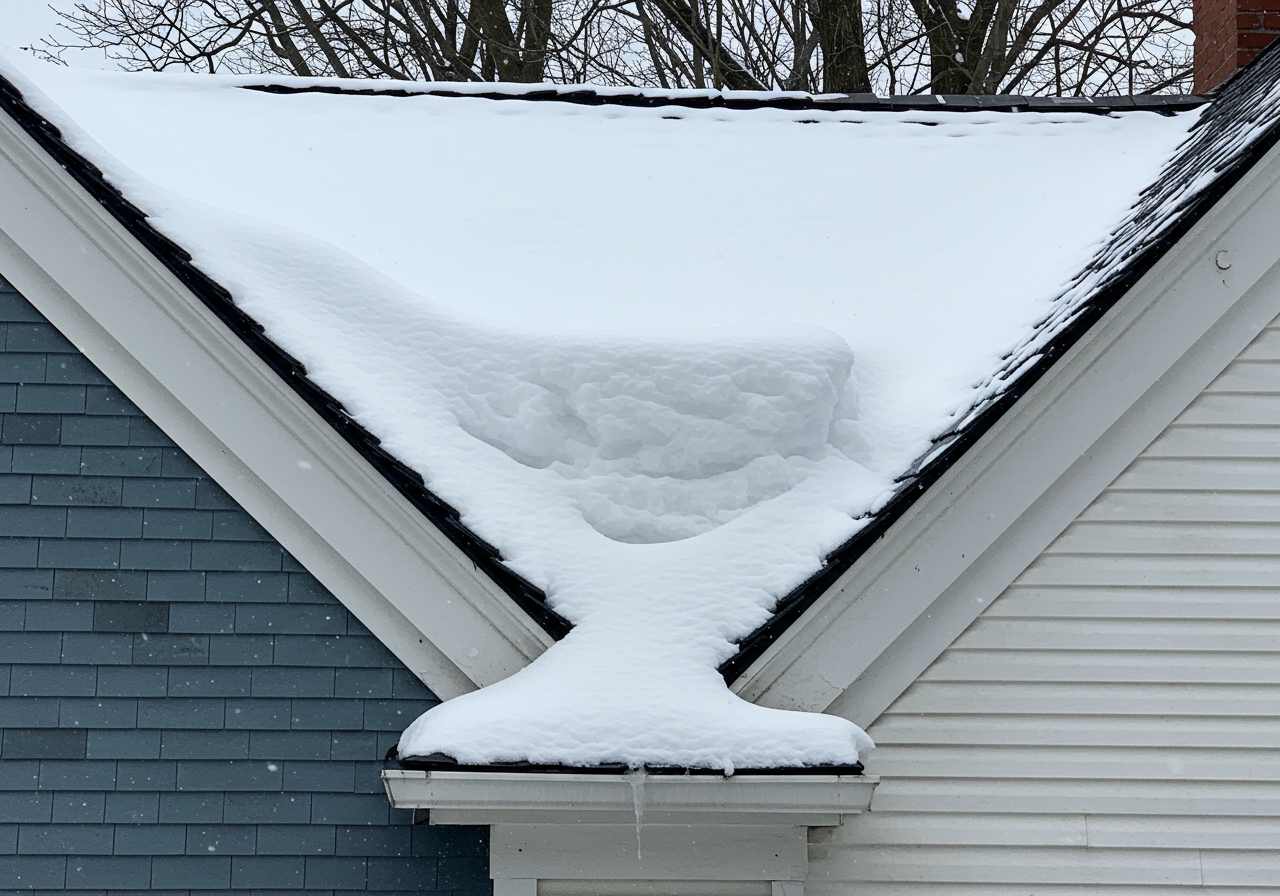
Snow load in roof valleys
Snow drifting in roof valleys can create localized pressure points exceeding 50 lbs per square foot.
Why Geometry and "The Valley Trap" Matter
In my experience, the brand of shingle—whether you're using GAF Timberline or Owens Corning Duration—matters far less than the geometry of the roof itself when it snows. New London has a lot of Saltbox and Gambrel style roofs. These designs are great for character but can be nightmare scenarios for snow load if not managed.
The "Valley Trap" is where most failures begin. When wind whips off the Thames River, it deposits snow into the interior angles of your roof. This isn't just an even layer; it's a concentrated drift. If you're concerned about how your specific roof layout handles these loads, talking with a repair specialist can help clarify whether your valleys need additional structural bracing.
The Pitch Factor
A roof with a 10:12 pitch (meaning it rises 10 inches for every 12 inches of horizontal run) is a snow-shedding machine. Gravity does the work for you. However, many New London additions from the 70s use low-slope 3:12 pitches. On those roofs, snow doesn't slide—it sits, melts, refreezes into ice, and acts like a sponge for the next snowfall.
Metal vs. Asphalt for Snow Management
Pros
- Snow slides off effortlessly on steep pitches
- Zero chance of ice dam penetration
- Lower structural weight than heavy slate
Cons
- 'Snow avalanches' can damage gutters
- Higher initial investment cost
- Noisy during heavy sleet
Mitigation: To Rake or Not to Rake?
This is where I get into trouble with the hardware store guys. Everyone wants to sell you a 20-foot aluminum roof rake. While they have their place, I've seen more roofs damaged by aggressive raking than by the snow itself. I've climbed onto roofs in the middle of March and seen "shingle scars"—areas where the granules have been scraped entirely off by homeowners trying to clear the eaves.
If you have a massive ice dam, the weight isn't just on the shingles; it's pulling on your gutters. If you're worried about the total weight, you might be better off using a roof replacement cost breakdown that includes modern structural reinforcements—rather than risking a fall from a ladder in a blizzard.
Structural Reinforcement Options
If we determine your rafters are undersized for New London's 35-pound snow load requirement, we don't always have to tear the house apart.
- Sistering rafters: Bolting a new 2x8 alongside an existing 2x6 to double the load capacity.
- Knee walls: Adding vertical supports in the attic to transfer the load to the floor joists below.
- Collar ties: Installing horizontal boards to prevent the rafters from "spreading" outward under weight.
"Snow load is a cumulative threat. It's rarely the first inch that breaks a rafter; it's the four inches of ice hiding underneath the fresh powder that does the damage."
Case Study: The 1920s Colonial vs. The Modern Modular
I did an inspection last year on two neighboring houses in the Post Hill area. One was a 1924 Colonial with true-dimensional 2x8 rafters (meaning they were actually 2 inches thick, unlike today's 1.5-inch boards). The other was a 2012 modular home with pre-engineered trusses.
After a particularly nasty wet snow event, the 1924 home showed zero deflection. The modern home, however, had significant "uplift" in the center of the trusses—a phenomenon called truss rising. It's a reminder that while modern codes are great, the "over-built" nature of New London's historic stock is often its best defense against weather extremes.
Did You Know?
Current Connecticut Building Code requires roofs in New London to handle a minimum of 30 lbs of snow per square foot, but I always recommend building for 45 lbs to account for drifting.
Before you sign any contract for winter repairs, make sure you verify the contractor's license with the state. In the rush after a storm, plenty of out-of-state "storm chasers" show up who don't understand the specific coastal load requirements of New London County.
Future-Proofing for the Next 25 Winters
If you're at the point where you're tired of worrying every time the forecast calls for "wintry mix," it might be time to stop patching. A modern roof system is more than just shingles; it's an integrated structural shield.
When we do a full roof replacement in New London, we focus on the ice and water barrier. Per the Connecticut Department of Consumer Protection home improvement guidelines, you need baseline protection—but I go further. I recommend 6 feet of membrane up from the eaves, rather than the standard 3 feet. Why? Because New London snow lingers, and that extra 3 feet of protection is the difference between a dry attic and a $10,000 mold remediation bill.
Get Your Free Roof Quote
Enter your zip code to get started
Final Advice for New London Homeowners
Don't wait for the rafters to groan. Take a look at your roof this spring. If you see "swales"—areas where the roof line looks like a gentle wave—you have a structural load issue that needs to be addressed before the next flakes fall. You can also browse the Better Business Bureau home improvement resources to see how local contractors handle structural repairs versus simple shingle swaps.
Stay safe, keep your gutters clear, and remember: gravity never takes a day off.