
Walking through the Northfield section of Thomaston, it's easy to admire the towering oaks that give our corner of Litchfield County its character. But as someone who has climbed onto hundreds of roofs after a heavy January storm, I see those same trees through a different lens—as potential four-ton kinetic energy hazards. When a limb or a full trunk comes down on a residence near the Naugatuck River, the damage is rarely just what you see on the surface. I've seen 30-year-old rafters snapped like toothpicks under shingles that looked, at first glance, entirely undisturbed.
Key Takeaways
- Immediate structural assessment is mandatory; even small branches can hairline-fracture the underlying roof deck.
- Documentation must occur before any debris removal to ensure your insurance claim reflects the true impact force.
- Thomaston's specific topography means wind-driven tree falls often involve rotational 'twisting' damage to the ridge beam.
- Water intrusion from tree damage in January often leads to ice damming within 48 hours if not tarped correctly.
1. Safety First: The 50-Foot Perimeter Rule
The reality is that after a tree hits your home, the structural integrity of the entire building is a giant question mark. I always advise Thomaston residents to maintain a 50-foot "no-go" zone until a pro clears the site. A tree resting on a roof is under immense tension; if it shifts, it can kick out with enough force to level a garage wall.
Checking for Foundation Shifts
Look, if a massive oak has fallen, the energy transfer doesn't stop at the rafters. I've documented cases where the impact was so severe it caused hairline cracks in the masonry of older Thomaston basements. Before you even think about the shingles, walk the perimeter and look for fresh gaps in your siding or windows that suddenly won't open. These are telltale signs that the house's frame has been racked.
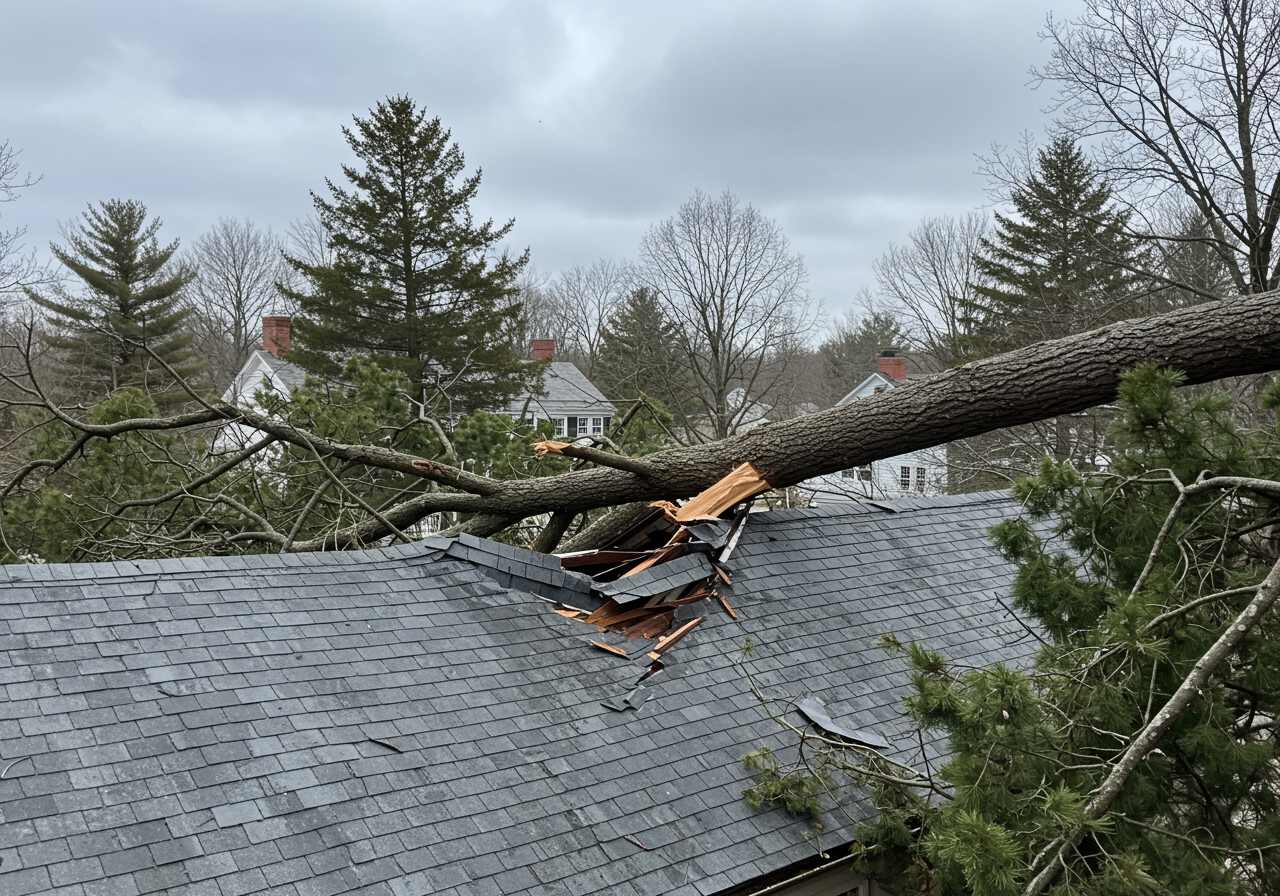
Fallen Tree Damage Assessment
Professional inspection reveals hidden structural damage including foundation shifts, rafter fractures, and compromised roof decking.
Managing Live Utilities
In our neck of the woods, trees rarely come down without taking out a service drop. I once inspected a home on High Street where the homeowner didn't realize the fallen branch was pinning a live wire against his aluminum gutters. (Always assume every wire is hot until Eversource says otherwise.)
2. Documenting the "Crush Zone"
Before the crews arrive with chainsaws, you need a forensic record. I keep a digital folder of every storm repair I oversee, and the most successful insurance claims always start with "as-is" photos. You need to show the diameter of the trunk and the height from which it fell.
Photograph the tree from four different angles before any branches are cut.
Capture the full extent of the damage from multiple perspectives to show the impact zone clearly.
Capture close-ups of where the wood meets the roofing material (shingles, metal, or slate).
These detail shots prove the point of impact and help assess material-specific damage.
Go into the attic with a high-lumen flashlight to find 'daylight' or splintered wood.
Structural damage often reveals itself from inside—look for cracks, breaks, or light coming through.
Measure the depth of any indentations in the roof surface using a standard ruler.
Quantify the compression damage; deeper indentations indicate more severe structural compromise.
Record a video walk-through of the interior ceilings directly below the impact point.
Document any water stains, cracks, or sagging that might not be visible in still photos.
3. Identifying "Invisible" Structural Trauma
This is where I get technical. Most adjusters look for holes, but I look for structural deflection. A tree doesn't just "hit" a roof; it compresses the entire system. According to FEMA's hurricane mitigation guide, even non-penetrating impacts can weaken the fasteners that hold your roof to the wall plates.
The Rafter Spread Phenomenon
When a heavy load hits the ridge, it pushes the rafters outward. I've used laser levels on jobs in Litchfield County and found rafters that had "spread" by as much as 1.5 inches. That might not sound like much, but it compromises the load-bearing capacity of the entire roof. If you see a new "hump" or "dip" in your roofline from the street, you aren't looking at a shingle issue; you're looking at a framing failure.
Granule Loss and Bruising
Even if the branch didn't poke a hole, it likely "bruised" the shingles. This is the accelerated loss of the protective mineral granules. (I've seen 40% of a shingle's lifespan vanish in a single six-second impact.) If you find piles of colored sand in your downspouts after a tree hit, those shingles are effectively dead.
"In my 17 years inspecting Litchfield County homes, the most expensive mistakes aren't the holes you can see—they're the structural shifts you can't see without an attic crawl."
4. Navigating the Insurance and Cost Reality
In Thomaston, the average cost to remediate major tree damage sits somewhere between $8,700 and $22,500, depending on the material. If you have a high-end GAF Camelot II shingle, for instance, your repair costs will be significantly higher than a standard 3-tab.
Estimated Repair Costs by Damage Severity (Thomaston Average)
If the damage covers more than 25% of a single roof slope, Connecticut building codes often trigger a requirement for a full roof replacement of that entire facet. Don't let an adjuster talk you into a "patch" that leaves your roof looking like a quilt and potentially violating local codes. If you're unsure where to start, our blog library has several deep dives on how to read an insurance scope of work.
5. Thomaston Weather: The January Threat
January in Connecticut brings a specific kind of misery: the freeze-thaw cycle. If a tree hits your roof on a Tuesday, and it rains on Wednesday before freezing on Thursday, that water will find the cracks caused by the impact and expand. This is why immediate tarping is non-negotiable.
Tree Species Risk Level (Litchfield County)
| Feature | White Oak | White Pine | Norway Maple |
|---|---|---|---|
| Wind Resistance | |||
| Impact Density | |||
| Failure Mode |
I've noticed that homes near the steeper slopes of the Clock Town often experience higher wind shear, making the pines more prone to uprooting. If you've suffered a strike, you might only need specialized repair services if the impact was glancing, but a direct hit usually requires a more aggressive approach.
6. Long-Term Mitigation: Energy and Airflow
While we're fixing the damage, it's the perfect time to look at your attic's performance. Often, a tree strike destroys the ridge vent. If we're rebuilding that section, I always check the Department of Energy's insulation recommendations to see if we can improve the R-value while the deck is open.
Ventilation Upgrades
If the impact requires us to pull up the decking, we can easily install baffles to ensure your soffit-to-ridge airflow is perfect. This prevents the very ice dams that often follow a winter tree strike. (I've measured attic temps in Thomaston that were 30 degrees too high because of poor venting, which literally "cooks" your shingles from the inside out.)
Future-Proofing
Consider a "tree-trimming" buffer of at least 10 feet from your roofline. It's an investment of maybe $800 to $1,500 now that can save you a $1,000 deductible and a month of headaches later.
Get Your Free Roof Quote
Enter your zip code to get started
In the end, dealing with a fallen tree is about more than just clearing the wood. It's about ensuring the skeleton of your home hasn't been compromised. If you're standing in your kitchen looking at a new crack in the ceiling after a storm, don't wait. The damage is already moving.