
Key Takeaways
- Weight Matters More Than Depth: Four inches of wet, slushy snow can weigh as much as two feet of dry powder, exceeding many older Tolland roof design limits.
- Ice Dams Are Structural Threats: Beyond leaks, ice dams create 'point loads' on your gutters and eaves that can pull the fascia board right off the rafters.
- Ventilation Is Your Best Defense: A cold roof deck prevents the melt-freeze cycle; if your attic is 45°F when it's 20°F outside, you're inviting disaster.
- Professional Vetting Is Non-Negotiable: Structural repairs require contractors who understand CT-specific building codes for snow loads.
The heavy, wet "heart attack" snow that blanketed Tolland County last week wasn't just a workout for your shovel; it was a stress test for your home's skeletal system. I spent most of Saturday morning out near the Shenipsit State Forest, looking at a 1970s colonial where the ridge beam had actually started to "smile"—that's industry speak for a sag that definitely isn't happy. The homeowner thought they were fine because the shingles were only eight years old, but the structural lumber underneath was screaming under the weight of roughly 14,300 pounds of frozen precipitation.
In Tolland, we deal with a specific brand of winter misery. Our elevation—higher than the valley but not quite the Berkshires—means we often catch the rain-to-snow transition perfectly, resulting in that dense, water-logged slush that weighs three times more than the fluffy powder you see in Vermont. If you're seeing new drywall cracks in your upstairs ceiling or doors that suddenly won't latch, you aren't just seeing "settling." You're seeing the physics of snow load in real-time.
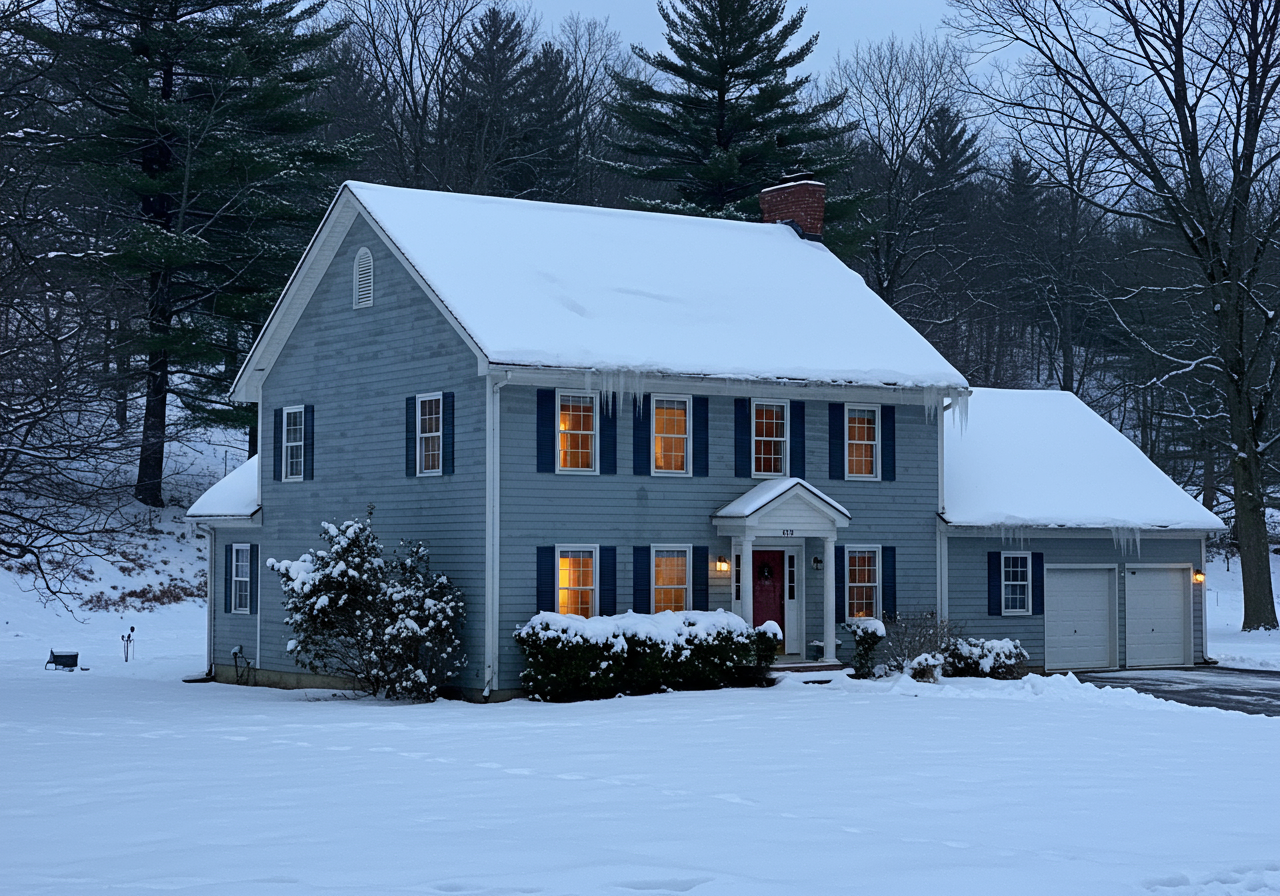
Snow load stress on a Tolland County roof
Heavy wet snow can exceed design limits of older homes
The Physics of Weight: Why Your Roof Deck is Bowing
Most Tolland homes built in the last thirty years were designed to handle a ground snow load of roughly 30 to 40 pounds per square foot (psf). But here is the thing: that number assumes the snow is distributed evenly and stays frozen. In our corner of Connecticut, we get "unbalanced loads." The wind whips across the open fields near Route 195 and dumps massive drifts on the leeward side of your roof. Suddenly, one side of your rafters is carrying 15 psf while the other is groaning under 65 psf.
Look, a standard 2x8 rafter (common in many of the older capes around here) spaced at 16 inches on center has a breaking point. When you add the weight of a heavy "ice lens"—that solid sheet of ice that forms under the snow—you are pushing the structural limits of the wood. I've seen 7/16-inch OSB decking (the wooden sheets under your shingles) bow so significantly between the rafters that it creates "troughs" where water pools. Once that happens, no amount of high-end shingles will save you from a leak.
Static vs. Dynamic Loads
We categorize snow as a "static load," but it becomes dynamic the moment it starts to slide. If you have a steep pitch, that snow can "avalanche." I remember a job on Crystal Lake Road where the sliding snow didn't just fall; it gathered enough momentum to rip the plumbing vent stacks right out of the roof. If your contractor didn't use heavy-duty flashing or snow guards, that moving weight can turn a $500 maintenance task into a $12,000 structural repair.
The "Ice Lens" Effect
Many homeowners focus on the white stuff, but the clear stuff is heavier. Ice weighs about 57 pounds per cubic foot. If your gutters are clogged and a 4-inch thick block of ice forms along your eaves, that's a massive amount of weight hanging off the most vulnerable part of your roof. I always recommend checking that your contractor followed the International Code Council (ICC) standards for ice barrier installation, which in our zone requires protection extending at least 24 inches inside the exterior wall line.
Material Face-Off: Asphalt vs. Metal vs. Slate under Pressure
When we talk about snow load mistakes, the biggest one is choosing a material that doesn't fit the local geography. Tolland isn't Hartford; we get more ice and longer-lasting snowpacks. I've compared hundreds of roofs after major storms, and the material you choose dictates how that weight interacts with your home.
Asphalt shingles are the standard, but they have a high "friction coefficient." This means the snow sticks to them. While this prevents dangerous avalanches, it keeps the weight on your house longer. Metal roofing, on the other hand, is designed to shed snow quickly. However, if you don't have a massive "clear zone" around your foundation, that falling snow can crush shrubs, HVAC units, or anyone standing below.
Roofing Material Performance in Tolland Winters
| Feature | Architectural Asphalt | Standing Seam Metal | Synthetic Slate |
|---|---|---|---|
| Snow Shedding Speed | Slow | Very Fast | Moderate |
| Weight (per sq) | 240-300 lbs | 100-150 lbs | 300-400 lbs |
| Ice Dam Resistance | Good (with underlayment) | Excellent | Excellent |
| Required Structural Support | Standard | Low | High |
Structural Reinforcement for Heavy Materials
If you are considering moving from asphalt to a heavier material like synthetic slate, you cannot just swap them out. Synthetic slate is beautiful, but it can weigh up to 400 pounds per "square" (a 10x10 area). Add 30 pounds of snow on top of that, and your 2x6 rafters might start to crack. I always tell my clients that if the spec isn't written down by a licensed pro, it doesn't count. You need to verify your contractor's license to ensure they are qualified to perform a structural load calculation before upgrading to heavy materials.
The Friction Coefficient and Shedding
I've worked with GAF and CertainTeed products for decades, and they both make excellent "cool roofs" that help with energy, but in Tolland, I'm more concerned with the granule texture. A smoother shingle sheds water better but holds snow longer. If you're in a high-wind area of Tolland County, you might actually want that snow to stay put rather than sliding off and taking your gutters with it. It's a delicate balance that requires a contractor who actually knows Tolland's microclimates.
Did You Know?
Did you know that 'snow creep'—the slow, downward movement of a snowpack on a roof—can exert enough lateral force to snap standard aluminum gutter spikes? This is why we recommend heavy-duty screw-in hangers spaced every 12 inches for CT homes.
Prevention and Remediation: Solving the Tolland "Snow Creep"
The most expensive mistake you can make is waiting for a leak to call a pro. By the time water is dripping onto your dining room table, the structural damage is already done. Prevention in Tolland comes down to two things: attic temperature and structural integrity.
I frequently see homeowners "over-insulate" their attics but forget to vent them. They stuff fiberglass batts right up against the roof deck, blocking the soffit vents. This traps heat, melts the bottom layer of snow, and creates the perfect recipe for ice dams. My crews use baffles to keep those air pathways clear. If your attic isn't within 10 degrees of the outside air temperature, you're basically running a slow-motion heater under your snowpack.
The Daniel Roberts Inspection Rule
Attic Ventilation and Temperature Regulation
A properly ventilated roof uses the "stack effect." Cold air comes in through the soffits and warm, moist air escapes through the ridge vent. If this system fails, the snow on your roof melts from the bottom up. That water runs down to the cold eaves, freezes, and creates a dam. Then, the weight of the water pooling behind that dam adds hundreds of pounds of pressure to your roof's edge.
Structural Bracing and Retrofitting
For older homes in Tolland, sometimes the answer isn't a new roof, but better bones. I've overseen projects where we added "sister rafters"—basically bolting a new, stronger board to the side of the old one—to meet modern 2026 safety standards. If you've already had a structural failure or a major collapse, you need 24/7 emergency storm response to stabilize the structure before the next band of weather hits.
Inspect the ridge line
Visually inspect the ridge line from the ground for any dipping or 'swaying'.
Check the attic
Check the attic for 'nail pops' where the plywood is pulling away from the rafters.
Measure door gaps
Measure the gap between interior doors and their frames; new sticking is a sign of load-shifting.
Look for water staining
Look for water staining on the insulation, which indicates snow-melt infiltration.
If you're unsure whether your roof is up to the task, don't guess. The difference between a $500 reinforcement and a $35,000 collapse is usually just one bad nor'easter. You can see what other CT homeowners experienced when they moved from "hoping for the best" to a data-backed roofing plan.
"In 20 years of inspecting Connecticut roofs, I've never seen a roof fail because of too much snow alone. It's always a combination of excessive weight and a pre-existing structural weakness or a 'point load' caused by poor drainage."
Taking Action Before the Next Storm
In Tolland, the "March Miracle" can quickly turn into a structural nightmare if you aren't prepared. We live in a region where the weather is unpredictable, but the physics of your roof aren't. If you are worried about those new cracks in your ceiling or the way your roof looks under a heavy load, it's time to stop guessing.
I've spent my career advocating for homeowners to get the facts before they sign a contract. Check the Better Business Bureau guidelines to see what a proper roofing contract should look like. Don't let a "storm chaser" convince you that a few shingles will fix a structural sag.
If you want to see where your roof stands without the sales pitch, you can get a baseline quote for structural upgrades or replacement through our automated matching system. We only work with contractors who understand the specific demands of Tolland County winters.
Stay safe, keep your gutters clear, and remember: it's not the depth of the snow that breaks the roof—it's the weight of the water hidden inside it.
Get Your Free Roof Quote
Enter your zip code to get started