Key Takeaways
- Decking Reinforcement: Solar panels add significant 'dead load' to your rafters; standard CT builds may need extra support.
- Material Selection: Asphalt shingles are fine, but 'solar-ready' requires specific high-performance underlayment to handle heat.
- Warranty Alignment: Ensure your roof warranty doesn't get voided by panel mounts (a common trap for the unwary).
- Timing is Everything: Installing solar on a roof older than 8 years is almost always a financial mistake in the long run.
Picture this: You're standing in your driveway near Wangumbaug Lake, coffee steaming in the January air, watching a crew haul heavy silicon panels onto your roof. You're excited to finally slash those Eversource bills. But then, the lead installer stops. He points to a soft spot in your plywood deck—a spot that should have been reinforced years ago. Suddenly, your "green energy transition" just turned into an emergency $12,000 roof replacement you hadn't budgeted for.
I see this scenario play out across Tolland County more often than I'd like to admit. Homeowners in Coventry are increasingly looking at solar as a way to combat rising energy costs, but they often forget that the roof is the foundation of that entire system. If you're thinking about going solar in the next five years, your roofing decisions today are the most critical financial moves you'll make.
Why "Solar-Ready" Isn't Just a Buzzword in Tolland County
In the weather business, we talk a lot about microclimates. Coventry, sitting higher than some of its neighbors, catches a fair amount of wind coming off the hills. When you bolt a solar array to your house, you're essentially adding a giant sail to your roof. "Solar-ready" means more than just having a flat surface; it means your roof is engineered to handle the unique stresses of solar attachments in a Connecticut climate.
I remember a project out near the Nathan Hale Homestead where the owner went for the cheapest 3-tab shingles possible. Three years later, they wanted solar. The problem? Those shingles weren't rated for the heat that gets trapped under solar panels. In the summer, that pocket of air can get 20 degrees hotter than the rest of the roof, effectively baking the shingles until they're brittle as a dry leaf.
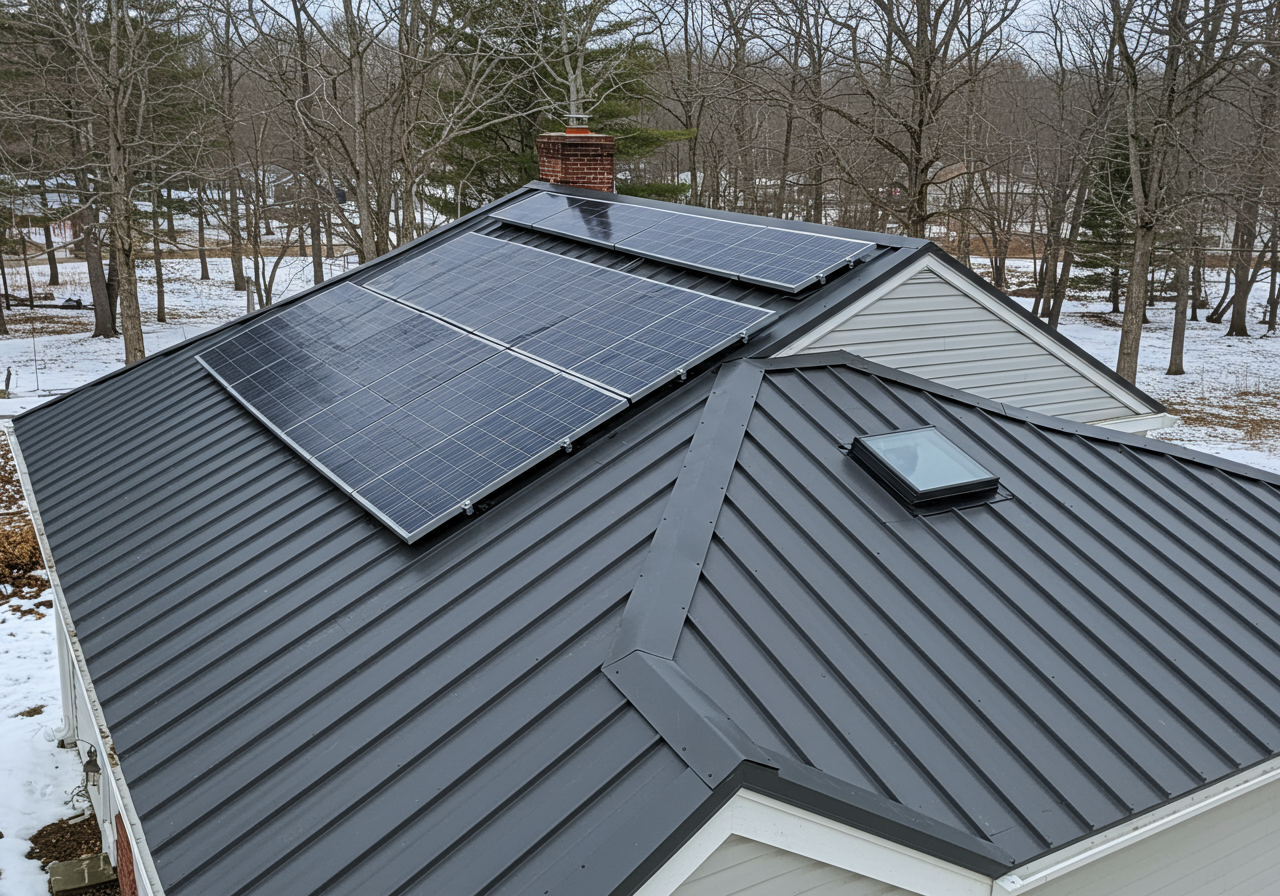
Solar-Ready Roofing in Coventry
Proper preparation ensures your roof can handle solar panels for decades
The Role of High-Temp Underlayment
Most standard roofs use felt or basic synthetic underlayment. For a solar-ready home, I always recommend a high-temperature "ice and water" shield across the entire south-facing slope. This prevents the accelerated degradation caused by the thermal sandwich effect created by the panels.
Structural Integrity for Heavy Loads
According to FEMA's roof system guidelines, the structural capacity of your roof must account for both the material and the environmental loads. Solar panels aren't just heavy—they change how snow accumulates, often leading to "snow drifting" that puts uneven pressure on your rafters.
The Structural Reality of Coventry Snow Loads
January in Coventry usually means we're watching the radar for the next big Nor'easter. While we aren't seeing the same 2011 "Snowtober" levels every year, our roofs still have to be built for the "worst-case" 30-pound-per-square-foot snow load.
When you add solar panels, you're adding about 3 to 4 pounds per square foot of permanent weight. That might not sound like much, but when you add 18 inches of wet, heavy CT snow on top of that, you're pushing the limits of older 2x6 rafters. Before you commit to a solar contract, a solar-ready roof inspection should include a look at your attic's ridge beam and collar ties.
Reinforcing the Decking
I've climbed into enough Coventry attics to tell you that 1/2-inch CDX plywood is the bare minimum. For a solar-ready build, upgrading to 5/8-inch or even 3/4-inch decking provides a much more secure "bite" for the lag bolts that hold your solar racking in place. It reduces the risk of leaks at the penetration points over the next 25 years.
Projected Roof Lifespan Under Solar Panels (Years)
Shingle vs. Metal: The Durability Divide
If you're replacing your roof and know solar is in your future, you have a big choice: asphalt or metal.
Asphalt is the "budget-friendly" choice, but it comes with a catch. Most solar panels are guaranteed for 25 years. If your asphalt roof only has 12 years of life left, you'll have to pay a crew roughly $2,500 to $4,000 just to take the panels off and put them back on when the roof fails.
Solar-Ready Material Face-Off: Asphalt Shingles
Pros
- Lower upfront cost ($9k-$14k)
- Easier to find local installers
- Matches traditional Coventry aesthetics
Cons
- Limited lifespan (20-25 years)
- Requires roof penetrations for mounts
- Retains more heat than metal
Solar-Ready Material Face-Off: Standing Seam Metal
Pros
- 50+ year lifespan (outlasts the panels)
- No roof penetrations (panels clip to seams)
- Reflective properties keep panels cooler
Cons
- Higher upfront cost ($18k-$28k)
- Can be noisy in heavy rain
- Specific aesthetic look
Metal is the "gold standard" for solar. Why? Because standing seam metal roofs allow the solar racks to clamp onto the ribs of the roof. Zero holes. Zero leaks. Plus, the metal will easily outlive the solar panels themselves.
Timing Your Installation Before the Spring Thaw
I always tell folks: don't wait for the April rains to start thinking about your roof. In Coventry, the ground stays frozen well into March, but roofing season starts the moment the ice melts off the shingles.
By planning your solar-ready roof in January or February, you're beating the "summer rush" when every contractor in Tolland County is booked six weeks out. It also gives you time to ensure your insulation is up to par. The Department of Energy's insulation guide highlights that a well-insulated attic prevents ice dams, which is even more critical when you have solar racking that can trap ice and snow on your eaves.
The "Shadow" Inspection
One thing I do when I'm out in the field is a "shadow map." In the winter, the sun is lower in the sky. If your neighbor's big oak tree is casting a shadow on your roof at noon in January, it's going to kill your solar production. A solar-ready roof plan includes identifying if any trees need a "haircut" before the roofers even arrive.
Hidden Electrical and Ventilation Prep
Most people think roofing is just about shingles and nails. But a truly solar-ready roof thinks about what's happening underneath.
When you get your instant roof estimate from ZikQuote, you're getting the numbers for the surface work. But I recommend talking to your contractor about "stubbing out" your electrical conduit.
Upgrade to high-temp underlayment and reinforced decking.
Install 'flashing boots' or conduit runs during the roofing process to avoid later holes.
Relocate plumbing vents to the north-facing slope to leave the south slope clear for panels.
Document the rafter locations with photos before shingles go down.
Moving a plumbing vent stack might cost $300 while the roof is being replaced. Trying to move it after the shingles are down could cost $1,500. By clearing the south-facing "solar real estate" of all obstructions now, you ensure a cleaner, more efficient panel layout later.
Finding a Contractor Who Speaks Both Roofing and Renewables
Connecticut is a "buyer beware" state when it comes to home improvements. You want someone who understands the CT Home Improvement Consumer Protection laws.
I've seen too many Coventry homeowners sign a contract with a solar company that uses a "sub-sub-contractor" for the roof. Those crews are often incentivized by speed, not longevity. They'll slap shingles over rotted wood just to get the panels up by Friday.
"A roof is a 25-year investment. Solar is a 25-year investment. If they aren't installed as a unified system, one will eventually destroy the ROI of the other."
Instead, I recommend how our matching process works to find a local roofing specialist first. You want a roofer who will stand behind the leak-proof integrity of their work, even after the solar guys have been stomping around up there.
Get Your Free Roof Quote
Enter your zip code to get started
Conclusion
Getting "solar-ready" in Coventry isn't about spending more money; it's about spending it smarter. By reinforcing your decking, choosing high-temp materials, and clearing your roof's "real estate" of vents today, you're saving yourself thousands in future headaches. Whether you go with high-performance asphalt or a lifetime metal roof, the goal is the same: a foundation that's as durable as the energy it's about to collect.
Don't let the February thaw catch you with a leaky roof and a missed opportunity for solar. Take a look at your shingles this week—if they're curling or losing granules, it's time to start the conversation.
FAQ

About Noah Knight
Verified ExpertNoah Knight is a Connecticut Weather & Climate Specialist who helps homeowners understand how New England's unique weather patterns affect their roofing systems. He combines meteorological knowledge with practical home maintenance advice.