
Key Takeaways
- Repairing is viable if damage is isolated to less than 22% of the total roof area and the shingles are under 14 years old.
- Full replacement is often the safer financial move for Colchester homes facing recurring ice dam issues during January freeze-thaw cycles.
- Local wind patterns near Salmon River State Park can strip older shingles, making a 'spot repair' a temporary and often wasteful fix.
- Always verify Connecticut licensing through state databases before committing to a project during the winter off-season.
While one Colchester homeowner might be looking at a $650 flashing fix to stop a minor drip in the mudroom, their neighbor down Route 85 could be staring at an $18,700 total replacement bill. It is a classic New London County dilemma: do you keep throwing "band-aid" money at an aging system, or do you bite the bullet and invest in a full tear-off? In my years tracking how our specific Connecticut microclimates chew through building materials, I have seen the "repair" route save some families thousands, while it leads others directly into a secondary, more expensive mold remediation project just six months later. January is often the month where these decisions come to a head, as the weight of snow and the creep of ice dams expose every tiny vulnerability in your home's armor.
The reality of living in a town like Colchester—with its beautiful mix of historic Colonials near the Green and newer builds tucked into the wooded outskirts—is that our roofs take a unique beating. We aren't quite catching the full salt-spray brunt of the Long Island Sound, but we certainly get the higher-elevation winds and the sharper temperature drops that inland New London County is known for. Choosing the wrong path isn't just a matter of a few dollars; it's about whether you'll be sleeping soundly during the next nor'easter or sitting up with a bucket every time the wind shifts.
Noah's Weather Insight
1. The Anatomy of the 15-Year Failure Point
There is a biological clock for asphalt shingles in Connecticut, and for most Colchester homes, it starts ticking loudly around year 15. If your roof was installed during the housing boom of the early 2010s, you are likely entering the danger zone. I often tell people that a shingle's "life" isn't just about how long it stays on the house; it's about how long the petroleum-based oils remain flexible enough to shed water. Once those oils dry out—accelerated by our humid CT summers and biting winters—the shingles become brittle.
When you call a contractor for a repair on a 17-year-old roof, you're often asking them to perform surgery on a patient that's too weak to handle the stitches. I've watched well-meaning crews try to slide new flashing under old shingles, only to have the surrounding shingles crack and crumble because they've lost all their pliability. It's a frustrating cycle. If you find more than a handful of granules in your gutters this January, your roof is telling you that the protective "sunscreen" is gone. At that point, a repair is like painting over rust.
I remember a project near the Westchester line where the homeowner insisted on a "spot repair" after a heavy wind event. We looked at the NWS Historical Storm Events Database and saw that their specific neighborhood had been hit by 55 mph gusts three times in two years. Those shingles were lifted just enough to break the sealant strip. A repair didn't fix the fact that the entire southern slope had lost its adhesive grip. Three months later, a standard Tuesday rainstorm caused a ceiling collapse.
2. When a Repair is the Smart Tactical Move
It isn't always doom and gloom; sometimes a repair is absolutely the right call. If your roof is less than 10 years old and you're dealing with "localized trauma," don't let a high-pressure salesperson talk you into a $20,000 replacement. Localized trauma usually looks like a fallen limb from a stray oak tree or a piece of trim that blew loose near a chimney. In these cases, the integrity of the rest of the system is still high, and a targeted fix can easily buy you another decade of service.
The key is looking at the "percentage of compromise." If the damage is limited to a single valley or a specific vent pipe, a skilled technician can get in and out for under $900. In Colchester, we see a lot of "pipe boot" failures. These are the rubber rings around the PVC pipes sticking out of your roof. They dry rot much faster than the shingles themselves. Replacing a $15 rubber boot is a no-brainer repair.
However, even for a minor fix, you have to be careful about who is climbing that ladder. In the winter months, some "tailgate contractors" wander up from the coast looking for quick cash. I always recommend that you verify their contractor's license before they even pull a hammer out of their truck. A bad repair is worse than no repair at all because it gives you a false sense of security while water continues to seep into your insulation.
Repair vs. Replacement Decision Matrix
| Feature | Favor Repair | Favor Replacement |
|---|---|---|
| Age of Roof: Under 12 years | ||
| Damage Extent: Single localized area | ||
| Granule Loss: Minimal/Normal | ||
| Shingle Condition: Flexible/Pliable | ||
| Future Plans: Staying 1-3 years |
Note: Factors that favor repair include roofs under 12 years old, single localized damage areas, minimal granule loss, flexible shingles, and short-term ownership plans. Factors favoring replacement include roofs over 17 years old, multiple leaks across slopes, heavy granule loss in gutters, brittle/cracking shingles, and long-term home ownership.
The 'Patchwork' Trap
3. The Hidden Math of New London County Roofing Costs
Let's talk about the numbers, because that's usually where the heart of the "Replacement vs. Repair" challenge lies. In Colchester, the average roof replacement for a 2,200-square-foot colonial is currently hovering between $14,400 and $19,600, depending on the material quality and the complexity of the roofline. A repair, conversely, might cost you $750.
On the surface, $750 looks much better than $15,000. But we have to look at the "Cost Per Year of Remaining Life." If you spend $1,200 on repairs for a roof that only has two years of life left, you are effectively paying $600 a year for protection. If you spend $16,000 on a new 30-year architectural shingle system, your cost per year is roughly $533—and you have the added benefit of a transferable warranty and significantly lower energy bills.
I've seen many residents try to manage their budget by doing one slope at a time. While this spreads the cost out, it actually costs you more in the long run. You pay for the "setup" and "mobilization" fees multiple times. Contractors have to bring out the dumpsters, the safety equipment, and the crew for every visit. If you're worried about the upfront hit, I usually suggest using a roofing cost calculator to get a baseline for your specific square footage before you start getting quotes. It helps you walk into a negotiation with your eyes open.
Average Cost Comparison (2,200 sq ft home)
"The most expensive roof is the one you have to pay for twice. In Connecticut, our freeze-thaw cycles don't give you a second chance if the initial repair was just a cosmetic fix."
4. The January Thaw and the Danger of Ice Damming
We are currently in the thick of the January freeze-thaw cycle, and in Colchester, this is the ultimate test of your roof's design. An ice dam occurs when heat escapes your attic, melts the snow on the roof, and the water then refreezes at the cold eaves. This creates a literal dam of ice that forces liquid water up under the shingles.
If your roof was built before the current building codes required a "water and ice shield" (a sticky, rubberized membrane) to be installed at least 3 feet up from the eaves, a repair isn't going to help you. You can replace the shingles all day long, but water will still find its way into your walls during a heavy winter. This is a situation where replacement is the only logical choice. A modern replacement includes that critical underlayment that acts as a waterproof gasket around every nail.
I once visited a home over on Old Hartford Road where the owners had spent $3,000 over five years on various repairs to stop a leak in their dining room. Every winter, the leak came back. When we finally tore the roof off, we found that there was no ice shield at all—just old-fashioned felt paper that had turned into wet mush. They could have used that $3,000 as a down payment on a new system that actually worked. If you find yourself in a situation where a storm has caused immediate, catastrophic failure, you might need emergency roofing services rather than a scheduled replacement, especially if there's an active threat to your home's interior.
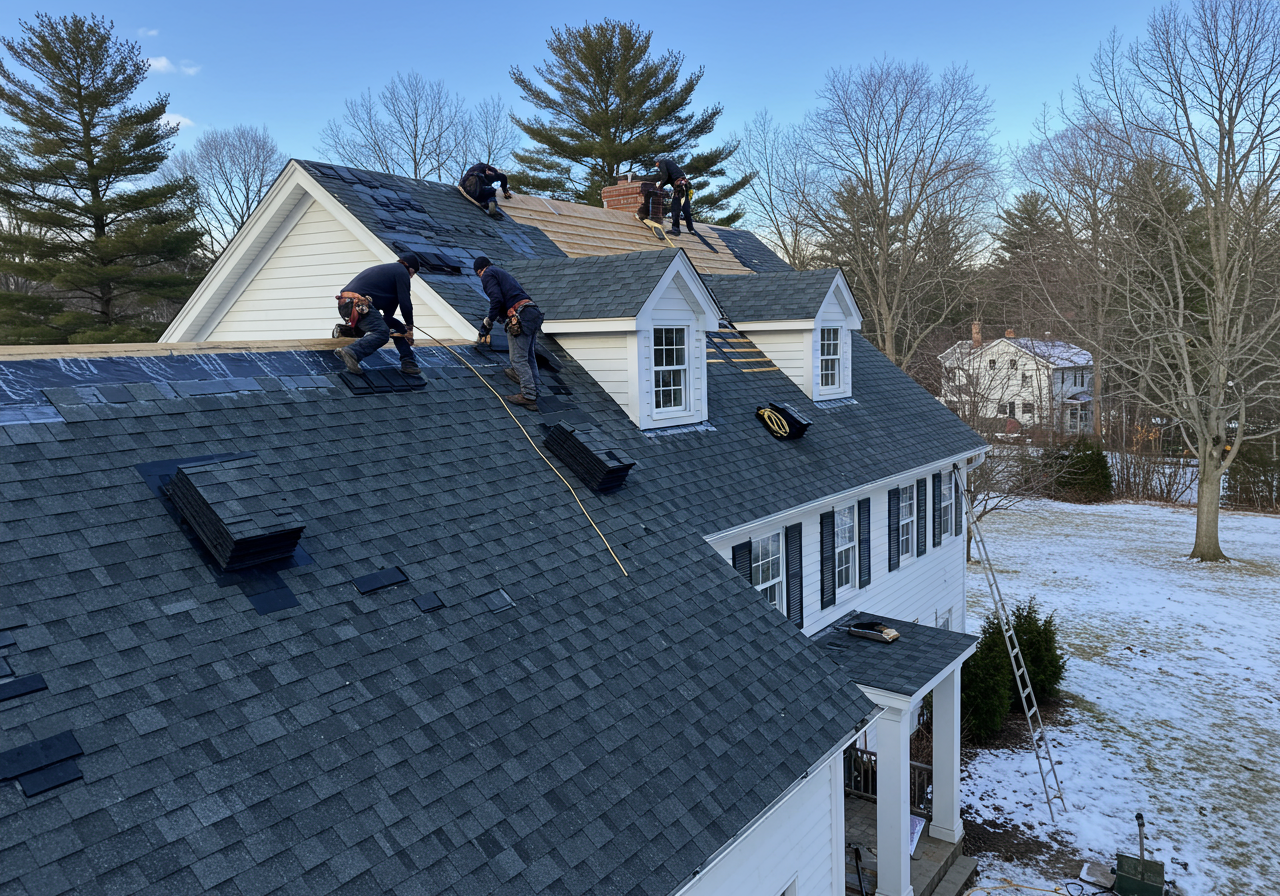
Ice Damming on a Colchester Roof
Ice dams in Colchester are a primary reason why simple repairs often fail to address the root cause of winter leaks.
5. Vetting Your Contractor for the Long Haul
The "Challenge" in the title of this article isn't just about the roof itself; it's about the people you hire to touch it. Connecticut has some great craftsmen, but we also have our fair share of "storm chasers" who disappear as soon as the check clears. This is especially true in January, when work can be lean and some crews are desperate for any job.
A "Verified Local Contractor" isn't just a marketing term; it means someone who understands the specific wind loads in New London County and uses the right number of nails per shingle (usually six for high-wind areas like ours). I always tell people to check the Better Business Bureau's roofing guide to see how a company handles complaints. Do they stand by their work when a repair fails six months later?
The smartest thing you can do is find a contractor who actually shows up and provides a detailed, line-item estimate. If a quote just says "Roof Repair - $1,500," run away. You want to see exactly what materials are being used, what the warranty covers, and how they plan to protect your landscaping during the process. In a town like Colchester, where we take pride in our properties, the last thing you want is a yard full of nails and shingle scraps hidden under the January snow.
Ground-Level Inspection
Conduct a ground-level inspection using binoculars to check for missing granules or 'lifted' shingle tabs.
Attic Check
Check your attic for daylight peeking through or dark 'water maps' on the plywood sheathing.
Get Multiple Quotes
Get at least three quotes that contrast a localized repair cost versus a full replacement value.
Verify Licensing
Verify the contractor's CT registration and insurance certificates through the eLicense portal.
Schedule Strategically
Schedule the work during a clear weather window, ensuring the crew uses cold-weather application techniques if it is below 40°F.
January might feel like the worst time to deal with a roof, but it's actually the most honest time. The weather doesn't lie. It shows you exactly where your home is failing. Whether you choose a surgical repair or a total system overhaul, the goal is the same: making sure that when the next big one rolls in off the Atlantic, you're the one watching the snow fall from the comfort of a dry living room.
Whatever you decide, don't let the "decision paralysis" lead to water damage. A small leak today is a mold colony tomorrow. Take the time to look at the data, check the weather patterns, and make a choice that protects your Colchester home for the next twenty Januaries to come.
Get Your Free Roof Quote
Enter your zip code to get started