Key Takeaways
- A missing permit is a ticking financial time bomb that usually explodes when you're trying to sell your house or file an insurance claim.
- In Connecticut, the permit isn't just a piece of paper; it's your only legal proof that your roof won't blow off when the next nor'easter rolls through.
- For a standard $16,500 roof replacement in Griswold, your permit fee should land somewhere around $250 to $275.
- Pulling a homeowner permit makes you legally responsible for all site safety and code compliance, potentially voiding your homeowner's insurance.
Most Griswold homeowners treat building permits like a "city hall tax"—an annoying fee that doesn't actually provide any value. I've seen people brag at the Jewett City VFW about how they saved a few hundred bucks by letting their contractor "work under the radar." But here is the cold, hard truth: a missing permit is a ticking financial time bomb that usually explodes exactly when you're trying to sell your house or file an insurance claim after a February ice storm. In Connecticut, the permit isn't just a piece of paper; it's your only legal proof that your roof won't blow off when the next nor'easter rolls through New London County.
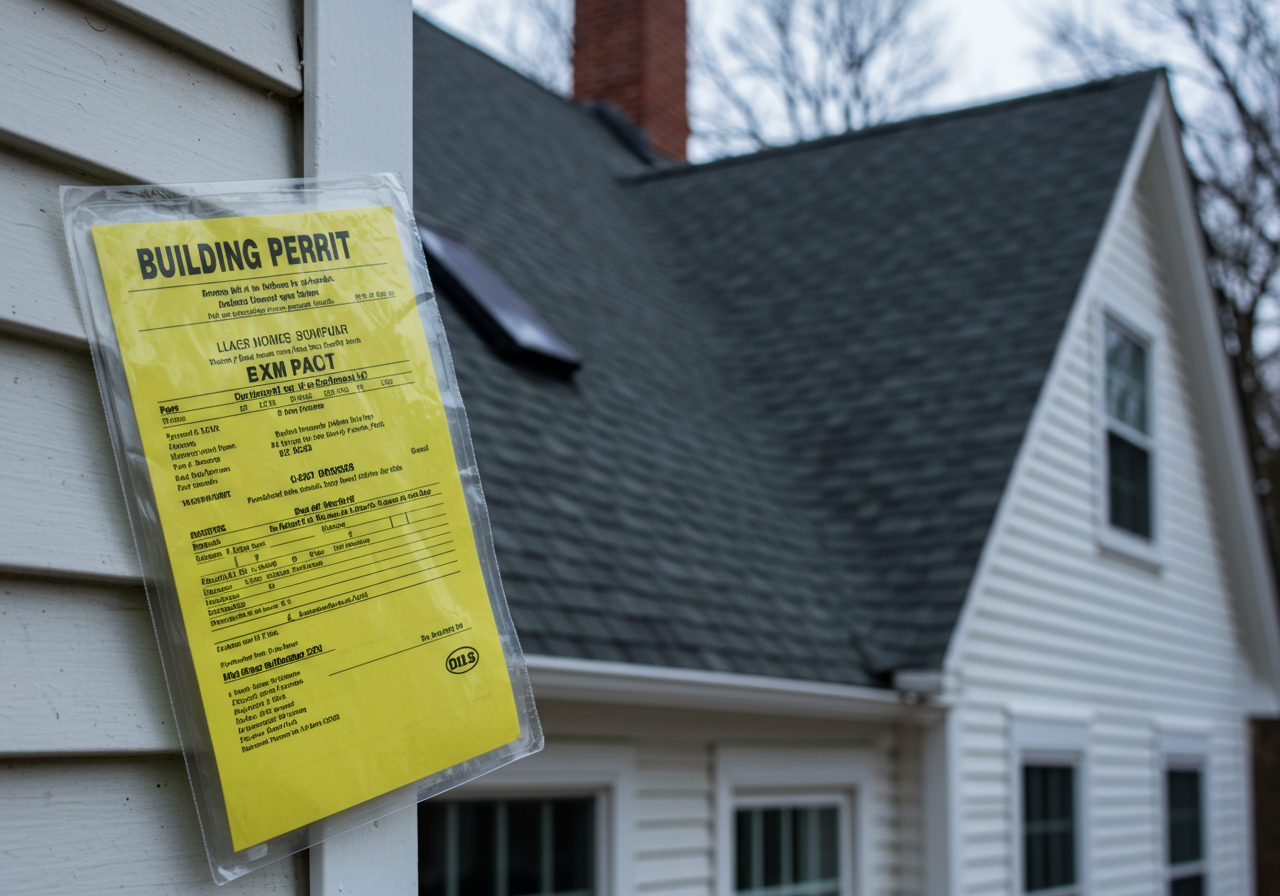
Griswold Roof Permit Requirements
Understanding the real cost of skipping permits in Connecticut
The "Invisible" Permit Trap in Griswold
The biggest problem I see isn't homeowners actively trying to break the law; it's the "invisible" permit trap. This happens when a contractor tells you, "Don't worry, I've got the paperwork handled," but then never actually steps foot in the Town Hall on School Road. I once worked with a couple near Pachaug Pond who paid $14,000 for a beautiful new roof, only to find out three years later—during a home inspection—that no permit was ever filed. They had to pay a "double fee" penalty and hire a second contractor to open up the roof just so the inspector could verify the ice and water shield was installed correctly.
In Griswold, the building department is there to protect your investment, not just collect fees. When a permit is pulled, it triggers a process where a third party (the inspector) verifies that the contractor isn't cutting corners on things you can't see, like deck thickness or nail patterns. If your contractor is hesitant to show you a physical copy of the permit before they tear off the first shingle, that's a massive red flag. You should always verify their contractor's license and permit status before any money changes hands.
What a Griswold Permit Actually Costs (Line-Item Math)
Let's look at the actual numbers because "estimated" costs are where people get scammed. Griswold generally follows a fee structure based on the total value of the job. While these rates can adjust, you're usually looking at roughly $15 for the first $1,000 of value and a slightly lower rate for every thousand after that, plus the mandatory Connecticut State Education fee (currently $0.26 per $1,000).
For a standard $16,500 roof replacement in Griswold, your permit fee should land somewhere around $250 to $275. If a contractor puts a line item on your quote for "Permit Services" that says $750, they are charging you a $500 premium just to drive to Town Hall. I always tell people to ask for the permit receipt from the town. If they can't show the receipt, you shouldn't be paying the line item.
Roofing Permit Costs vs. Potential Fines (Griswold, CT)
The Danger of the "Homeowner-Pulled" Permit
"Hey, if you pull the permit yourself as the homeowner, I can knock $200 off the price." If a contractor says this to you, show them the door. This is a classic move used by unlicensed or under-insured "trunk slammers" to avoid accountability. When you sign that permit application as the "applicant," you are legally declaring that you are the one supervising the work and ensuring it meets the Connecticut State Building Code.
By doing this, you're essentially telling the state that you're the general contractor. If a worker falls off the roof and isn't covered by workers' comp, or if the roof leaks and ruins your living room, the contractor's insurance company will laugh you out of the room because you took on the legal responsibility. I've seen this go sideways more times than I can count. According to Connecticut's consumer protection laws, a registered contractor should be the one pulling the permit for any major home improvement.
Who Should Pull the Permit?
Pros
- Contractor takes full legal liability
- Inspector holds contractor accountable
- Ensures contractor is licensed/insured
Cons
- Contractor handles all paperwork
- Slightly higher initial quote (admin time)
- Requires valid CT registration
Griswold Building Code Essentials (Ice and Snow)
We live in a part of the country where snow load and ice damming aren't just theoretical problems—they're annual certainties. In Griswold, the building inspector is looking for specific code compliance that keeps your house from rotting from the inside out. For example, the code requires an ice and water shield to extend from the eave's edge to a point at least 24 inches inside the exterior wall line.
I've looked at the NWS Historical Storm Events Database for New London County, and the frequency of heavy wet snow followed by rapid freezing is exactly why these codes exist. Without a permit and inspection, a lazy crew might only run one row of ice shield to save $300 in materials. You won't know they did it until three years from now when your bedroom ceiling starts dripping during a February thaw. A permit ensures that the "invisible" parts of your roof—the ones that actually keep the water out—are installed to state standards.
The Paperwork Trail: Ensuring Your Contractor Actually Filed
Don't take a verbal "we're all set" as gospel. I recommend a "trust but verify" approach. Once the project is scheduled, ask your contractor for the permit number. You can call the Griswold Building Department yourself to confirm it's active. It takes five minutes and could save you five figures.
Another thing: make sure the permit is posted. Connecticut law usually requires the permit to be visible from the street or in a window during the duration of the work. If the crew is ripping off shingles and there's no yellow or white card in your window, you're technically in violation. If you're feeling overwhelmed by the technicalities, reading through our blog can help you understand the other milestones you should be looking for during a replacement.
The Resale Nightmare: Unpermitted Work in New London County
If you think you're "getting away with it" because the work is done and the roof looks great, wait until you try to sell. Today's home inspectors and title companies are more aggressive than ever. In Griswold, a savvy buyer's agent will check the permit history of the property. If they see a brand-new roof but no permit on file from 2026, they will use that as a massive hammer in negotiations.
I've seen buyers demand a $5,000 credit just to "assume the risk" of an unpermitted roof. Or worse, the bank might refuse to fund the mortgage until the roof is certified by a structural engineer. At that point, the "savings" from skipping the permit have vanished ten times over. I always tell my clients: the cheapest way to do a roof is to do it legally the first time. Don't just take my word for it— see what other CT homeowners experienced when they insisted on doing things by the book.
"In twenty years of inspecting homes in Southeast CT, I've never seen a 'handshake deal' roof that actually met every line of the current state code. The permit is the homeowner's only real insurance policy against bad craftsmanship."
How to Verify Permit Status Without a Law Degree
You don't need to be a bureaucratic genius to handle this. When you get your quotes, look for the permit fee. If it's missing, ask why. If it's bundled into "Miscellaneous Fees," ask for it to be broken out. A professional contractor will have no problem explaining the Griswold building department's requirements because they deal with them every week.
Also, keep an eye on safety. A contractor who skips permits often skips safety gear, too. I always suggest homeowners glance at the OSHA Guide to Fall Protection to see what a professional setup should look like. If they're cutting corners on the law and their own lives, they are definitely cutting corners on your plywood. Use a service that matches you with verified pros so you don't have to play detective with every line item.
Stop guessing about permit costs.
Get an instant, accurate estimate from contractors who know Griswold codes inside and out.
No credit card required • Free to use
Get Your Free Roof Quote
Enter your zip code to get started
I know it feels like just another hand in your pocket, but that permit is your receipt for a job done right. In February, when the wind is howling and the snow is piling up, you'll be glad you have the paperwork to prove your roof was built to handle it.
FAQ

About Dana Jackson
Verified ExpertDana Jackson is a Homeowner Advocate & Cost Analyst who helps Connecticut families navigate the financial aspects of roofing projects. She specializes in finding the best value and avoiding common pricing pitfalls.