Let's talk about the "Miller House." It isn't actually called that, but for the sake of the privacy of a lovely couple out on Boston Post Road in Madison, we'll go with it. Their home is a stunning 1840s Greek Revival—the kind of place you see on a postcard near the Madison Green. When they realized their cedar shakes were curling like old parchment, they did what any responsible homeowner does: they called three local contractors.
The quotes that came back were, frankly, offensive. One guy quoted them $68,000 without even climbing a ladder. Another suggested they just "slap some architectural shingles over the old wood" (please, never do this). The third contractor spent forty minutes talking about "historic prestige" while adding a $12,000 premium just for the zip code. The Millers were ready to sell the house rather than fix the roof. That's when they called me.
Here's the thing about Madison: we love our history, but contractors often use that love as a license to overcharge. They assume that if you live in a New Haven County landmark, you have a bottomless bank account and zero interest in the line-item math. But whether your home was built in 1790 or 1990, a square of roofing material shouldn't suddenly double in price just because there's a historical plaque by the front door.
Key Takeaways
- Madison Historic District Commission (HDC) guidelines often allow for modern synthetic materials that look identical to cedar or slate but cost 40% less.
- Structural weight is the "silent killer" of old Madison roofs; switching from wood to heavy slate without reinforcing rafters can cause a $15,000 structural failure.
- Always demand a "tear-off" quote that specifies how they will handle "spaced sheathing" common in 19th-century Connecticut builds.
- Local permit fees in Madison are based on project value, so an inflated quote actually costs you even more in town taxes.
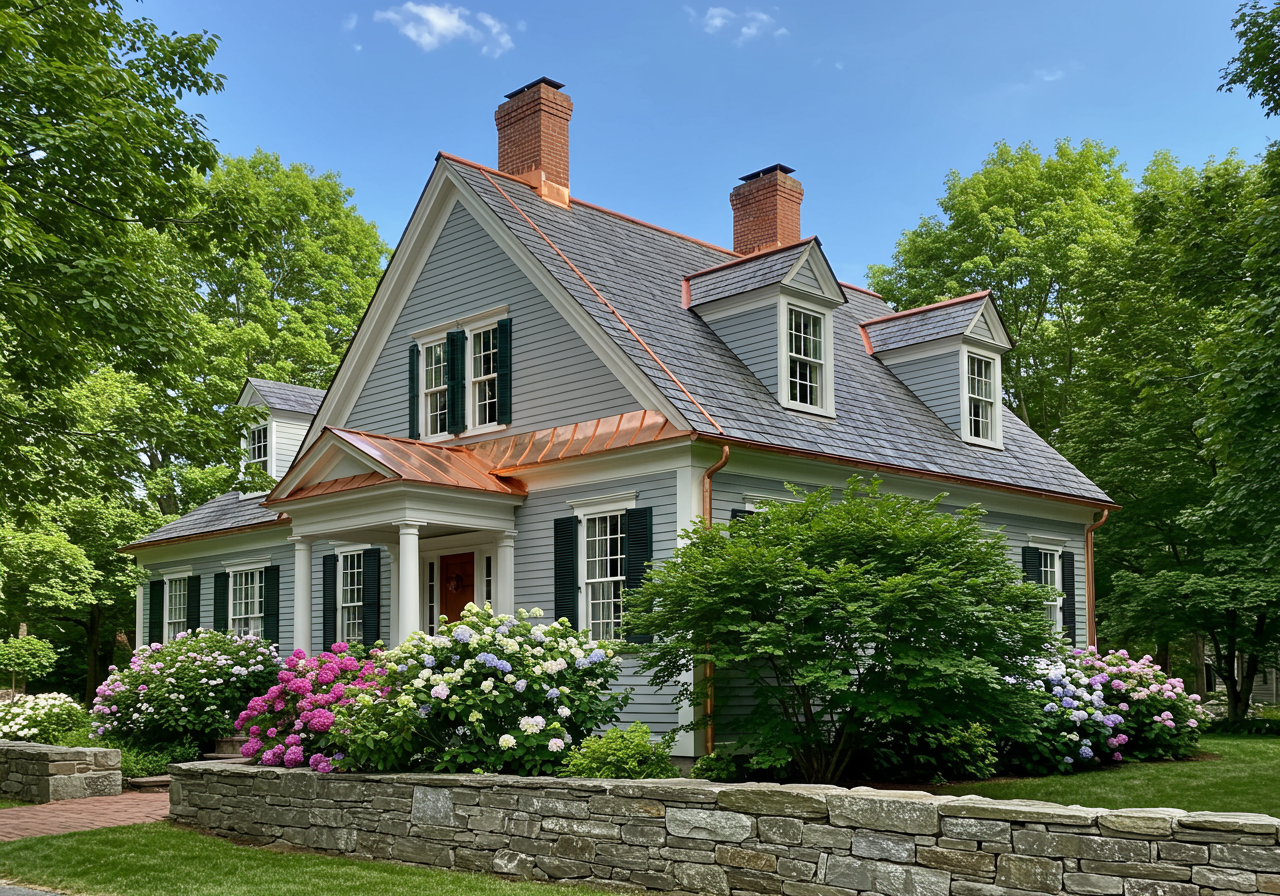
Madison Historic Rooflines
Greek Revival homes near the Green often carry cedar or slate profiles that contractors use to justify inflated quotes.
The "Madison Tax" and Navigating the Historic District Commission
When you own a piece of Connecticut history, you aren't just the owner; you're the custodian. In Madison, especially if you're within sight of the shoreline or the historic center, that means dealing with the Historic District Commission. I've seen homeowners get paralyzed by the fear of the HDC. Contractors feed into this, claiming that "only this one specific, overpriced wood shingle will be approved."
That is a myth. The secret most contractors won't tell you is that the HDC is often more reasonable than the people trying to sell you the materials. In June 2026, we're seeing a massive shift toward high-quality polymer synthetics. These materials mimic the texture of hand-split cedar but carry a Class A fire rating and last twice as long.
But here's the catch: the contractor has to do the legwork to prove the aesthetic match. Most don't want to. It's easier for them to quote you the $55,000 "standard" cedar job than to spend two hours at a town meeting defending a more durable, cost-effective alternative.
The True Cost of "Like-for-Like"
If you insist on authentic cedar shakes, you're looking at a market in 2026 where high-quality Western Red Cedar is fetching $1,200 to $1,500 per square (100 sq. ft.) just for materials. Add in the Madison labor rate, and you're easily pushing $2,200 per square. For an average 2,500-square-foot roof, that's a $55,000 starting point.
I tell my clients to verify their contractor's experience with historic materials before signing. Ask them for the address of a local project they did five years ago. Drive by it. Does it look like a historic treasure, or does it look like a "flip"?
Building Codes vs. Historic Charm
According to the International Code Council (ICC), roof deck preparation is non-negotiable, even for a house built when Abraham Lincoln was practicing law. Many Madison homes have "skip sheathing"—boards with gaps between them to let old wood shakes breathe. If you're moving to asphalt or synthetic, you can't just nail into air. You need to "deck over" with plywood. If your contractor didn't include the cost of 60 sheets of CDX plywood in the initial quote, you're looking at a $4,500 "surprise" on day two of the job.
Material Math: Why Slate and Cedar Aren't Your Only Options
Back to the Millers. We sat down at their dining room table and looked at the math. They wanted the look of slate but their rafters—original hand-hewn oak from the 1840s—were never designed for the 800-lb-per-square weight of real stone. To use real slate, they would have needed to bring in a structural engineer and sister-in every single rafter.
The price for that? An extra $18,700 just in structural "prep."
Instead, we looked at synthetic slate. It's made from recycled polymers and weighs about the same as a standard asphalt shingle. From the street, even the HDC members would have a hard time telling the difference without a ladder.
Cost vs. Lifespan for Madison Historic Homes
Expected service life in years before major replacement
The 2026 Energy Credit Loophole
Many homeowners don't realize that even historic-looking roofs can qualify for federal tax breaks if they meet certain reflectivity standards. While the IRS doesn't care if your house looks like it's from 1776, they do care about your energy footprint. Under the IRS Instructions for Form 5695, certain metal roofs or asphalt shingles with cooling granules can net you a significant credit.
I've had Madison clients save nearly $1,200 on their tax bill just by choosing a "Cool Roof" certified shingle that looked identical to the "non-cool" version. You can find more about how these work in the Energy Star: Cool Roofs Consumer Guide.
Real Slate vs. Polymer Synthetic Slate
Pros
- Incredible lifespan (75+ years)
- Authentic historical value
- Environmentally natural
Cons
- Extremely heavy (requires structural reinforcement)
- Costs $35,000 - $60,000 more than synthetic
- Repairs require specialized stonemasons
The Hidden Infrastructure of 19th-Century Homes
You can't talk about Madison roofing without talking about what's under the shingles. I once walked an attic in a colonial near East Wharf where the rafters were literally tree limbs with the bark still on them. They'd held up for 200 years, but they weren't exactly "to code."
When a contractor gives you a quote for an old house, they are guessing. They're guessing how many layers of old shingles are there. They're guessing if the chimney flashing is lead, copper, or rusted tin. And they're guessing if the fascia boards are rotted.
A "Dana-approved" quote doesn't guess. It includes a "per-sheet" price for plywood and a "per-linear-foot" price for rafter repair. If a contractor says, "Don't worry, we'll handle the rot if we find it," you should worry. That is a blank check.
Evaluating Your Roof Deck
If your home is pre-1900, your roof probably doesn't have a solid wood deck. It has "lath" or "spaced sheathing." Before you can install a modern shingle, you have to create a solid surface.
Full tear-off
Tear off all existing layers down to the original wood strips.
Inspect the rafters
Inspect original rafters for 'crowning' or sagging (common in older Madison homes).
Deck over the lath
Install 5/8-inch CDX plywood over the existing lath to create a flat, nailable surface.
Ice and water shield
Apply a high-temperature ice and water shield (critical for our CT winters).
Drip edge and starter
Install the drip edge and starter shingles.
I've seen so many homeowners get burned by the "flashings" line item. On a historic home, you likely have dormers, chimneys, and complex valleys. If a contractor suggests using aluminum flashing on a historic home to save money, show them the door. For a house with character, you want copper. Yes, it's more expensive—about $18 to $25 per linear foot compared to $4 for aluminum—but aluminum will react with the tannins in cedar or the minerals in stone and fail within 15 years. Copper lasts 100.
Copper Flashing Warning
The Negotiation Script: Don't Let "Historic" Mean "Blank Check"
So, how do you actually talk to these guys? You have to let them know you've done your homework. When the Miller's second contractor tried to hand them a one-page "estimate" for $42,000, I told them to send it back with a request for a line-item breakdown.
Specifically, you want to see the "Material vs. Labor" split. In Madison, labor usually accounts for about 40% of the job. If the labor is 70% of the quote, they are charging you a "prestige premium."
Use This Script
"I've looked at the ZikQuote deep-dive blog library regarding historic home costs. I see you've quoted $45,000 for the total project. Can you provide a breakdown that shows the specific cost for the 28 squares of material, the linear footage of copper flashing, and the per-sheet cost for any decking replacement? Also, I'd like to see the price difference if we opted for a high-end synthetic rather than the Western Red Cedar."
This script does two things. First, it tells the contractor you aren't a "blank check" homeowner. Second, it forces them to justify their numbers. If they can't (or won't), move on. There are plenty of transparent, vetted pros in Connecticut who are happy to show their math.
The Power of Social Proof
Before you commit to a $30,000+ project, see what other CT homeowners experienced with their historic renovations. Look for mentions of "cleanliness" and "respect for property." On an old Madison lot, you likely have prize-winning perennials or antique stonework. You don't want a crew that's going to toss 4,000 pounds of old shingles onto your grandmother's hydrangeas.
Get Your Free Roof Quote Today
Connect with verified CT pros who understand Madison historic homes.
No credit card required • Free to use
Get Your Free Roof Quote
Enter your zip code to get started
The Millers ended up choosing a high-end synthetic slate. We found a contractor who agreed to a fixed labor rate plus the cost of materials. We saved them $14,600 over the initial "prestige" quote. The best part? The roof looks incredible, the HDC is happy, and they didn't have to mortgage their retirement to keep the rain out.
In the end, roofing in Madison isn't about finding the cheapest bid; it's about finding the fairest bid. Don't let the age of your home be used as a weapon against your wallet. Put the numbers on paper, demand the math, and remember that you're in charge.
FAQ: Madison Historic Roofing Questions

About Dana Jackson
Verified ExpertDana Jackson is a Homeowner Advocate & Cost Analyst who helps Connecticut families navigate the financial aspects of roofing projects. She specializes in finding the best value and avoiding common pricing pitfalls.