
Key Takeaways
- Immediate Load Stress: Even if shingles look intact, a 500-lb limb can compromise the structural integrity of your rafters or ridge board.
- The 90% Humidity Factor: New Haven's current high humidity means trapped moisture under a punctured deck will lead to rot within 72 hours.
- Insurance Nuance: Claims in New Haven County often hinge on whether the tree was healthy or neglected prior to the fall.
- Professional Specs: A standard visual check is insufficient; look for 'telegraphing' in the ceiling joists to catch structural shifting.
New Haven is currently sitting at a damp 35°F with a heavy 90% humidity level—the kind of January air that feels heavier than the thermometer suggests. For homeowners around East Rock or Westville, this specific combination of near-freezing temperatures and high moisture creates a unique problem when a tree limb decides to give way. Brittle, ice-laden branches don't just "fall"; they impact with a force that can ripple through the entire structural frame of a colonial or Victorian-style home.
When a branch comes down, the damage is rarely just what you see on the surface. While the cloudy skies today might hide the extent of the trauma, the reality is that the shockwave of a tree impact can unseat flashings thirty feet away from the strike zone. I've spent a significant portion of my career analyzing these impact patterns, and the data consistently shows that the "invisible" damage—cracked rafters and pulled fasteners—is what leads to the most expensive repairs three years down the line. We need to look past the splintered wood and evaluate the skeleton of the home.
The Structural Physics of a Roof Strike
When a tree hits a roof, it's not just a weight issue; it's a kinetic energy event. In New Haven, many of our older homes use "true-dimensional" lumber, which is sturdier but also more rigid than modern 2x4s. This rigidity means the energy of an impact doesn't dissipate—it travels. I've seen impacts in the Wooster Square area where a tree hit the rear of the house, but the force caused the chimney flashing at the front to separate by nearly half an inch.
Look, you have to understand the difference between a "puncture" and "deflection." A puncture is obvious; you have a branch in your attic. Deflection is the silent killer. This happens when the roof deck flexes under the weight and then snaps back. This movement often shears the nails holding your shingles in place (I'm talking about the 1.25-inch galvanized clouts we use for standard Owens Corning or GAF installs). Once those fasteners are compromised, the wind-lift rating of your roof drops by as much as 60%, even if the shingles look "fine" from the ground.
Hidden Moisture and the January Humidity Trap
With the humidity currently at 90% in New Haven, any breach in your roof's weather barrier—even a hairline crack in the underlayment—is essentially a vacuum for moisture. In our January freeze-thaw cycles, that moisture enters the wood fibers of your decking, freezes, expands, and then thaws into a liquid state that accelerates delamination. If you've got standard 1/2-inch CDX plywood, it only takes a few cycles of this to turn a solid sheet into something resembling wet cardboard.
I always tell people that the tarping process is just as critical as the eventual repair. According to OSHA's fall protection standards, any contractor assessing this damage should be using proper tie-offs even on a low-slope roof. If they're just "eyeballing it" from a ladder, they're going to miss the micro-fractures in the asphalt mat of your shingles. These fractures are the entry points for the 90% humidity we're seeing today, leading to mold growth in the attic insulation that can cost upwards of $4,500 to remediate on its own.
Navigating the Insurance Negligence Clause
In New Haven County, insurance adjusters look at "maintenance" very differently than they do in other regions. If an Oak or Maple falls on your house during a storm, it's usually an "Act of God." However, if that tree was visibly dead or diseased—something common in the older, tree-lined streets of New Haven—the carrier might argue negligence. I've sat through enough inspections to know that an adjuster will look for signs of previous rot in the fallen trunk.
Filing a Claim vs. Out-of-Pocket Repair
Pros
- Insurance covers structural stabilization and full replacement if damage exceeds 25%
- Ensures professional-grade materials like ice and water shield are used
- Documentation builds a history of home maintenance
Cons
- Potential premium increase if negligence is cited
- Deductible might be higher than a minor patch repair
- Wait times for adjusters during New Haven storm surges
If you're unsure about the extent of the damage, how our matching process works is designed to get a qualified eye on the scene quickly, rather than waiting for an overworked insurance adjuster to show up two weeks late. Getting a documented professional assessment immediately is your best defense against a denied claim.
The Cost Spectrum: Branch vs. Trunk Impact
The financial reality of tree damage is rarely a flat fee. We categorize these into "nuisance strikes" (small limbs), "structural breaches" (major branches), and "catastrophic loads" (the whole tree). In New Haven, a mid-sized branch impact usually runs between $1,800 and $3,400 depending on the shingle type. If we're talking about a full trunk, you're looking at structural stabilization, which is a different beast entirely.
Estimated New Haven Roof Repair Costs by Damage Severity (2026)
As noted in FEMA's hurricane and storm mitigation guidelines, reinforcing the roof-to-wall connections during a repair can significantly prevent future blow-offs. I've often recommended my clients in New Haven upgrade to hurricane clips during a tree-related repair—it's a $500 add-on that can save the entire house during the next Nor'easter.
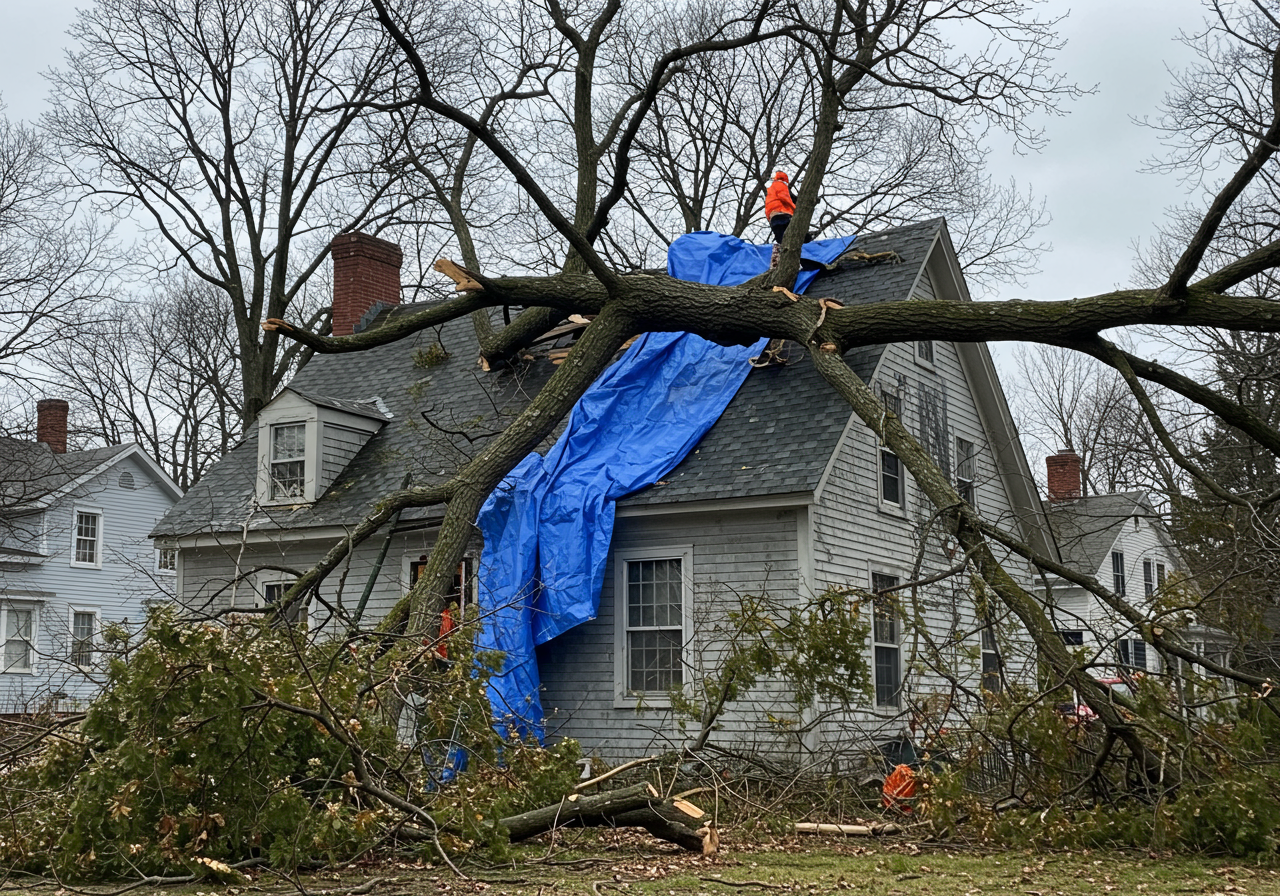
Fallen tree damage on a New Haven roof
The impact of a fallen tree extends far beyond visible shingle damage, affecting structural integrity and creating hidden moisture entry points.
Five Steps to a Defensible Damage Assessment
When the tree is still on the roof, the urge is to call a tree removal service immediately. While that's necessary, you need to document the "before" state for your claim. I've seen tree crews accidentally cause more damage during the crane lift because they didn't understand how the weight was distributed across the load-bearing walls.
Document Before Removal
Take high-resolution photos from 360 degrees before anything is moved.
Inspect the Attic
Inspect the attic with a high-lumen flashlight for 'light leaks' or cracked rafters.
Check Interior Drywall
Check interior drywall for hairline cracks near door frames and windows.
Hire Qualified Tree Service
Hire a tree service that carries specialized crane insurance for residential 'lifts'.
Professional Assessment
Get a roofing professional to perform a 'manometer' test to check if the ridge line has dipped.
If you want to find local roofing pros who actually understand the nuances of New Haven's architectural styles, you need to vet them for their experience with storm damage specifically. A guy who just does new construction won't know where to look for the "hidden" stress fractures that a tree impact leaves behind.
Long-Term Mitigation and the New Haven Canopy
We love our "Elm City" reputation, but the reality of living under a dense canopy is that your roof is under constant assault from organic debris. The 90% humidity we're experiencing today doesn't just affect the wood; it keeps fallen leaves and small twigs damp, creating a mulch-like substance in your gutters. This mulch traps water against the fascia board, rotting the very wood that your rafters rely on for support.
The Daniel Roberts 'Tension Check'
Get Your Free Roof Quote
Enter your zip code to get started
In conclusion, a fallen tree in New Haven is more than just a mess in the yard—it's a structural event that requires a data-driven response. Don't let the 35°F January chill fool you into thinking the damage is "frozen" and can wait. Between the moisture levels and the risk of structural shift, time is your biggest enemy. Ensure you have a professional who looks at the rafters, not just the shingles, and always get your estimates in writing before the first tarp is nailed down.