Key Takeaways
- Immediate Stabilization: Why tarping is only 20% of the battle after a strike.
- Deflection Detection: How to spot the 1/240 ratio structural failures adjusters often miss.
- Insurance Accuracy: The specific documentation needed to ensure a $4,800 repair doesn't turn into a $15,000 structural headache later.
- Material Matching: Why Fairfield County's aesthetic standards require specific shingle blending techniques.
In Fairfield County, nearly 42% of emergency roofing calls in March aren't actually about leaks—they're about limbs. When a heavy oak or maple decides to relocate into your attic during a spring Nor'easter, the immediate structural math of your home changes instantly. I've seen homeowners in North Mianus look at a downed branch and think they just need a few new shingles, only to find out six months later that their ridge beam is sagging by three-quarters of an inch. The reality is that the visible trauma is often just the tip of the iceberg. In Stamford, where our aging "Gold Coast" canopy meets high-value real estate, a tree strike isn't just a landscaping issue; it's a forensic engineering project.
The Physics of a Strike: Why It's Never "Just Shingles"
Last season, I walked a property in Westover where a white oak limb, roughly 14 feet long, had punctured a slate roof. The homeowner was relieved because the hole was "only the size of a dinner plate." But here is the thing: a falling limb carries kinetic energy that doesn't just stop at the plywood. That energy vibrates through the rafters, often popping the nails on the opposite side of the roof or cracking the collar ties that keep your walls from spreading.
Look, when a 500-pound limb hits a roof, it creates a "point load" that the truss system was never engineered to handle. Most Stamford roofs are built for "distributed loads"—like a foot of heavy, wet snow—not the concentrated hammer blow of a falling tree.
Identifying Compression Fractures
When I'm up on a ladder, I'm not just looking for torn granules. I'm looking for compression fractures in the lumber. (I always carry a high-lumen tactical flashlight for this, even in broad daylight, to catch the shadows of hairline cracks). If you see daylight through the roof deck, you clearly need emergency repairs, but the real danger is the rafter that looks fine but has "checked" or split internally.
The Secondary Impact Zone
I often find damage 15 to 20 feet away from the actual strike zone. The shockwave can dislodge chimney flashing or break the seal on your skylights. In one Shippan Point case, a tree hit the garage, but the vibration was so intense it backed out fasteners on the main house ridge vent.
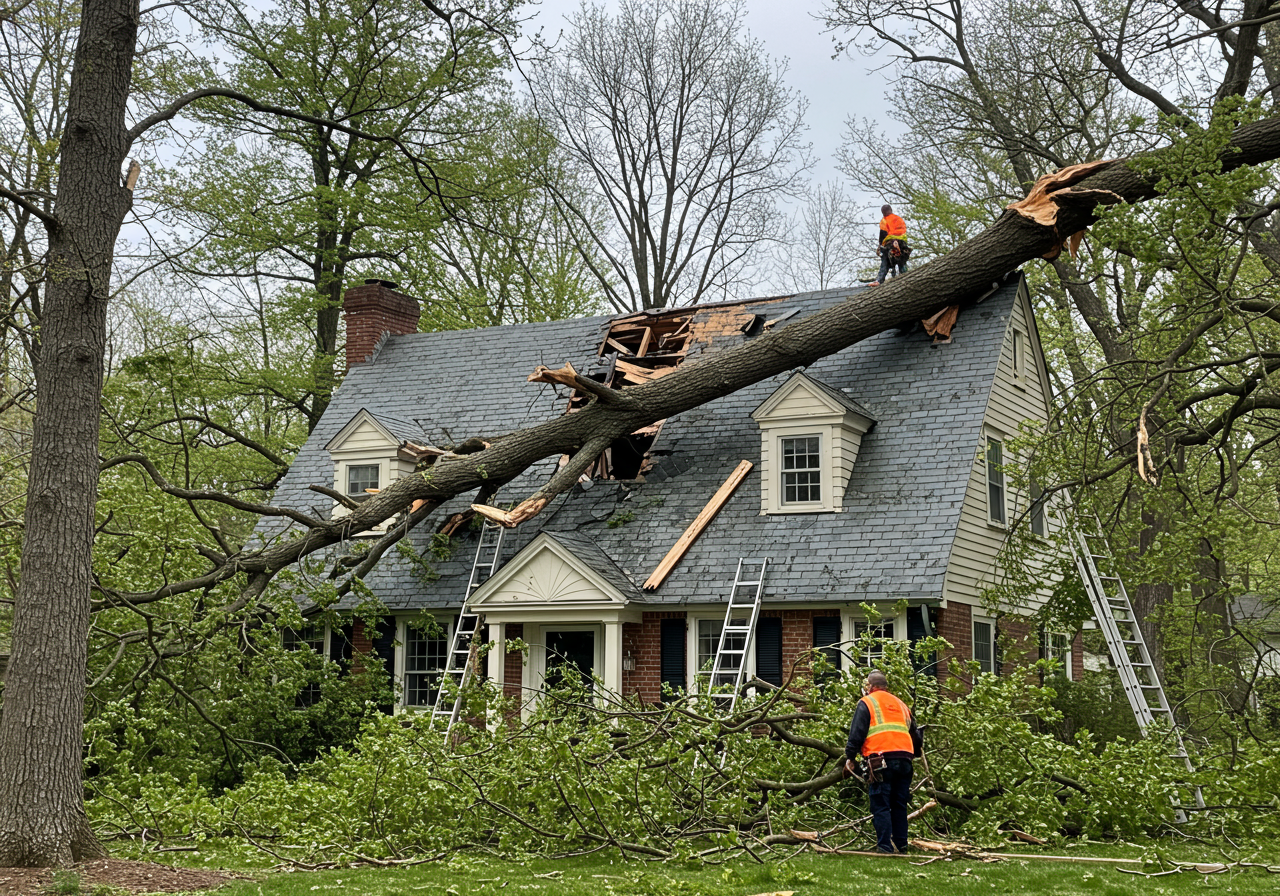
Tree Damage Assessment
Hidden structural damage often extends far beyond the visible impact point
Assessing Structural Deflection: The 1/240 Rule
In the roofing world, we talk about "deflection"—which is a fancy way of saying "how much did the wood bend?" According to building codes used across Connecticut, a certain amount of flex is allowed, but once you hit a ratio of 1/240 of the span, you've got a structural failure.
I've had many conversations with insurance adjusters who try to claim a rafter is "just slightly bowed." My response is always the same: if it's outside the engineered tolerance, it's a liability. We've seen roofs in the Revonah Manor area where a strike caused a subtle 1.2-inch dip. It doesn't look like much until the next big snow load hits that weakened spot.
Checking for Header Displacement
In many older Stamford colonials, the roof weight is transferred through specific load-bearing headers. A tree strike can shift these by just a few millimeters, which is enough to make the bedroom doors on the second floor stick. If your doors suddenly don't close right after a storm, your roof moved.
Fastener Withdrawal
I've spent a lot of time documenting "fastener withdrawal." This happens when the roof deck flexes so hard upon impact that the nails actually pull halfway out of the rafters. You can't just hammer them back in; the hole is stripped. You need a professional to verify if the decking needs to be pulled and re-fastened to maintain wind uplift ratings, especially since FEMA's hurricane mitigation guide emphasizes the importance of deck-to-rafter integrity for coastal zones like ours.
The Insurance Chess Match: Documentation is Your Only Move
Dealing with insurance after a tree falls is like a high-stakes game of chess. The adjuster's job is to settle the claim for the "visible damage." My job is to make sure the "invisible damage" is covered before you sign a release. I always tell my clients: if it isn't in a photo with a tape measure next to it, it didn't happen.
"In twenty years of consulting, I've never seen an adjuster find more damage than a contractor with a moisture meter and a level."
The "Line of Sight" Rule in Connecticut
Connecticut is a state that generally respects the "matching" rule. If a tree destroys 20% of your roof and the remaining 80% is 12-year-old GAF Timberline shingles that have faded in the sun, you may be entitled to a full replacement because a patch would look like a giant band-aid. This is particularly relevant in high-end Stamford neighborhoods where curb appeal directly impacts property value.
Why You Need a Forensic Estimate
Standard estimates often miss the "code upgrades." If your roof was built in 1985, a tree strike triggers a requirement to bring that section (and sometimes the whole roof) up to 2026 Connecticut State Building Codes. This might include adding ice and water shield or improving attic ventilation to meet Department of Energy's insulation standards, which can add $2,500 to $4,000 to the total project cost.
Repair vs. Replacement: Calculating the Long-Term ROI
Sometimes, a repair is the smart move. If the tree was small and the roof is less than 5 years old, we can usually swap out a few sheets of OSB and a square of shingles. But if your roof is over 15 years old, a tree strike is often the signal that it's time to stop throwing "patch money" at a dying system.
The cost-benefit analysis changes when you realize that the labor to "tie in" a repair often costs 50% more per square foot than a standard installation. You're paying for the surgeon's precision to weave new shingles into old, brittle ones without breaking them.
Average Recovery Costs: Repair vs. Replacement (Stamford 2026)
The Brittle Test
Before deciding to repair, I perform what I call the "brittle test." I take an existing shingle near the damage and bend it. If it cracks, the roof is too far gone to be repaired. Forcing new shingles into an old, brittle roof is like trying to sew a new piece of denim onto a pair of dry-rotted jeans—the stitches just pull through. In these cases, upgrading to a new roof system is usually the only way to guarantee a leak-free result.
For accurate cost estimates, use our roofing cost calculator to get a realistic budget before meeting with contractors.
Step-by-Step: The Stamford Homeowner's Recovery Plan
If you're standing in your yard looking at a limb sticking out of your master bedroom, don't panic. There is a specific order of operations that protects your wallet and your home's structural integrity. The biggest mistake I see is people calling a roofer before they call a tree service, or vice versa, without a coordinated plan.
Safety First
Clear the area and ensure no power lines are involved. Do not walk on a roof that has sustained a major structural hit.
Document Everything
Take 20+ photos from different angles before anything is moved. This is your 'Exhibit A' for insurance.
Emergency Tarping
Hire a pro to dry-in the home. Use heavy-duty 10-mil tarps, not the cheap blue ones from the hardware store.
Structural Inspection
Have a roofing consultant check the attic for cracked rafters and 'deflection' in the ridge beam.
Detailed Estimating
Use a roofing cost calculator or get a line-item bid that includes code upgrades and material matching.
Choosing the Right Contractor in Fairfield County
In Stamford, you want someone who understands the local permitting process. The Building Department at 888 Washington Blvd can be sticklers for structural details. If your contractor doesn't mention "permitting for structural repairs," they aren't the right person for a tree-damage job. You need a team that uses torque drivers for structural screws, not just a framing hammer and a prayer.
Get Your Free Roof Quote
Enter your zip code to get started
The reality of living in a beautiful, wooded city like Stamford is that our "urban forest" occasionally clashes with our architecture. While a tree through the roof is a headache, it's also an opportunity to address aging ventilation or insulation issues that have been costing you money for years. By focusing on the structural data and demanding precise documentation, you can turn a disaster into a long-term investment in your home's safety.
FAQ: Tree Damage and Roofing in Stamford

About Daniel Roberts
Verified ExpertDaniel Roberts is a Senior Roofing Consultant with over 15 years of experience in the New England residential construction industry. He specializes in storm damage assessment and energy-efficient roofing systems.