I was standing on a driveway near Lake Wononscopomuc last March—right in the thick of that sloppy Litchfield County mud season—watching a homeowner named Elias stare at a $32,000 estimate. The contractor had pitched him a "Coastal Protection Package." Elias was confused. We're in Lakeville, not Stonington. We have the Salisbury Winter Sports Association nearby, not the Atlantic Ocean. Why on earth would he need to pay a 25% premium for materials designed for the shoreline?
The reality is that while we don't deal with salt spray in the Northwest Hills, our wind loads and moisture levels around the lakes create a micro-coastal environment that eats standard roofs for breakfast. But here is the thing: some contractors use the word "coastal" as a license to print money. They'll upcharge you for stainless steel fasteners you don't need while skipping the high-temp underlayment you actually do need.
In this guide, I'm going to strip away the marketing fluff. We're going to look at the line-item math for Lakeville homes and decide if those coastal upgrades are a smart investment or just a Litchfield County tax.
Key Takeaways
- Lakeville's elevation and lake proximity create high-wind and high-moisture micro-climates that justify certain coastal-grade materials.
- The "Coastal Premium" usually adds $3,500 to $5,800 to a standard 2,500 sq. ft. roof replacement in Litchfield County.
- Prioritize "Coastal Grade" underlayment and shingles with 130mph wind ratings over expensive salt-resistant metal finishes.
- Always demand a line-item breakdown so you are not paying for "coastal" marketing instead of coastal performance.
Why Lakeville homeowners are eyeing coastal materials
Most people think "coastal roofing" and they think of beach houses in Old Saybrook. But Lakeville sits in a unique topographical pocket. When those March winds whip across the lakes and funnel through the hills, your roof takes a beating that looks remarkably like a shoreline gale.
The Litchfield wind funnel
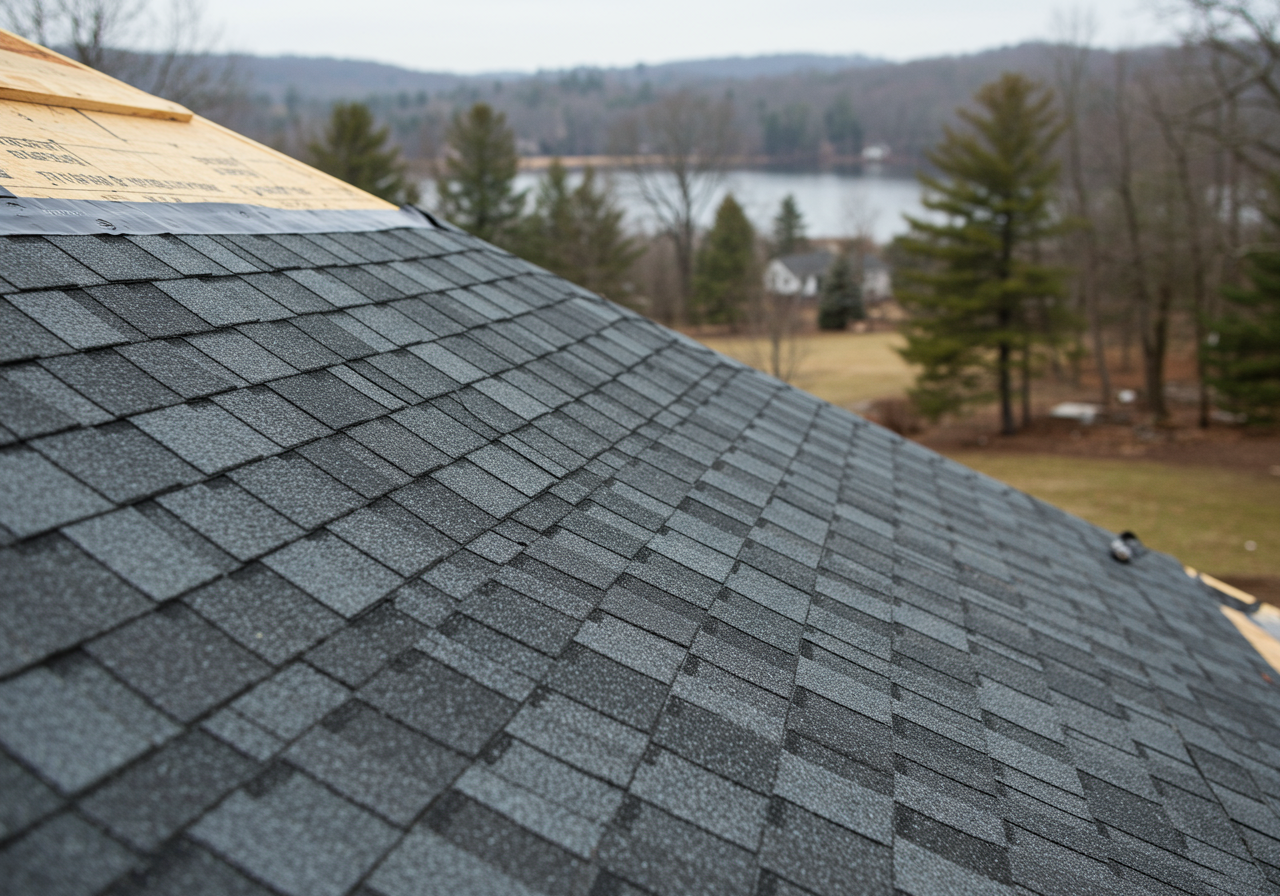
In the Northwest Hills, wind doesn't just blow; it swirls. I've seen 15-year-old architectural shingles on Interlaken Road that looked like they'd been through a blender. Standard shingles are often rated for 60-80 mph, which sounds like plenty until you realize a standard gust in a Litchfield thunderstorm can hit 70 mph easily. Coastal-grade shingles are typically tested for 110-130 mph. For a Lakeville home, that's not overkill—it's an insurance policy against having to call for 24/7 emergency help when wind peels tabs at 2:00 AM.
Moisture and the "lake effect"
Living near the water—whether it's the Atlantic or Lake Cochituate—changes the humidity profile of your attic. Standard felt paper can trap moisture, leading to deck rot before the shingles even wear out. This is where coastal considerations actually make sense inland. We're seeing more homeowners opt for synthetic, breathable underlayments that are staples on the coast. According to EPA research on reflective materials and roof surfaces, managing temperature and moisture at the roof surface can significantly extend the life of the entire structure.
Lakeville wind, lake humidity, roof loads
Coastal-grade upgrades are not about salt spray here—they are about wind-driven rain and attic moisture that mimic shoreline stress.
The coastal premium: Is coastal grade worth it?
Let's talk about the show-me-the-receipt part of the conversation. I recently audited two quotes for a colonial-style home in the center of Lakeville. Contractor A quoted a standard builder-grade roof at $18,650. Contractor B quoted a coastal-enhanced system at $23,125. That's a $4,475 difference.
Breaking down the coastal line items
When you look at the math, where is that extra four grand going? Usually, it's three things: high-wind shingles ($1,200), synthetic underlayment ($950), and enhanced flashing and fastener packages ($2,325). In Lakeville, the first two are worth every penny. The third? That's where you need to be skeptical.
Standard vs. Coastal-Spec Costs (Lakeville, CT)
Illustrative bids for the same colonial—bars show relative scale; dollar amounts are in the labels
The full zinc and copper option is what you'd see on a multi-million dollar mansion in Greenwich. In Lakeville, unless you're building a legacy estate, that $34k price tag is probably not going to provide a better ROI than the $23k enhanced option.
The fastener trap
Here is a Dana Jackson tip: If a contractor tells you that you need 316-grade stainless steel nails in Lakeville because of the "coastal environment," thank them for their time and show them the door. Stainless fasteners are for salt air. In Litchfield County, high-quality hot-dipped galvanized nails are perfectly fine. You don't need to pay a $1,500 fastener premium to fight salt that isn't there.
Dana's Money Rule
The underlayment secret: Why "coastal" matters inland
If you've ever walked into your attic in Lakeville during a humid July day, you know it feels like a sauna. Standard roofing systems often ignore the breathability aspect that coastal homes rely on.
Synthetic vs. felt
Standard #15 or #30 felt paper is basically paper soaked in asphalt. It's heavy, it tears, and it doesn't breathe. Coastal-spec synthetic underlayments act like a high-tech raincoat for your house—they let moisture escape from the attic but keep wind-driven rain from getting in. For how insulation and building assemblies interact with moisture, the Department of Energy insulation guidance is a useful baseline when you talk with your contractor about ventilation and drying paths.
I remember a project on Wells Hill Road where the homeowner had coastal underlayment installed. Two years later, a massive branch from a hemlock tree punctured the shingles during a storm. Because that synthetic underlayment was so tough, the water didn't penetrate the deck for three days. It bought them time. That's the kind of coastal benefit that actually matters in Lakeville.
High-temp ice and water shields
In Lakeville, our winters are longer and colder than the coast. We deal with ice dams that would make a New Haven resident weep. Coastal roofing packages often include double-width ice and water shields. This is one coastal upgrade I always advocate for in the Northwest Hills. If you aren't running that shield at least six feet up from the eaves, you're asking for a ceiling leak when the February thaw hits.
Did You Know?
Wind-driven rain is the leading cause of attic mold in Litchfield County—and standard underlayment often cannot handle the pressure of 60mph gusts pushing water upward under the shingles.
The negotiation script: Don't let 'coastal' be a buzzword
When a contractor realizes you live in a nice part of Lakeville, the coastal package pitch starts coming out. They assume you have the budget for it, so they bundle unnecessary upgrades together. You need to unbundle them.
Ask to see the math
Here is how I want you to handle the next contractor who walks onto your property. Use this script: "I see you've included a coastal protection package for $5,000 extra. Can you break that down? I want to see the specific cost for the 130mph shingles versus the standard ones, and I want to see the brand name of the underlayment you're using."
If they can't—or won't—give you those line items, they're just padding the margin. You can use our three-step matching process for line-item transparent bids to compare pros who actually spell out materials before you sign.
Red flags to watch for
- The salt spray scare: If they mention salt air in Lakeville, they're using a template script.
- The lifetime vague-ness: Ask if the coastal warranty covers wind-driven rain specifically. Most lifetime warranties have more holes than a piece of Swiss cheese.
- The fastener upsell: Again, unless you can see the ocean from your roof, you don't need stainless steel.
Valley flashing reality check
Protecting the investment: Maintenance in the Litchfield Hills
Getting a coastal-grade roof in Lakeville is only half the battle. The other half is making sure it stays coastal-grade. Our climate is brutal on materials because of the extreme temperature swings.
The low-slope challenge
If your Lakeville home has a flat section—common on some of our mid-century moderns or additions—the rules change. You aren't just looking for coastal wind protection; you're looking for standing water protection. FEMA's fact sheet on low-slope roof systems highlights how important reinforced membranes are in high-wind areas—worth a read before you accept a single-ply quote on a shallow pitch.
Annual checkups
In March, I always tell people to do a binocular inspection. Don't get on the ladder yourself—the ground is too soft and the roof is too slick. Just stand back and look for shingles that are tabbing up. If the wind has broken the seal on your coastal shingles, they're no better than the cheap stuff.
Projected lifespan of roofing systems in Lakeville
The bottom line is that a little extra spent now on high-wind shingles and better underlayment will likely save you $10,000 in premature replacement costs a decade from now.
If you're ready to see how the numbers look for your specific roofline, running an instant replacement-cost baseline on ZikQuote is the best way to set expectations before you talk to a single salesperson. Don't let them set the price; you set the bar.
Don't pay the Litchfield Tax on vague bids
Instant, transparent quoting—no coastal fluff—so you know what you're paying for before the crew shows up.
No credit card required • Free to use
Get Your Free Roof Quote
Enter your zip code to get started
Frequently asked questions

About Dana Jackson
Verified ExpertDana Jackson is a Homeowner Advocate & Cost Analyst who helps Connecticut families navigate the financial aspects of roofing projects. She specializes in finding the best value and avoiding common pricing pitfalls.