Key Takeaways
- Wind "uplift" can break shingle seals without blowing them off, leading to hidden leaks during the next rainfall.
- Avon building codes require specific ice and water shield depths that "storm chaser" contractors often ignore.
- Standard homeowners insurance usually covers storm damage, but waiting more than 30 days to file can complicate your claim.
- Granule loss in your gutters is a measurable indicator of hail or high-wind impact that shortens roof life by 6-8 years.
If you've lived in Avon long enough, you know that looking up at the Heublein Tower after a heavy March wind tells you exactly what kind of day the ridge is having. When the gusts whip across Talcott Mountain and funnel down into the valley, our roofs take a beating that isn't always obvious from the curb. I was grabbing a coffee near the intersection of West Avon Road and Country Club Road last week, and I couldn't help but notice how many colonial-style homes had shingles that looked "puffy."
That puffiness is often the first sign that a storm did more than just blow a few twigs into your yard. In Connecticut, March is a transitional beast. We're moving out of the freeze-thaw cycles that stress shingle adhesives and into the season of heavy, driving rains. If a storm just rolled through, you might think you're in the clear because you don't see a giant hole or a fallen oak tree. But the reality is often much more subtle—and expensive if ignored.
The Deception of "Lifting" vs. Missing Shingles
Most homeowners in Hartford County wait to see a missing shingle before they call a pro. That's a mistake that ends up costing about $4,200 more in structural wood rot later on. When high winds hit a roof, they often create a vacuum effect. This "uplift" breaks the thermal seal—that bead of glue holding one shingle to the next—without actually tearing the material away.
Once that seal is broken, the shingle acts like a flap. It lifts up during the next breeze and lets rain travel uphill, underneath the course above it. I've seen 14-year-old roofs in the Secret Lake area that looked pristine from the driveway but were completely saturated underneath because the seal failed during a routine nor'easter. You need to check for "creased" shingles, where a dark line appears near the top of the shingle—a sign it's been flapping like a deck of cards.
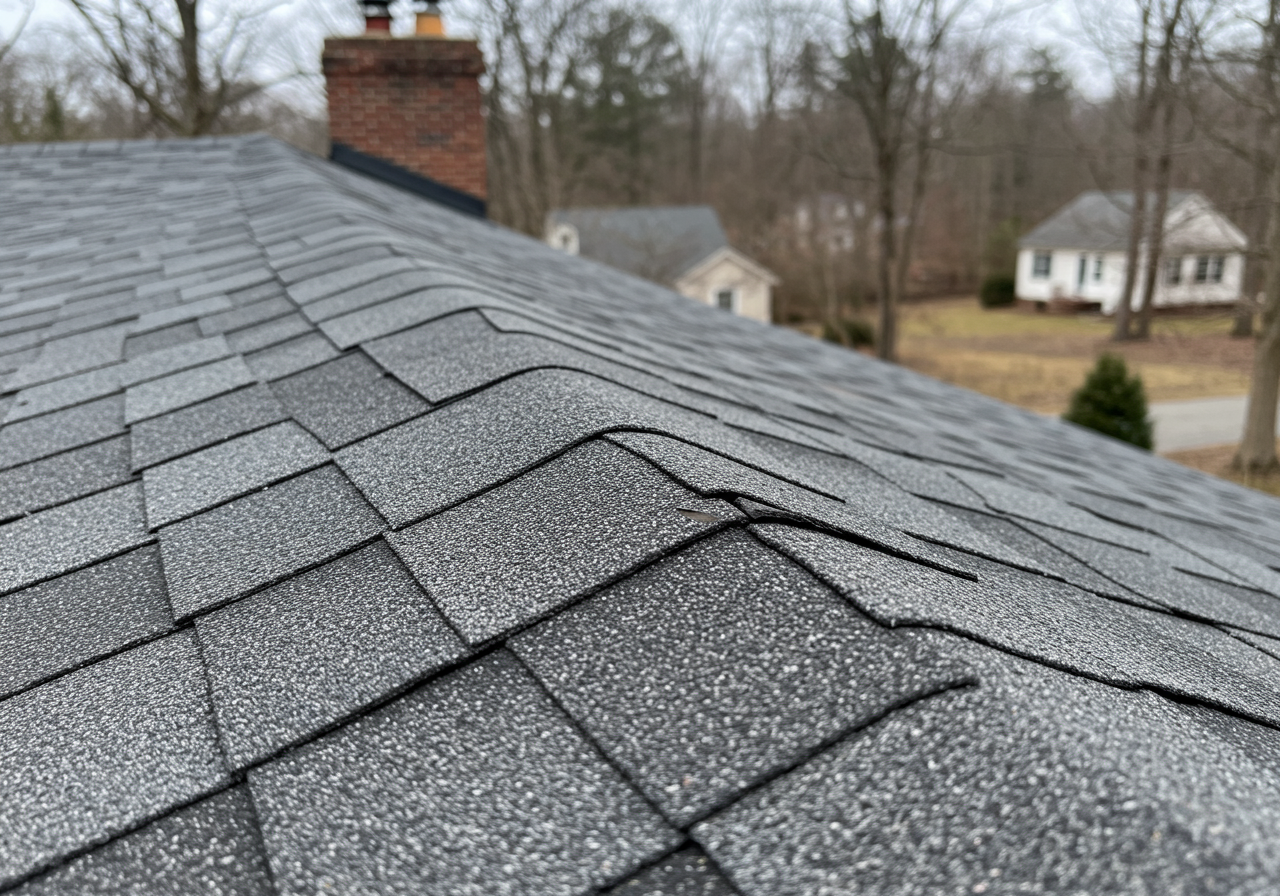
Hidden storm damage inspection on an Avon colonial roof
What to look for when assessing post-storm roof damage in Hartford County
Granule Loss: The "Check Engine Light" of Your Roof
After a storm, check your downspouts. If you see what looks like coarse coffee grounds piling up, your shingles are shedding their UV protection. Those granules are what protect the asphalt from the sun. Without them, the Hartford summer sun will bake your roof brittle in a single season.
Did You Know?
A single heavy hail event (even with small stones) can remove up to 22% of a shingle's protective granule layer. This effectively accelerates the aging of your roof by nearly five years in one afternoon.
Choosing Your Path: Repair vs. Replacement
When the damage is localized—say, a limb fell on one corner of your garage—a repair is the logical move. But the math changes when the damage is systemic across the whole slope. In Avon, our local housing stock varies from 1970s split-levels to modern builds, and the age of your roof dictates the "tipping point" for replacement.
I always tell people to look at the "seal integrity" across the entire roof. If 15% of your shingles have broken seals, the rest aren't far behind. Patching a roof that has lost its overall wind resistance is like putting a band-aid on a leaky dam.
Storm Damage: Patching vs. Full Replacement
Pros
- Lower immediate out-of-pocket cost
- Faster completion time (usually 1 day)
- Solves immediate leak issues
Cons
- New shingles won't match the weathered ones
- Patching doesn't reset the roof's overall lifespan
- May void existing manufacturer warranties
If you're staring at a leak right now, don't wait for the weekend. The trick is finding a contractor who actually shows up to tarp the area before the next front moves in.
Navigating the Avon Building Code Maze
We have strict rules here in Connecticut for a reason. The International Code Council (ICC) standards adopted by our state require specific deck preparation that many out-of-state "storm chaser" contractors skip. For instance, in our climate zone, the ice and water shield must extend at least 24 inches inside the interior wall line.
I've audited jobs in the Farmington Valley where the contractor only used a single 36-inch starter strip. When the next ice dam formed, the water backed up right into the homeowner's dining room.
Why Material Choice Matters in March
In March, the temperature swings are wild. You need a shingle that remains flexible. If a contractor tries to install a cheap 3-tab shingle when it's 38°F outside, those shingles are going to be brittle. They'll crack the moment the installer drives a nail through them. I prefer seeing architectural shingles installed this time of year—they have more mass and handle the "thermal shock" of Connecticut springs much better.
"The biggest mistake Avon homeowners make after a storm is signing a contract with the first guy who knocks on their door. Local weather patterns require local installation techniques—especially regarding ridge vent 'baffling' which prevents snow from blowing back into your attic."
The Insurance Reality: Vetting Your Professional
Dealing with insurance adjusters is a game of documentation. You don't just need a roofer; you need a biographer. They should be taking photos of the "bruised" asphalt and the lifted tabs.
Before you sign anything, verify your contractor's license and check their standing with the Better Business Bureau's roofing guide. Many "disaster specialists" pop up after a storm, collect a deposit, and vanish toward the next storm cell.
Visual Ground Inspection
Walk the perimeter with binoculars to check for creased or missing shingles.
Gutter Check
Inspect downspout exits for excessive granule accumulation.
Attic Observation
Check rafters for dark spots or damp insulation after the first post-storm rain.
Documentation
Take photos of any debris in the yard (limbs, shingles) before clearing it.
Professional Assessment
Get a detailed report that separates 'wear and tear' from 'storm impact'.
If you're worried about the cost of a full upgrade, remember that certain energy-efficient shingles might qualify for federal tax credits. You can find the specifics in the IRS instructions for Form 5695, which covers residential energy credits. It's a great way to offset the cost of a higher-quality material that can withstand the next big blow.
Planning for the Next Storm
We know another storm is coming; it's just a matter of when. Whether it's a late-season snow load or a spring thunderstorm, your roof is your first line of defense. If you've got a drip or a suspicious shingle, getting an expert eyes on it now is cheaper than a midnight emergency call.
FAQ
Final Thoughts on Avon Roof Resilience
Don't let the calm after a storm fool you. The "hidden" damage is what leads to the $15,000 mold remediation bills three years down the line. Take a walk around your property this weekend. Look for the granules, the creases, and the slightly lifted edges. If you see something, say something to a pro.
For those facing an immediate crisis—like a tree limb through the guest room—you'll want to look into emergency roofing services that can secure the structure before the next rain hits the valley. Stay dry, Avon.
Get Your Free Roof Quote
Enter your zip code to get started

About Noah Knight
Verified ExpertNoah Knight is a Connecticut Weather & Climate Specialist who helps homeowners understand how New England's unique weather patterns affect their roofing systems. He combines meteorological knowledge with practical home maintenance advice.