
Many homeowners in the historic heart of Chester believe that a roof replacement on an 1850s Federal-style home is fundamentally the same as a job on a 1990s colonial in Glastonbury. They assume the only variable is the price of the shingle. Here is the reality: that assumption often leads to a $22,400 "surprise" mid-project. When you pull back shingles on a home near the Chester-Hadlyme Ferry that hasn't seen a full deck replacement in sixty years, you aren't just looking at old wood; you're looking at a structural history that modern building codes weren't designed for. Contrary to what the "quick-quote" guys might tell you, you cannot simply nail modern architectural shingles over 150-year-old tongue-and-groove board without addressing the lateral stability of the entire system.
Key Takeaways
- Structural Decking: Most historic Chester homes require a full 're-deck' with CDX plywood to meet modern fastener withdrawal ratings.
- Material Compliance: Synthetic slate and cedar are gaining traction in Middlesex County as durable, code-compliant alternatives to high-maintenance natural wood.
- Flashings: Reusing old copper flashing is the #1 cause of 'new roof' leaks in older shoreline properties.
- Code Requirements: Connecticut's 2022 Building Code (based on the 2021 IBC) mandates specific ice and water shield coverage that many historic rafters can't support without reinforcement.
The Structural Reality of Chester's Colonial-Era Framing
When I'm walking a roofline on Main Street or near the Pattaconk Brook, the first thing I look for isn't the shingle—it's the sag. Historic Chester homes often utilize "true-size" rafters, which are significantly more robust than modern 2x8s but have often endured over a century of moisture cycles.
Timber Frames vs. Dimensional Lumber
In homes built before 1900, the rafters are often hand-hewn. These aren't perfectly straight lines. If a contractor tries to install a rigid metal roof or a heavy designer shingle without leveling the plane, you'll see every "wave" in the structure. I've seen projects where the aesthetic was ruined because the installer didn't account for the 3-inch variance across a 40-foot span.
Identifying "Spongy" Rafter Ends
Because Chester sits in the Middlesex Shoreline corridor, we deal with higher-than-average humidity. This often leads to "soft" rafter tails where the gutters meet the roofline. On a recent inspection of a Greek Revival, we found that 14% of the rafter ends needed "sistering"—bolting new lumber to the old—before we could even think about laying a drip edge.
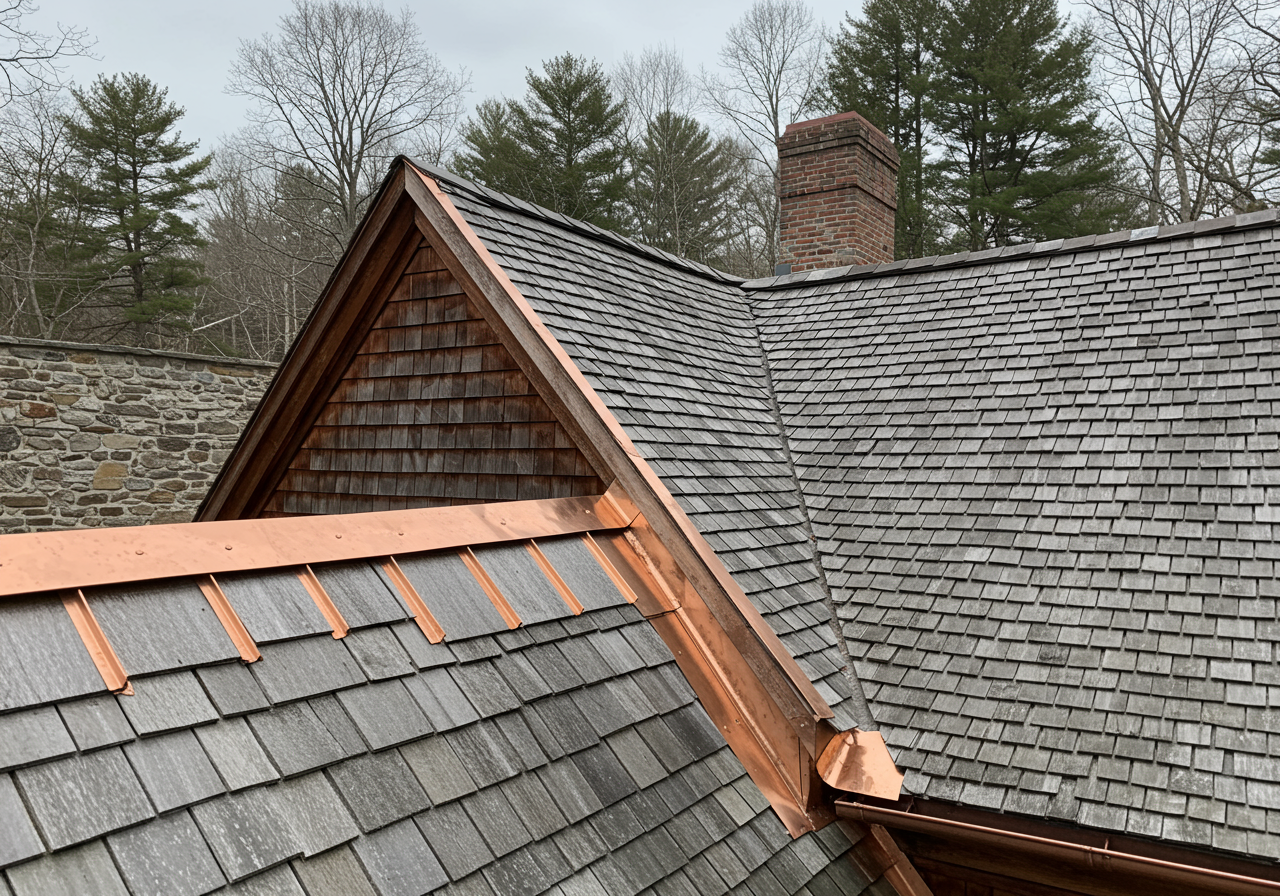
Historic Chester Roof Structural Challenges
Understanding the unique framing requirements for colonial-era homes in Middlesex County
Cedar Shake vs. Modern Synthetic: The Aesthetic and Legal Balance
Chester takes its architectural heritage seriously. While not every home falls under a strict historic district commission, maintaining the "shoreline character" is vital for property value. The choice between authentic cedar and synthetic alternatives is usually where the budget either stays on track or explodes.
Authentic Red Cedar
Pros
- 100% historically accurate, excellent natural insulation, 'silvering' patina is unmatched.
Cons
- Requires chemical treatment every 5-7 years, highly susceptible to moss in shaded Chester lots, 45% higher labor cost.
Synthetic Slate/Cedar (e.g., DaVinci or Brava)
Pros
- Class 4 impact rating, 50-year warranty, fire-resistant, mimics the look of 100-year-old materials.
Cons
- Higher initial material cost than asphalt, requires specialized contractors who understand historic joinery for proper installation.
Why Authentic Cedar Commands a Premium
The cost of #1 Grade Western Red Cedar has fluctuated wildly. In January 2026, we are seeing prices roughly 30% higher than pre-2020 levels. If you choose natural wood, you aren't just paying for the material; you're paying for the stainless steel ring-shank nails and the specialized breathable underlayment (like Cedar Breather) required to keep the wood from rotting from the underside. For synthetic materials, you'll need to work with contractors who understand historic joinery to ensure proper installation that maintains the aesthetic integrity of your Chester home.
The Hidden $6,500 Decking Problem
Here is a technical detail that gets missed in 3 out of 5 estimates I review. Most historic homes have "spaced sheathing"—1x6 boards with gaps between them—originally designed to let cedar shakes breathe. You cannot legally or safely nail modern asphalt shingles to these boards. Always reference the International Code Council standards to ensure your contractor is following proper installation guidelines.
Strip-to-Sheathing
Remove all existing layers (often 2 or 3) down to the original wood boards.
Gap Inspection
Measure the gaps. If they exceed 1/4 inch, you cannot nail shingles directly to them per International Code Council standards.
CDX Overlay
Install 7/16" or 5/8" CDX plywood over the entire surface to create a 'nailable' deck.
Fastener Verification
Use 2-inch coils to ensure the nail penetrates the new plywood and bites into the original board.
This process typically adds $5,500 to $8,200 to a standard Chester roof quote, depending on the square footage. If your contractor didn't mention this after looking in your attic, they are planning a "change order" the moment your roof is half-naked.
The 'Change Order' Trap
Flashing and Leadwork: The "Forgotten" 12% of Your Quote
I have a folder of photos from Chester homes where a $30,000 roof failed because of a $200 piece of flashing. On historic masonry, like the chimneys found on stone-foundation colonials, the flashing needs to be "regletted"—cut into the mortar—rather than just caulked to the surface.
"In Chester, we see a lot of 'dead valleys' where two roof planes meet a vertical wall. If you aren't using 16-ounce copper or a high-grade lead-coated copper in these transition zones, the salt air from the shoreline will eat through standard aluminum in less than 15 years."
Chimney Re-Pointing: The Essential Pre-Roof Step
Before you verify a contractor's credential, ask them if they inspect the chimney mortar. If the bricks are loose, installing new flashing is like putting a Band-Aid on a broken leg. I always recommend having a mason address the top three courses of brick before the roofers arrive. This prevents falling debris from damaging your brand-new shingles.
Ventilation Nightmares in Uninsulated Attic Spaces
Many of the older homes near the Chester center were built to "breathe" through every crack and crevice. When we suddenly seal them up with modern underlayments and "air-tight" shingles, we trap moisture. This is why you see urgent leak mitigation calls in January when "attic rain"—condensation dripping from the rafters—starts.
Did You Know?
Did you know that 85% of ice dams in Connecticut are caused by poor attic ventilation rather than just cold weather? In historic homes, the lack of 'soffit vents' means we often have to use specialized 'SmartVents' or 'Deck-Air' systems to pull cool air in at the gutter line.
Ridge Vents on Steep Gables
If your home has a pitch steeper than 10/12 (common in Victorian and Gothic styles), a standard ridge vent might not be enough. We often have to calculate the "Net Free Ventilating Area" to ensure your attic doesn't reach 130°F in the summer, which can cook your shingles from the inside out, shortening a 30-year warranty to a 12-year reality.
Navigating Chester's Local Codes and Contractor Vetting
Chester is a small town, and word travels fast. However, I still see homeowners getting burned by out-of-state "storm chasers" who don't understand the Middlesex County building department's specific quirks. Always check the Better Business Bureau's roofing guidelines before signing a contract that seems too good to be true.
The "Historic District" Tax Credit Myth
I often get asked if there are state grants for roofing historic homes. While the Connecticut State Historic Preservation Office (SHPO) offers some tax credits, they are almost exclusively for "income-producing" properties or very specific landmarked structures. For most Chester residential owners, the "credit" is simply the massive jump in resale value that comes with a documented, high-spec roof replacement.
Don't just take my word for the complexity involved; see what other CT homeowners experienced when they tried to balance historic aesthetics with modern budgets. The goal isn't just to keep the rain out—it's to ensure the structure survives another century.
Get Your Free Roof Quote
Enter your zip code to get started