
Key Takeaways
- Historic homes need structural assessments before installing heavy materials—authentic Vermont slate can add 12,000 pounds your old rafters weren't designed for.
- Synthetic composites that mimic slate or cedar can cut weight by 70% and save thousands in structural shoring costs.
- Cheshire Historic District Commission approval takes 30–60 days; get your COA and material list before signing any contract.
- Line-item transparency matters: if flashing or 'miscellaneous' isn't measured in linear feet, squares, or hours, it's a guess that favors the contractor.
Two years ago, I sat down with a couple on Academy Road who were staring at a $31,000 estimate for a "historically accurate" roof replacement on their 1880s Victorian. The contractor had quoted them for authentic Vermont slate without mentioning that their original rafters—narrow, true-cut timber from the late 19th century—would likely buckle under that 12,000-pound load. They were one week away from signing a contract that would have potentially compromised their home's structural integrity. We pivoted them to a high-end synthetic composite that mimicked the aesthetic but weighed 70% less, saving them nearly $9,400 in structural shoring costs. In Cheshire, "historic" doesn't have to mean "bankrupting," but it does require you to be the smartest person in the room during the bidding process.
The Structural "Weight Trap" in New Haven County Heritage Homes
The biggest mistake I see homeowners in the Cheshire Historic District make is assuming an old house can handle modern "upgrades" without a fight. If your home was built before 1920, those rafters weren't designed for three layers of asphalt or heavy stone slate. I've walked through attics near the Town Green where the ridge beam was visibly sagging because a previous owner took the "easy" route and roofed over old wood shingles.
Before you even look at a shingle sample, you need to see a line item for a structural assessment. If a contractor tells you "it looks fine from the ground," show them the door. A real pro will get in the crawl space and check for "sistering" needs—essentially reinforcing those old bones. This typically adds about $2,100 to $4,500 to a project, but it prevents a $20,000 structural failure down the road. I also tell people to verify their contractor's license specifically for historic work; you want someone who understands how old wood breathes, not just someone who can swing a nail gun.
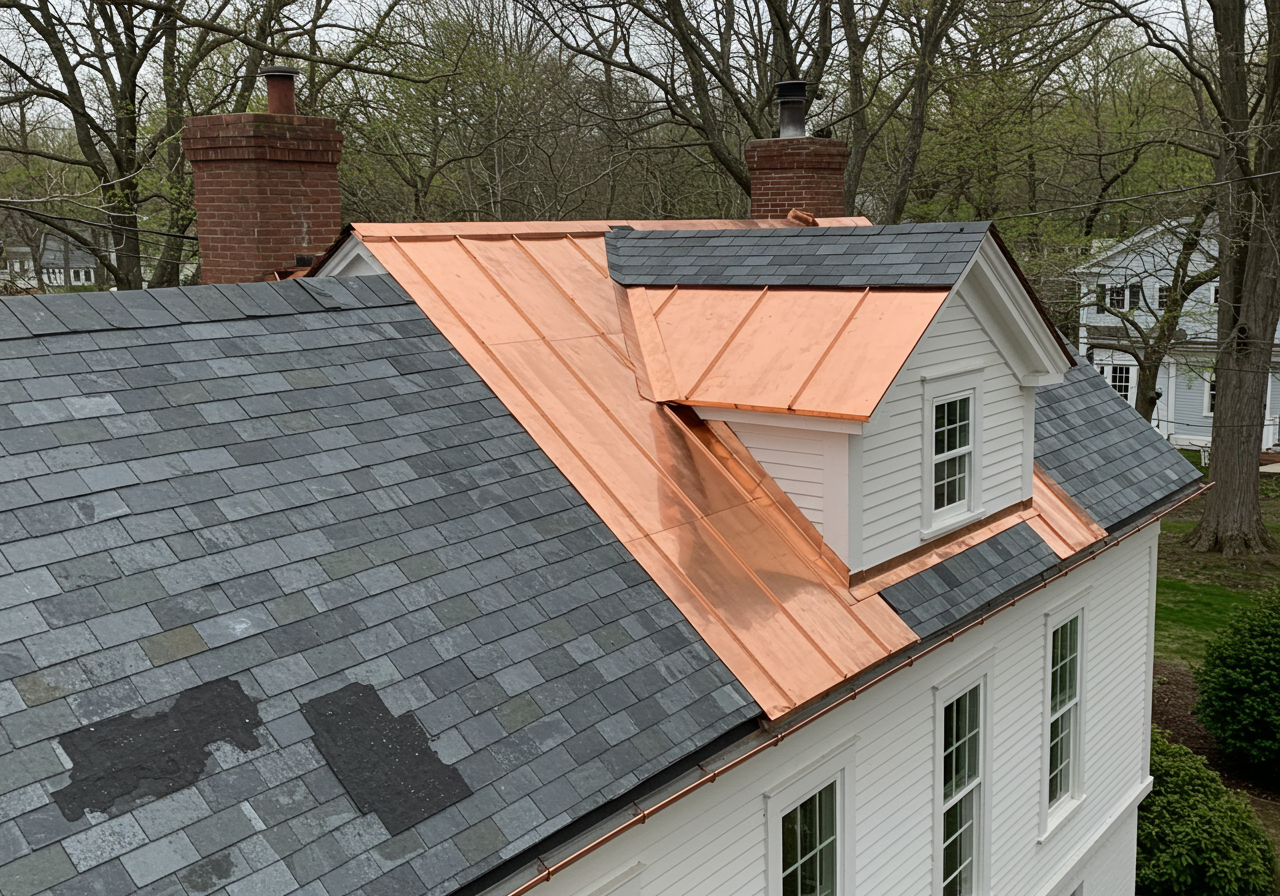
Historic Cheshire roof with period-appropriate materials
A well-maintained heritage home showing proper roof construction in the historic district
Navigating the Cheshire Historic District Commission and Costs
If your home is one of the 200+ properties in our local historic districts, you aren't just answering to your wallet—you're answering to the Commission. I've seen homeowners get hit with "stop-work" orders because they chose a shingle color that wasn't on the approved palette. March is the perfect time to start this paperwork because the approval process can take 30 to 60 days.
Don't let a contractor "ballpark" the price of historic compliance. Ask for the "COA" (Certificate of Appropriateness) assistance to be written into the contract. Authentic cedar shakes in Connecticut are currently hovering around $18.50 to $22.00 per square foot installed, while high-quality synthetics are closer to $13.00. If you're looking at a flat roof addition—common on those sprawling New Haven County colonials—make sure your team follows the FEMA guidelines for low-slope protection to handle our specific snow-load patterns.
Material Lifespan in CT Climate
The "Show Me the Math" Approach to Historic Materials
I'm a stickler for line-item transparency. When you get a quote for a historic home, the "miscellaneous" or "flashing" line is where contractors hide their profit margins. Copper flashing is the gold standard for Cheshire's older homes, but it's expensive. I recently saw a quote where the contractor charged $4,800 for "custom metal work" without specifying the linear footage or the gauge of the copper.
Here is my Golden Rule: If it isn't measured in a standard unit (linear feet, squares, or hours), it's a guess. And guesses always favor the house, not you. You should also check for any available federal grants for historic preservation if your home is on the National Register. While these are competitive, they can sometimes offset the 20% "historic premium" that local contractors often bake into their bids.
The Dana Jackson 'BS Meter' for Historic Bids
Negotiating the Best Value Without Cutting Corners
You want a roof that lasts another 50 years, not just one that looks good for the next two. When comparing bids, look at the safety standards. A crew working on a steep-pitched Victorian without proper harnesses isn't "saving you money"—they're a massive liability. I always recommend that homeowners review the OSHA standards for residential fall protection so they know what a professional setup actually looks like. If they aren't tied off, they aren't pros.
Once you have three comparable bids, don't just pick the middle one. Look at the "trash and debris" line. On a historic home, you're often stripping off old cedar AND asphalt. That's double the weight and double the disposal fee. If one guy is $2,000 cheaper but hasn't accounted for the "tear-off" of two layers, you'll get a "change order" mid-project that eats your savings. Don't just take my word for it— see what other CT homeowners experienced when dealing with these types of mid-project surprises.
Check Historic District status and approved material list
Verify your property's designation and obtain the Commission's approved material list before soliciting bids.
Commission a structural load-bearing assessment of your attic
Hire a qualified professional to evaluate whether your rafters can support your chosen roofing material.
Get three line-item bids specifying material weight and copper gauge
Ensure every cost is measured in standard units—linear feet, squares, or hours.
Submit COA application to the Cheshire Historic District Commission
Start this process early; approval can take 30 to 60 days.
Verify insurance and OSHA compliance before the first shingle is pulled
A crew working without harnesses on a steep-pitched historic roof is a liability, not a savings.
"An old house is a living document. Don't let a sloppy roofing contract scribble all over its history just to save a few bucks on the front end."
Get Your Free Roof Quote
Enter your zip code to get started
In the end, protecting a piece of Cheshire's history is about more than curb appeal—it's about protecting your biggest financial asset. If you do the math now, you won't be paying for it later. For more deep dives into Connecticut-specific roofing issues, our blog library has detailed breakdowns on everything from ice dam prevention to the latest tax credit updates.