
Key Takeaways
- 42% of storm-damaged roofs in Killingworth show no visible holes yet harbor structural fractures.
- Immediate assessment and repair costs $1,850-$3,200, but neglect can lead to $14,250+ in damage.
- Professional assessments ensure proper shingle matching and code compliance for Killingworth's unique climate.
- Documentation from a qualified roofer is essential for insurance claims and protecting resale value.
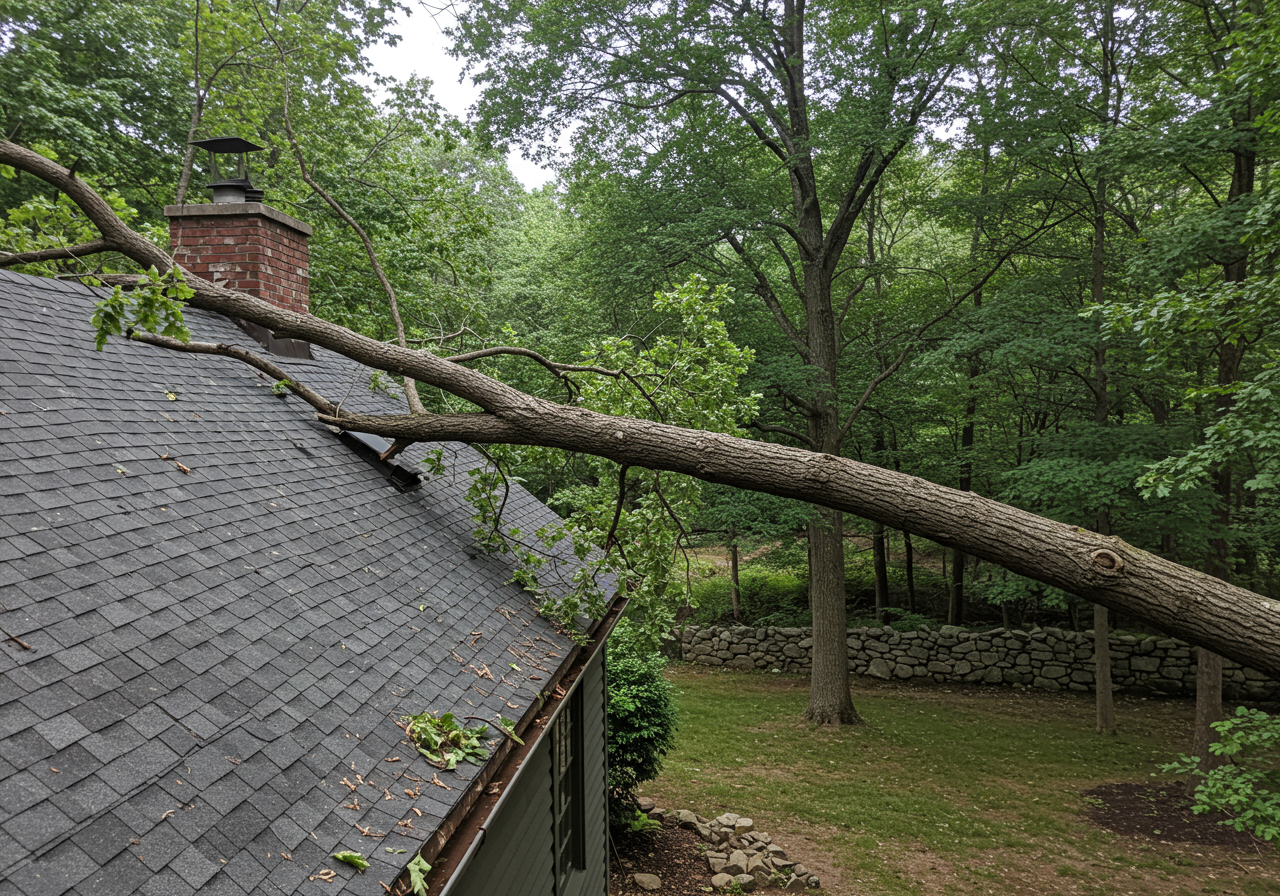
Did you know that 42% of storm-damaged roofs in Killingworth show absolutely no visible holes from the ground, yet they harbor structural fractures that fail two winters later? It's a staggering figure that I often share with neighbors when they see a rogue oak limb resting on their shingles after a heavy wind. Most of us look up, see the shingles are still mostly there, and think we dodged a bullet. But in my years of looking at how homes "meet the sky," I've learned that the impact of a tree is less like a puncture and more like a concussion. The house looks fine on the outside, but the "brain"—the rafters and ridge beams—might be reeling.
Living in Killingworth means living in the woods. Whether you're tucked away near Chatfield Hollow or have a view of the reservoir, those beautiful, towering canopies are also a liability when March winds start howling through Middlesex County. I remember a friend near Roast Meat Hill Road who had a "glancing blow" from a maple branch. She didn't call for a pro because nothing was leaking. Fast forward fourteen months, and her entire master bedroom ceiling started to sag. The impact had microscopic-ally cracked the seal on her chimney flashing, and slow-motion rot had been invited to dinner. That's why we need to talk about why a formal assessment isn't just about "fixing a hole"—it's about protecting your biggest investment.
1. The Hidden Structural "Concussion" from Heavy Limbs
When a tree hits a roof, the weight isn't the only problem; it's the kinetic energy. Think about the massive oaks we have here in Connecticut. A limb that looks "small" from the ground can weigh 400 pounds. When that drops 15 feet onto your roof, it sends a vibration through the entire frame of the house. I've seen cases where a tree hit the front of a Cape-style home, but the drywall cracked in the back of the house because the energy traveled through the rafters.
A professional assessment looks for these "silent" failures. They aren't just looking at the black granules on your shingles; they are checking the "line" of your roof. Is the ridge still perfectly straight? Are the collar ties in the attic still snug? I once walked through an attic with a homeowner near Route 81 who was convinced her roof was fine. When we looked at the rafters directly under the impact site, we saw a hairline split in the wood. It hadn't snapped yet, but the next heavy snow load would have finished the job.
The Ground-Level Trap
Getting a professional pair of eyes on the situation is the only way to be sure. If you're worried about the cost of just having someone come out, remember that finding a contractor who actually shows up for a dedicated inspection is the first step to avoiding a $20,000 structural failure down the road. It's about peace of mind, sure, but it's also about cold, hard math.
2. The $14,250 Difference Between Repair and Neglect
Let's talk numbers, because that's usually where the stress starts. In Killingworth, the average cost to professionally patch and reinforce a limb-strike area is roughly $1,850 to $3,200, depending on the height and pitch. However, if that damage is ignored and water starts seeping into the roof deck, that number skyrockets. I've seen neglected "minor" hits turn into $14,250 full-deck replacements within three years.
Why is the jump so big? It's the plywood. Once the wood under your shingles gets wet, it loses its structural integrity. You can't just nail new shingles onto mushy wood. According to the International Code Council (ICC) digital building codes, roof decks must provide a solid base for fasteners. If a pro assesses the damage early, they can replace a 4x8 sheet of plywood and some shingles. If you wait, the moisture spreads like a localized infection, rot sets in, and suddenly you're stripping the whole side of the house.
Long-Term Cost of Impact Neglect (3-Year Projection)
I always tell people: your insurance company actually prefers the smaller bill. But they also have "limitations of Discovery." If you wait two years to report that a tree hit your house, they might argue the damage was due to "lack of maintenance" rather than the storm. A formal assessment provides the paper trail you need to prove the date of loss. If the damage is extensive, you'll want to get a quote from a vetted contractor immediately to ensure the numbers you give your adjuster are based in reality, not just a "guesstimate."
3. Maintaining the Killingworth Aesthetic and Curb Appeal
We live in a town that values its looks. Whether you have a historic farmhouse or a modern colonial, your roof is about 40% of what people see when they pull into your driveway. A tree hit often results in a "patch" that looks like a sore thumb. I've driven past so many homes in Middlesex County where the homeowner clearly went to a big-box store, grabbed "black" shingles, and slapped them on a "charcoal" roof. From the street, it looks like a checkerboard.
Precision Shingle Matching
A professional assessment doesn't just look for holes; it identifies the exact shingle manufacturer and dye lot to ensure a seamless repair that preserves your home's design integrity.
A professional assessment includes a "material match." Shingles fade over time. A 10-year-old shingle in the Killingworth sun won't match a brand-new one out of the bundle, even if it's the same brand. Pros know how to "blend" the repair or, in some cases, advocate for a full slope replacement through insurance so the colors remain consistent. This is a design choice as much as a functional one. If you ever plan to sell your home, a patchy roof is the first thing a buyer's inspector will flag. It screams "temporary fix," and that can shave $10,000 off your asking price instantly.
I once worked with a couple near Deer Lake who were devastated because a limb took out a chunk of their rare cedar shake roof. They thought they'd have to replace the whole thing. A specialist assessed it and found a way to "weather" the new shakes so they blended within a single season. That's the kind of expertise you're paying for—the ability to keep your home looking like a cohesive piece of architecture rather than a collection of repairs.
4. Codes, Compliance, and the Shoreline Factor
Killingworth sits in a specific zone where we get the worst of both worlds: heavy inland snow and the gusting winds of the Long Island Sound. Because of this, our building codes are tighter than they are in, say, central Hartford. When a tree impacts your roof, you aren't just repairing shingles; you're often triggering a requirement to bring that section of the roof up to current code.
For instance, if the impact damaged the "ice and water shield" (that sticky membrane under the shingles), you can't just patch over it. You have to ensure it extends the proper distance up the roof to meet local Middlesex County standards. A pro will know if your roof deck needs the extra "beefing up" that the ICC building codes demand for high-wind areas.
The 25% Rule
Furthermore, if you are forced into a larger repair, this is actually an opportunity to improve your home's energy profile. I often suggest that homeowners look into reflective "cool" shingles during a repair. According to the Energy Star Cool Roofs guide, these materials can significantly reduce attic temperatures in those humid Connecticut summers. And here's a tip I gave a neighbor last month: if you upgrade to specific energy-efficient materials during your repair, you might be eligible for federal tax credits. You can find the specific requirements in the IRS instructions for Form 5695. It's a way to turn a "bad luck" tree strike into a long-term financial win.
5. Your Post-Storm Action Plan: Beyond the Chainsaw
When the tree finally stops moving, the first instinct is to call someone with a chainsaw. That's fine for the driveway, but don't let a "tree guy" tell you the roof is okay. They are experts in wood, not waterproofing. Your roof needs a different kind of specialist.
I've put together a quick sequence for what to do when you're standing in your yard, looking at a branch that shouldn't be there. This is the exact advice I'd give if we were chatting over coffee at the Killingworth True Value. If you need immediate help, make sure you're connecting with an urgent storm response team that can stabilize the situation quickly.
Safety First
Ensure no power lines are involved and the tree is stable before approaching.
Photo Documentation
Take 'wide' shots of the whole tree and 'tight' shots of where it meets the shingles.
Emergency Tarping
If there is a visible hole, call for an urgent storm response team to prevent interior water damage.
Structural Assessment
Have a roofing pro check the attic rafters for stress fractures or 'popped' nails.
Insurance Sync
Compare the professional roof estimate with your adjuster's report to ensure all structural needs are covered.
The most important part of this process is the "documentation" phase. I once saw a homeowner lose out on a $12,000 claim because they removed the tree and "cleaned up" the roof before the insurance company saw the extent of the impact. The assessment report from a qualified roofer acts as your expert witness. It says, "The impact was here, the stress traveled to there, and this is why we need to fix it this way."
If you find yourself in an emergency situation where the rain is coming in right now, you don't have time to wait for a three-week scheduling window. You need to know you're finding a contractor who actually answers the phone and can get a crew out to stabilize the situation. In Killingworth, the wind can shift in an hour, and a small leak can become a flood before you find your bucket.
The bottom line is that we choose to live in Killingworth because we love the trees. We love the privacy they give us and the way they turn gold in October. But part of that relationship is acknowledging that trees and roofs are natural enemies. A fallen limb isn't just a chore; it's a test of your home's structural health. By getting a professional assessment, you aren't being "overly cautious"—you're being a smart homeowner who knows that the most expensive damage is the kind you can't see from the ground.
Don't let a 'minor' limb strike turn into a major structural headache
Get an instant, accurate estimate for your Killingworth roof repair today.
No credit card required • Free to use
Get Your Free Roof Quote
Enter your zip code to get started