
Key Takeaways
- Flashing leaks account for nearly 90% of all chimney-related water intrusion issues in Middlesex County.
- Copper remains the gold standard for Essex homes due to its 50-year lifespan and beautiful patina.
- Modern lead-free alternatives offer safer, flexible options for complex masonry joints.
- Professional counter-flashing is the only way to ensure a watertight seal against New England storms.
April in Essex usually means the Griswold Inn is bustling and the Connecticut River is looking a bit restless as spring rains settle in. It's that time of year when we start noticing the little things that winter gifted our homes. Last week, while walking near the waterfront, I noticed a stunning Federal-style home with a telltale dark streak running down the masonry of its chimney. That's the heartbreak of flashing failure—it's a small piece of metal that can cause a massive headache for our historic Shoreline properties. If you've spotted a water stain on the ceiling near your hearth, you aren't just looking at a plumbing problem; you're looking at a breakdown in the most vulnerable transition on your roof.
Why Chimney Flashing Fails in Shoreline Homes
Living so close to the Sound means our homes deal with a unique cocktail of salt air and intense humidity. While a roof might last 25 years, the flashing often gives up the ghost much sooner. The primary culprit? Simple physics. Your chimney and your roof deck are two different structures that move independently. As the house settles and the temperature fluctuates, the gap between them grows and shrinks.
I've seen too many Essex homeowners try to solve this with a bucket of roofing cement. (Please, don't be that person!) Slathering goop over a leak is like putting a Band-Aid on a broken leg—it might look covered, but the underlying issue is still there. In our area, the salt in the air can actually accelerate the corrosion of cheaper galvanized steel flashings, leading to pinhole leaks that you won't even notice until the drywall starts crumbling in the living room.
The Impact of Connecticut Weather Cycles
Our freeze-thaw cycles in late winter are particularly brutal on chimney transitions. Water gets behind the metal, freezes, and slowly pries the flashing away from the brick. By the time April showers arrive, the path is wide open for water to take the elevator straight down into your attic.
Material Alternatives: Lead, Copper, and Beyond
When we talk about alternatives in Essex, we're usually balancing the historic aesthetic of the village with modern performance. For decades, lead was the go-to because it's incredibly soft and easy to mold around irregular bricks. But, for obvious environmental and health reasons, many of us are looking for better ways to protect our homes.
Copper is my personal favorite for any home near Main Street or out in Ivoryton. It starts with that bright penny shine but eventually settles into a stately verdigris that looks like it's been there since the 1800s. If copper is outside the budget, high-grade aluminum or lead-free flexible flashings are excellent contenders. These modern synthetics use an EPDM or butyl base with a metal mesh, allowing them to stretch and contour without the toxicity of old-school materials.
The Case for Copper Flashing
Pros
- Exceptional longevity (50+ years)
- Stunning curb appeal for historic homes
- Naturally corrosion-resistant
Cons
- Highest upfront material cost
- Requires specialized soldering skills
- Can be a target for metal theft during construction
Why Aluminum is a Practical Shoreline Choice
But what if you have a more contemporary home? Anodized aluminum is a workhorse. It doesn't rust, comes in colors that can match your shingles perfectly, and provides a clean, minimalist line where the roof meets the sky.
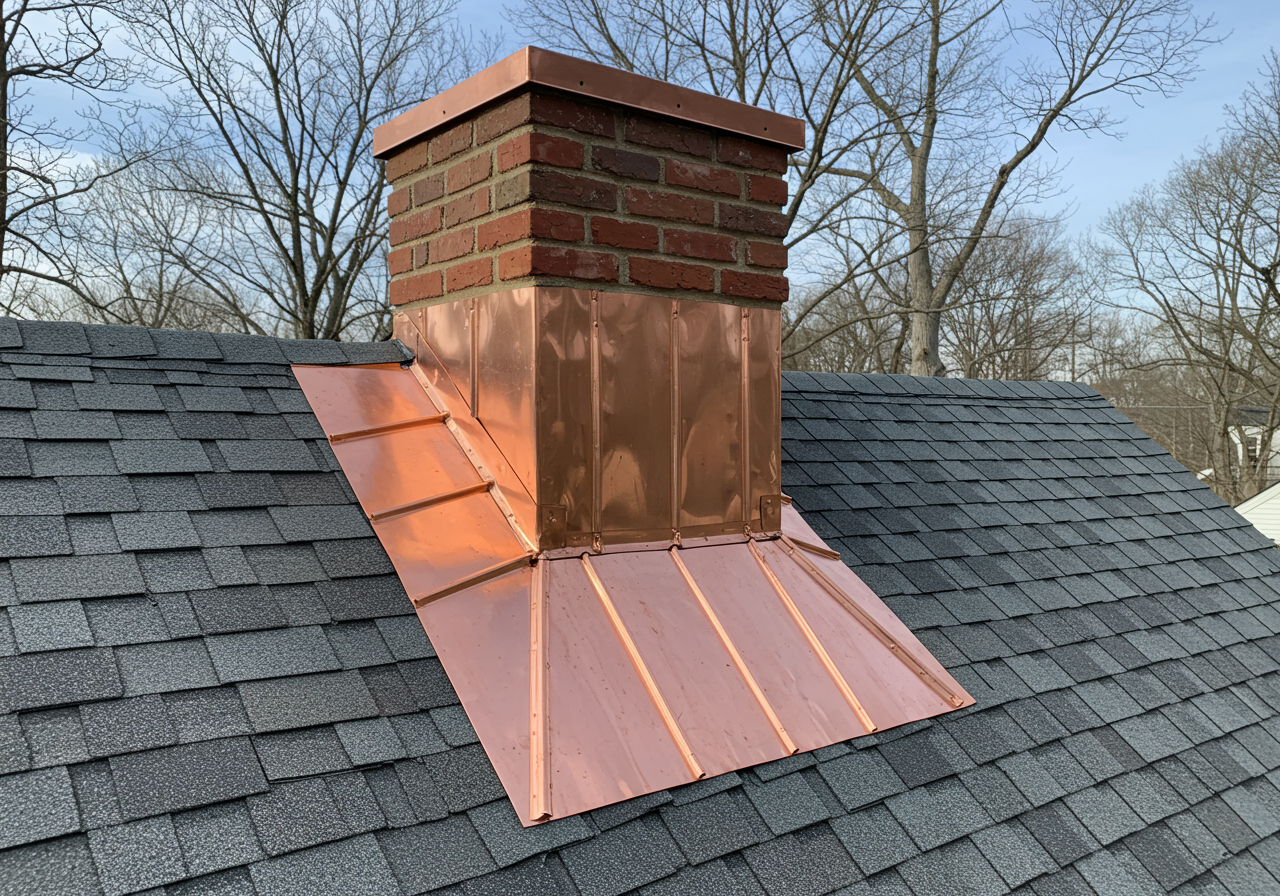
Chimney Flashing on an Essex Home
Proper flashing at the roof-to-chimney transition protects Shoreline masonry from spring rains and salt air.
The Counter-Flashing Secret to Longevity
If you want your chimney to stay dry for the next two decades, you need to understand the two-part system. Most leaks happen because a contractor took a shortcut and only installed step flashing (the pieces that go under the shingles). In Essex, where the wind can whip up off the water, that's just not enough.
True protection requires counter-flashing. This is where a professional mason or roofer cuts a groove (a reglet) directly into the mortar joint of your chimney. The metal is tucked into that groove and then folded down over the step flashing. It creates a shingle-like effect on your wall. It's a bit more labor-intensive, but it's the difference between a dry house and a damp one. I always tell my neighbors to read what other Shoreline homeowners experienced when they invested in proper masonry integration versus a quick fix.
Grinding vs. Surface Mounting
Some crews will try to just caulk a piece of metal to the side of the brick. In our climate, that caulk will crack within three years. Demand that the flashing be let into the mortar. It's the professional standard that keeps the water out even when the rain is blowing sideways.
Did You Know?
Did you know that "Step Flashing" gets its name because the individual pieces of metal overlap each other like a staircase? This ensures that water is always directed onto the surface of the next shingle rather than underneath it.
When to Repair vs. When to Replace
I often get asked, "Sheri, can't we just caulk it one more time?" The reality is that once the metal has started to lift or corrode, you're on borrowed time. If your shingles are relatively new (less than 10 years old), a surgical repair of the flashing is a smart investment. However, if your roof is nearing the end of its life, it's almost always better to do the flashing and the shingles together.
Why? Because to replace flashing correctly, you have to tear up the surrounding shingles. Doing it twice is just throwing money into the River. According to FEMA's residential roof protection guidelines, ensuring proper flashing integration during a full replacement is the most cost-effective way to prevent storm damage.
Average Lifespan of Flashing Materials
Choosing Materials That Match Essex Architecture
Design matters. A bright silver flashing job on a weathered cedar shake roof or a deep brown architectural shingle looks—well, it looks like a mistake. In Essex, we care about the visual conversation our homes have with the street.
If you have a historic brick chimney, copper is the natural partner. If you have a stone chimney (common in the wooded parts of Middlesex County), you might want a lead-free flexible flashing that can hug the irregular nooks and crannies of the stone. For those with white-painted chimneys, a white-coated aluminum provides a seamless look that doesn't break the vertical line of the house.
I remember helping a friend in the village who was worried that new flashing would look too industrial. We chose a bronze-toned aluminum that vanished against her brickwork. It's those little design choices that keep Essex looking like the Best Small Town in America.
Why Professional Installation is Non-Negotiable
This is not a weekend DIY project. Chimney work involves heights, steep pitches, and specialized tools like grinders and metal brakes. Safety is the biggest factor here. According to OSHA guidance on residential fall protection, work on a roof requires specific fall protection that most homeowners simply don't have in the garage.
Beyond safety, there's the water-tightness factor. A pro knows exactly how to dog-ear the corners—a specific way of folding the metal so there isn't a single hole for water to enter. If you're looking for someone who knows the local building codes, I always suggest you confirm license and insurance with a verified contractor before they ever set foot on a ladder.
Inspection
Check for water stains in the attic and crumbling mortar on the chimney.
Material Selection
Choose between copper, aluminum, or synthetic based on budget and style.
Removal
Carefully strip back shingles and old metal to expose the roof deck.
Step Flashing
Install individual metal L pieces integrated with each shingle course.
Counter-Flashing
Cut a reglet into the mortar and tuck the secondary metal layer in.
Sealant
Apply high-grade polyurethane sealant to the mortar joints for a final barrier.
Stop chimney leaks before they ruin ceilings and trim
Get matched with Essex-area pros who know counter-flashing and Shoreline weather.
No credit card required • Free to use
Getting the Numbers Right
Don't let a contractor give you a handshake price on a chimney leak. There are too many variables. Make sure your quote includes the cost of any masonry repointing that might be needed. If the project feels financially overwhelming, remember that federal home repair assistance programs exist for critical structural repairs, especially for historic preservation.
If you're tired of worrying every time the clouds turn gray, it might be time for a professional look. You can explore more Shoreline roofing and maintenance guides in our library, or better yet, get a clear picture of what your specific project might cost below.
Get Your Free Roof Quote
Enter your zip code to get started