Key Takeaways
- Synthetic composites handle the 22°F freeze-thaw cycles in Waterford without the cracking common in traditional asphalt.
- While the initial investment is higher, the 50-year lifespan often offsets the cost of two traditional roof replacements.
- Local wind loads near Niantic Bay require Class 4 impact-rated materials to withstand 110+ mph gusts.
- Federal tax credits under Form 5695 can recover a portion of costs for energy-efficient synthetic upgrades.
Right now, the mercury is sitting at a crisp 22°F here in Waterford, and if you step outside toward Mago Point, that 11 mph wind coming off the water feels a lot sharper than the numbers suggest. It's exactly this kind of January morning that makes me think about what's happening to the shingles over our heads. While we're inside cranking the heat, the materials protecting us are expanding and contracting in a violent, microscopic tug-of-war.
I was walking the dog near the Duck Pond yesterday and noticed three different houses with "shingle blow-off"—those telltale dark patches where the wind finally won. Most people think roofs fail during the big 60 mph nor'easters, but the truth is often more subtle. It's the 22°F nights followed by a 40°F sunny afternoon that turn standard asphalt brittle. This is where the conversation about synthetic roofing—composite slate, rubber mimics, and polymer resins—stops being "fancy" and starts being practical for New London County.
The Brittle Point: Why Waterford Winters Break Traditional Roofs
The biggest problem we face in Southeast CT isn't just the cold; it's the humidity trapped under the freeze. With humidity at 42% today, we're seeing a relatively dry cold, but as soon as the sun hits those dark shingles, the frost turns to moisture, seeps into the asphalt granules, and then refreezes tonight at 22°F. This "heaving" effect is what separates the aggregate from the shingle mat. I've seen 12-year-old roofs in the Quaker Hill area that look like they've been through a war zone simply because the asphalt couldn't handle the thermal shock.
Synthetic materials, usually made from a mix of recycled rubbers and specialized plastics (polymers), don't have this granular structure. They are "dimensionally stable." That's a fancy way of saying they don't grow and shrink nearly as much as the organic materials found in cheaper shingles. When the temperature swings, the synthetic material flexes. Asphalt, once it hits its "glass transition temperature," just snaps.
I remember a project back in 2019 where a homeowner near the high school was tired of finding "shingle crumbs" in their gutters every spring. We looked at their data from the previous three winters and realized their roof was literally shedding its protective layer every time we had a January thaw. If you're tired of seeing your investment wash down the downspout, upgrading to a more resilient composite system is often the only way to break the cycle of constant repairs.
The Coastal Wind Factor and the Niantic Bay Breeze
Waterford homeowners have a unique challenge: the wind. Today's 11 mph breeze is a whisper, but we all know what happens when a low-pressure system crawls up the coast. The NWS Historical Storm Events Database shows that New London County gets hit with "non-thunderstorm wind events" frequently enough to make standard shingle warranties look like a joke.
Most synthetic roofing products are rated for 130 mph winds right out of the box. Because they are often installed with specialized interlocking tabs or heavier-duty fasteners, they don't "lift" the way a traditional 3-tab shingle does. I've personally stood on a roof in the middle of a gale (not recommended, by the way) and watched how wind curls over the peak. Standard shingles act like little sails. Synthetic slate and shakes, because of their density and molded edges, tend to let the wind slip past.
But here's the thing: the material is only half the battle. If your contractor isn't using the right nail pattern for coastal zones, even the best synthetic slate will end up in your neighbor's yard. I always tell people to check the OSHA guidelines for residential fall protection when they see a crew on their roof. If the crew isn't taking safety and proper attachment seriously, they're probably cutting corners on the "high wind" nailing patterns required for our area.
Comparing the Dollars: Is the Synthetic Premium Justified?
Let's talk about the elephant in the room: the price tag. I'm not going to sit here and tell you that synthetic roofing is cheap. It's not. If a standard architectural shingle roof costs you $11,400, a synthetic composite might run you $22,800 or more. It's a significant jump. But you have to look at the math over a 30-year horizon.
In Waterford, a standard roof usually gives up the ghost around year 17 or 18 due to the salt air and the freeze-thaw cycles we discussed. That means in 35 years, you're buying two roofs. With synthetic, you buy one. And you don't pay for the intermediate repairs that plague older asphalt roofs.
Synthetic vs. Traditional Asphalt in CT
| Feature | Standard Asphalt | Synthetic Composite |
|---|---|---|
| 45-60 Year Lifespan | ||
| 110-130+ MPH Wind Rating | ||
| High Algae Resistance | ||
| Class 4 Impact Rating (Highest) |
I recently helped a family near Pleasure Beach run these numbers. They were looking at a $19,250 quote for synthetic slate. When they realized it would likely be the last roof they ever bought, the "cost per year" dropped from $633 (for asphalt) to about $385 for the synthetic. If you want to see how these numbers shake out for your specific square footage, using a local cost estimator can give you a much clearer picture than a generic national average.
The Secret Advantage: Energy Efficiency and Tax Credits
One thing most Waterford contractors won't mention (because they're focused on the shingles, not the science) is the thermal performance. Synthetic materials are often more "reflective" than asphalt, even in darker colors. This means during those humid August days in CT, your attic isn't acting like a 140°F oven.
More importantly, there's the federal side of things. If you choose a synthetic product that is specifically rated for energy efficiency, you might be eligible for the Energy Efficient Home Improvement Credit. According to the IRS Instructions for Form 5695, certain "metal roofs with appropriate pigmented coatings" and "asphalt roofs with appropriate cooling granules" qualify, but many modern synthetic composites also meet these high-bar standards for heat reduction.
Always ask your contractor for the 'Manufacturer's Certification Statement'
I've seen homeowners claw back up to $1,200 or more on their tax liability just by choosing the right material. When you factor in the lower cooling bills during our humid July months, the synthetic option starts looking like a financial hedge rather than a luxury.
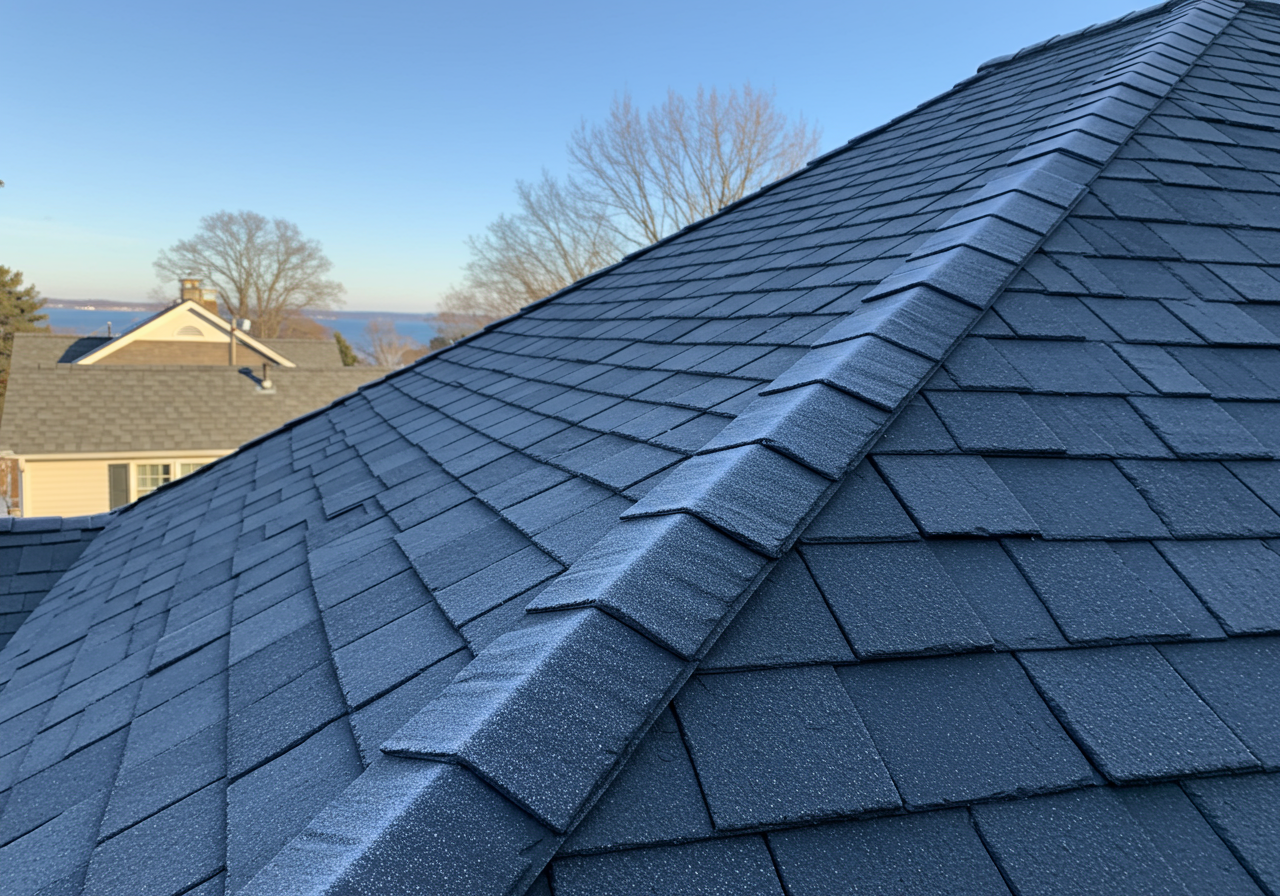
A modern Waterford home featuring grey synthetic slate roofing
Perfectly mimics natural stone but offers better winter durability.
Installation Hurdles: Why January Isn't Always the Best Time
Even though I'm writing this while it's 22°F, I have to be honest with you: installing synthetic roofing in the dead of winter is a challenge. While these materials don't get as brittle as asphalt, many of the underlayments and adhesives used to seal the "valleys" of your roof need temperatures above freezing to bond correctly.
I've seen crews trying to use heat guns to warm up ice and water shields in 20-degree weather. It's a mess. If you're dealing with a catastrophic leak right now, emergency repairs are your best bet to bridge the gap until we hit a consistent 45°F in the spring.
Synthetic tiles also require a bit more "finesse" to cut when it's cold. If a contractor tries to rush a synthetic slate job in January, they might end up with uneven lines because the material hasn't had a chance to "relax" into its final shape. I always recommend scheduling these big installs for the "shoulder seasons"—April, May, or October.
Inspection
Verify if your current decking can support the weight of composite materials.
Selection
Choose a Class 4 impact-rated product for maximum storm protection.
Scheduling
Aim for a window where temperatures are consistently above 40°F for proper adhesive bonding.
Installation
Ensure the crew uses stainless steel fasteners to prevent salt-air corrosion.
Certification
Collect your warranty paperwork and tax credit certification immediately.
Conclusion: The Long View for Waterford Homeowners
At the end of the day, your roof is a weather-management system. When I look at the radar and see a line of storms moving across the Sound, I want to know that the house is protected by something that doesn't "age out" every time the temperature drops to 22°F. Synthetic roofing is the closest thing we have to a "set it and forget it" solution in the Connecticut climate.
Yes, the upfront cost is a hurdle. And yes, finding a crew in New London County that truly understands the nuances of polymer installation takes a bit of digging. But when you're sitting in your living room ten years from now during a February blizzard, you won't be worrying about whether your shingles are cracking or if the wind is peeling back the corners. You'll just be warm.
If you're curious about how a synthetic system would look on your specific roofline, or if you're just tired of the "asphalt cycle," take the time to get a real estimate. The peace of mind during our next 22°F "flash freeze" is worth every penny.
Get Your Free Roof Quote
Enter your zip code to get started
FAQ

About Noah Knight
Verified ExpertNoah Knight is a Connecticut Weather & Climate Specialist who helps homeowners understand how New England's unique weather patterns affect their roofing systems. He combines meteorological knowledge with practical home maintenance advice.