I spent a cold morning out near Morey Road last November looking at a cedar roof that was barely twelve years old. The homeowner was devastated because the "silver-gray aesthetic" he'd paid a premium for had turned into a warped, rotting mess that was actively leaking into his primary suite. When I pulled a few shakes, the problem was immediate: the previous installer hadn't used a pneumatic spacer, and the wood was literally suffocating. In Ashford's dense, wooded environment, that kind of technical oversight is a death sentence for a roof.
The reality is that cedar isn't just a "set it and forget it" material like asphalt. It's a living, breathing organic substrate. With today's temperature sitting at 28°F here in Ashford, those shakes are currently undergoing a brutal freeze-thaw cycle. If they weren't installed with the right gaps, that moisture gets trapped, turns to ice, and begins the slow process of splitting the wood from the inside out.
Key Takeaways
- Demand Blue Label shakes: Only 100% heartwood, 100% edge grain shingles can survive Tolland County's humidity.
- Stainless is standard: Anything less than 304-grade stainless steel fasteners will cause "bleeding" streaks within five years.
- Airflow is life: A dedicated ventilation matrix (like Cedar Breather) is mandatory to prevent underside rot.
- Slope restrictions: Never install cedar on a pitch lower than 4:12 without specialized underlayment systems.
Compare Ashford cedar quotes without the sales pressure
See what verified local pros actually charge for wood roofing in 2026.
No credit card required • Free to use
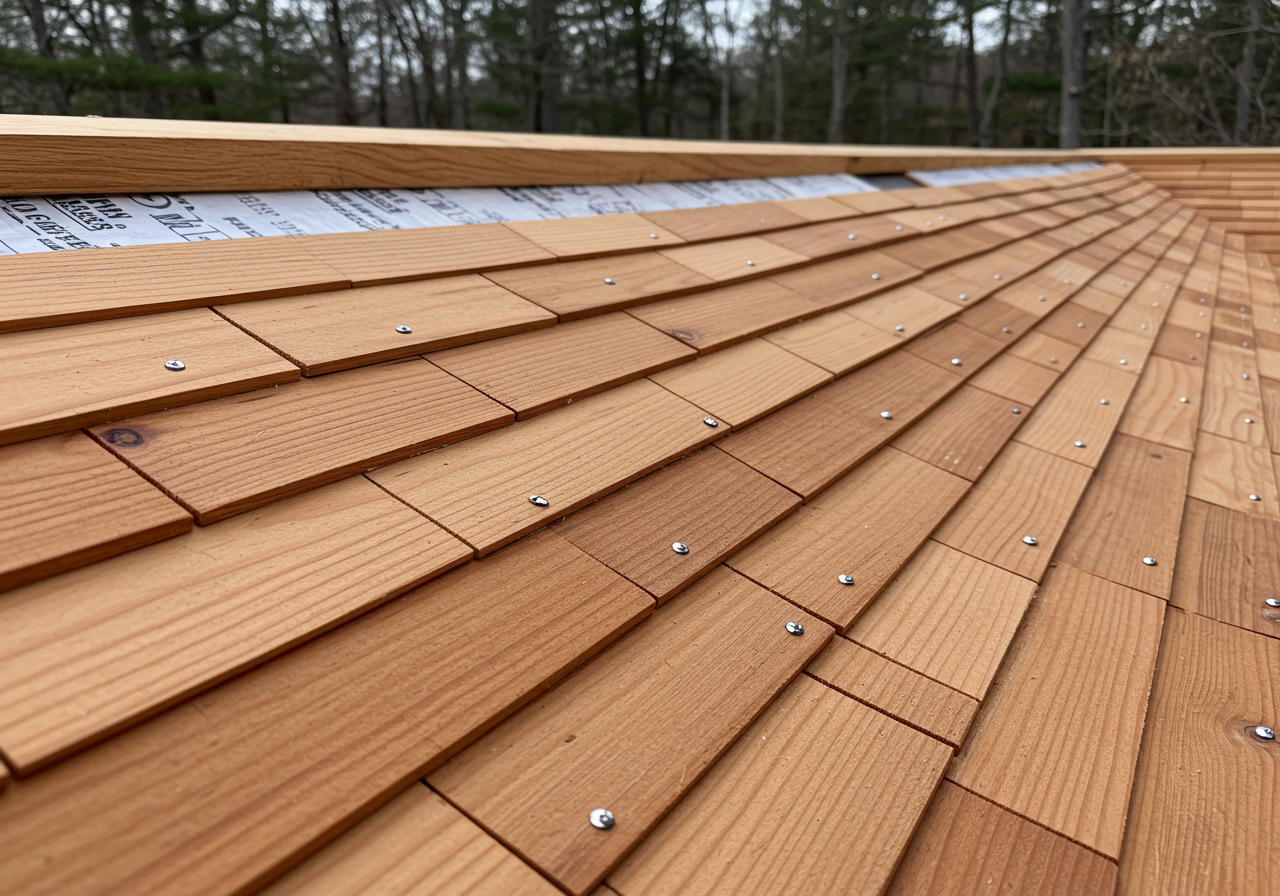
Cedar shake installation detail in a wooded Connecticut lot
Spacing, fasteners, and ventilation decide whether wood thrives—or rots—in Ashford.
1. The Ashford Shade Trap: Why Your Lot Matters
Ashford is beautiful because of its canopy, but those towering oaks and maples are a cedar roof's natural enemy. While the current 43% humidity seems low, the microclimate under a heavy Ashford tree line keeps moisture trapped on the roof surface for hours after a rainstorm.
I've seen roofs in the sunnier parts of Mansfield last 35 years, while the exact same material on a shaded lot in Ashford fails at year 18. If your home is tucked into the woods, you cannot skip the fungicide treatment. Without it, the moss and lichen will act like a sponge, holding water against the wood and accelerating decay.
2. Grading Deception: The "Clear" Shingle Myth
Here's something a lot of contractors won't tell you: "Clear" shingles aren't always the best choice. In the roofing world, we look for Certi-label® certifications.
Understanding Edge Grain vs. Flat Grain
Flat grain shakes are cut parallel to the tree rings. They look fine on day one, but they are prone to "cupping" and "curling" as they age. Look, if you want a roof that actually hits that 30-year mark, you need 100% edge grain. It's more stable because the grain runs vertically through the thickness of the shake. I've measured shakes on older Ashford farmhouses that were flat-sawn; they had curled up so much you could slide a deck of cards under them.
3. The Ventilation Gap: Why "Breathability" Isn't Optional
The biggest mistake I see in Tolland County is installing cedar shakes directly onto a solid plywood deck without a spacer. Wood needs to dry from both sides. When the sun hits a wet roof, the moisture tries to drive inward. If there's no air gap, that moisture gets trapped against the roof deck.
The Role of Furring Strips and Mats
In the old days, we used "skip sheathing"—spaced 1x4 boards that let the wood breathe. Today, we mostly use nylon matrix mats. It creates a 1/4-inch cavity (0.25") that allows air to circulate. If your quote doesn't include a product like Benjamin Obdyke's Cedar Breather, your roof's lifespan is effectively cut in half.
Deck and slope check
Inspect the roof deck for structural integrity and proper slope (minimum 4:12).
Ice and water at critical areas
Install a high-temperature ice and water shield at the eaves and valleys.
Ventilation matrix
Apply a continuous ventilation matrix over the entire deck to ensure underside airflow.
Stainless fastening
Fasten shingles using two stainless steel nails per shake, positioned 1 inch above the exposure line.
Expansion gaps
Maintain a 1/4-inch to 3/8-inch gap between shingles to allow for natural expansion.
4. Fastener Failure: The Hidden "Bleeding" Problem
I've walked onto job sites where crews were using galvanized nails. That's a massive red flag. The tannins in cedar are highly acidic. They will eat through the zinc coating on galvanized nails in a matter of seasons.
Once the coating is gone, the nail rusts, and you get those ugly black "bleeding" streaks running down your beautiful wood. More importantly, the nail loses its grip. During a 7 mph wind like we have today, it's no big deal. But during a summer thunderstorm with 50 mph gusts, those loose shakes will fly off like frisbees. I always specify Type 304 stainless steel at a minimum—or 316 if you're closer to the coast, though Ashford usually does fine with 304.
5. Building Codes and Fire Ratings in Connecticut
You need to be aware of the International Code Council (ICC) standards regarding fire-retardant treated (FRT) wood. Depending on your specific location in Ashford and your proximity to other structures, local code may require a Class A or Class B fire rating.
Pressure-Treated vs. Fire-Retardant
Don't confuse the two. Pressure-treated shakes are for rot and insect resistance. Fire-retardant shakes are impregnated with chemicals to slow flame spread. In many CT jurisdictions, if you are doing a full roof replacement to today's standards, you must meet the current code, not the code that existed when the house was built in 1985.
6. The 2026 Cost Reality for Ashford Homeowners
Let's talk numbers, because that's usually where the sticker shock happens. A high-quality cedar shake installation in Ashford currently runs between $18.50 and $26.00 per square foot. For a standard 2,500-square-foot roof, you're looking at a total investment of roughly $46,250 to $65,000.
Expected Lifespan Comparison (With Proper Maintenance)
If those numbers feel high, you can run the numbers on your own roof footprint and materials to see how different options affect long-term ROI. Remember, a cedar roof adds significantly more resale value to an Ashford colonial than standard asphalt ever will.
7. Flashing: The Vulnerable Joints
I've never seen a cedar roof fail in the middle of a field; it's always at the chimneys, valleys, or dormers. Because cedar lasts so long, your flashing needs to match that lifespan. Using thin aluminum flashing with cedar is a mistake. The acidic runoff from the wood can eventually pit the aluminum. I prefer lead-coated copper or heavy-gauge copper. It's expensive, but it's the only thing that will actually last the 35 years the wood is capable of.
If you're noticing small spots of rot near your chimney, don't wait. Addressing targeted cedar repairs at chimneys and valleys now can save you from a full deck replacement later.
8. Vetting Your Ashford Contractor
Cedar is a specialty craft. If a contractor tells you they can "knock it out in two days," they are probably cutting corners on the spacing or the flashing. Before you sign anything, I recommend checking the BBB's home improvement directory to ensure the company has a history with wood roofing, not just asphalt.
The contract should explicitly state the grade of the shingle (Blue Label), the type of fastener (Stainless Steel), and the specific ventilation product being used. If it just says "cedar shakes," you're leaving too much to chance.
Energy Tax Credits
While standard cedar doesn't usually qualify, some specialized treated wood systems may meet efficiency standards. Check the IRS Form 5695 instructions for the most current residential energy credit details for 2026.
Get Your Free Roof Quote
Enter your zip code to get started
Final Thoughts for Ashford Homeowners
A cedar roof is an investment in your home's character and longevity. It's not the right choice for every budget, but for a historic or high-end Ashford home, nothing else compares. Just make sure you aren't paying for "Blue Label" quality and getting "Red Label" shortcuts. The difference is often hidden behind the wood, in the nails and the air gaps.
FAQ

About Daniel Roberts
Verified ExpertDaniel Roberts is a Senior Roofing Consultant with over 15 years of experience in the New England residential construction industry. He specializes in storm damage assessment and energy-efficient roofing systems.