
Key Takeaways
- The 1/300 Rule: Proper ventilation requires 1 square foot of vent area for every 300 square feet of attic floor space to prevent moisture buildup.
- Ice Dam Prevention: Keeping attic temperatures within 10-15 degrees of outdoor air prevents the freeze-thaw cycles that destroy shingles.
- R-Value Standards: In Tolland County, R-49 to R-60 insulation is the current benchmark for maximizing ROI on energy bills.
- Moisture Control: Effective ventilation manages humidity (currently 58% in Columbia) to prevent mold growth on plywood sheathing.
Most homeowners in Columbia think that "sealing up" their house for winter is the gold standard for energy efficiency. They pile insulation into the attic like they're stuffing a Thanksgiving turkey, assuming that more fluff equals lower heating bills. But here is the reality that usually hits right around the time the first major ice dam forms: a "warm" attic is actually a failing attic.
Contrary to popular belief, your attic shouldn't be the warmest room in the house during a Connecticut winter. In fact, if I walk into an attic and it feels like a comfortable 68°F while it's 4°F outside, I know the homeowner is in for a world of structural hurt. The goal isn't to trap heat in the attic space; it's to keep the heat in your living quarters and ensure the attic stays as close to the outdoor temperature as possible. When you disrupt that balance, you aren't just losing money—you're literally rotting your roof from the inside out.
1. The "Cold Attic" Paradox: Why Thermal Isolation Matters
When the mercury drops to 4°F in Tolland County, the physics of your home changes. Heat naturally migrates toward cold areas. If your attic floor isn't sealed tighter than a drum, that expensive air you just paid to heat rises straight through your ceiling.
Why Your Attic Shouldn't Be Warm
In a perfectly balanced Columbia home, the insulation acts as a thermal blanket, while the ventilation acts as a lung. The air in the attic needs to move. If that air sits stagnant, it picks up "bypass" heat from your recessed lights, attic hatches, and plumbing stacks. This warm air then hits the underside of your cold roof deck. The result? Condensation. I've seen attics in the Chestnut Hill area where it looked like it was raining inside because of this exact issue.
The 4°F Reality Check
With today's clear skies and 4°F temperature, the temperature differential is extreme. If your attic is poorly ventilated, that heat loss isn't just a number on your Eversource bill; it's a catalyst for disaster. High-performance roofing isn't just about the shingles you see from the driveway; it's about the air movement you can't see. If you're noticing your furnace running non-stop today, the culprit might be above your head, not in the basement.
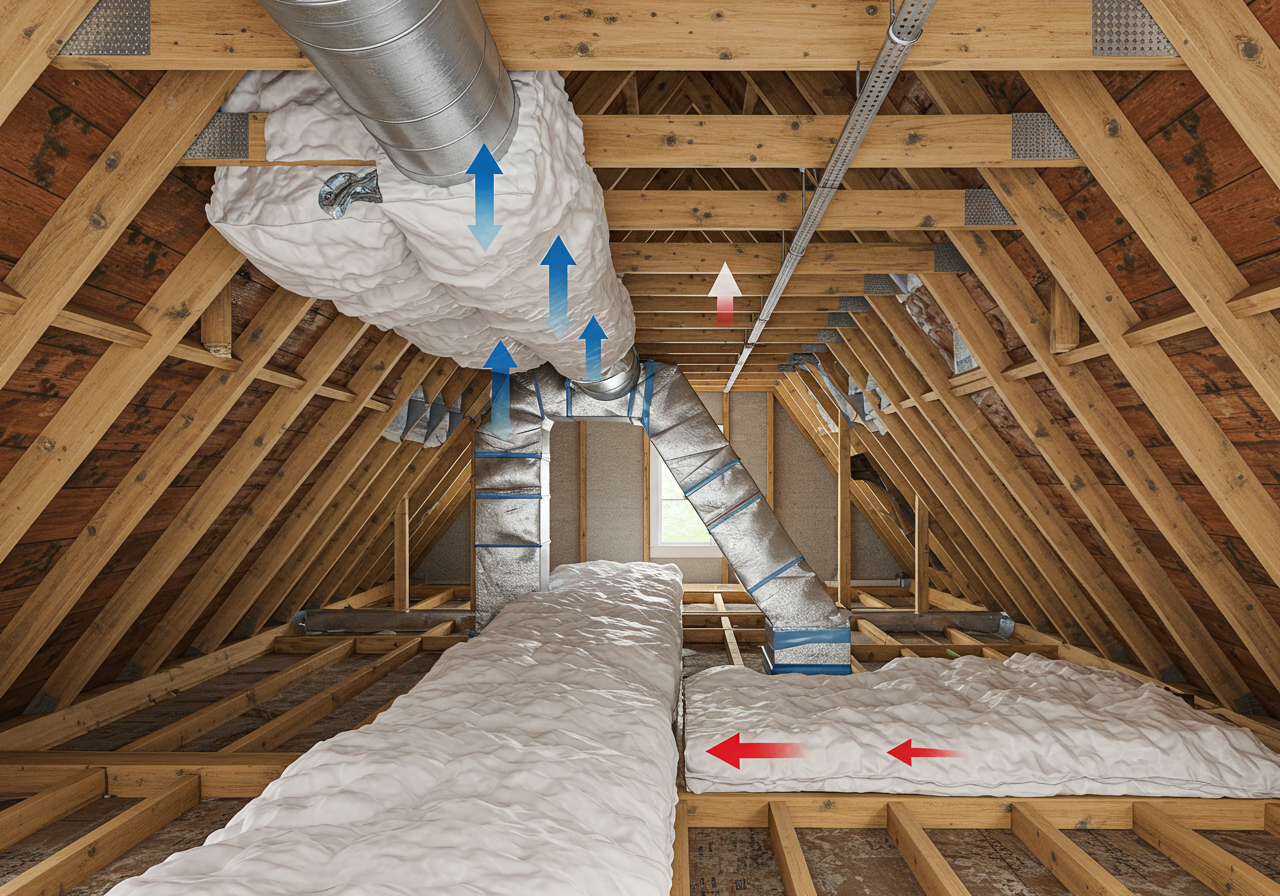
Properly Ventilated Attic Cross-Section
A cross-section showing soffit intake and ridge vent exhaust with thick cellulose insulation in a typical Columbia, CT colonial home during winter
2. Ice Dams: The Silent Roof Destroyers in Tolland County
In Columbia, we're no strangers to heavy snow loads. But snow itself isn't the primary enemy of your shingles—it's the ice that forms at the eaves. This happens when heat escaping your house melts the bottom layer of snow on your roof. That water runs down to the gutters, which are overhanging the cold air, and freezes solid.
The Anatomy of a Freeze-Thaw Cycle
Once an ice dam forms, it creates a reservoir. Subsequent melt-water backs up under your shingles. Most standard asphalt shingles are designed to shed water moving downward, not water sitting in a pool or moving upward via capillary action. I've documented cases where a single $200 insulation fix could have prevented a urgent repair for storm damage that ended up costing $8,740 in interior drywall and floor replacement.
Identifying R-Value Gaps
If you see a row of icicles longer than 12 inches hanging off your gutters near Route 66, you have an insulation problem. It means your "R-Value"—the measure of thermal resistance—is insufficient. In Connecticut, we've moved past the days of thin fiberglass batts. Modern standards often require blowing in 15 to 18 inches of cellulose to reach that R-49 sweet spot.
3. Calculating Intake vs. Exhaust: The 1/300 Rule
Ventilation is a math game. You can't just throw a fan in the gable and call it a day. In fact, power fans often do more harm than good by pulling conditioned air out of your house through "leaky" light fixtures. The gold standard is a passive system.
Soffit Vents and Baffles
Air needs to enter at the lowest point of the roof—the eaves—and exit at the highest point—the ridge. I often find that Columbia homeowners have "covered" their soffit vents with insulation. This is a critical mistake. You need baffles (plastic or foam channels) to keep the insulation away from the roof deck, allowing a 10 mph wind like we have today to flow freely into the attic space.
Ridge Vents vs. Gable Vents
The "1/300 rule" states you need 1 square foot of net free vent area for every 300 square feet of attic floor. For a 1,500-square-foot attic in a typical Columbia ranch, that's 5 square feet of venting. This should be split 50/50 between intake (soffits) and exhaust (ridge). If you have gable vents (those triangles on the side of the house) and you install a ridge vent, you can actually short-circuit the airflow, leaving the middle of your roof to rot while air just moves between the two vents.
Estimated Attic Lifespan Based on Ventilation Quality
4. Connecticut R-Value Standards: Is R-49 Enough?
Back in the 90s, R-19 or R-30 was considered "fine." But energy prices in Tolland County haven't stayed in the 90s. The Department of Energy now recommends R-49 to R-60 for our region (Zone 5).
Blown-In Cellulose vs. Fiberglass Batts
I prefer blown-in cellulose for Columbia homes, especially older ones with irregular joist spacing. Cellulose (treated recycled paper) fills the nooks and crannies that fiberglass batts miss. If you have gaps in your insulation, you have "thermal bridges"—areas where heat escapes unimpeded. It's like wearing a heavy parka but leaving it unzipped.
The Cost of Under-Insulating in 2026
Looking at recent data, a home in Columbia that is under-insulated (say, R-19) is likely losing $450 to $700 per year in wasted heating energy. Over a decade, that's $7,000—more than the cost of a full insulation and ventilation overhaul. When I review projects, I always tell people that the most expensive insulation is the stuff that was installed poorly.
"Most Columbia roofs don't fail because of the weather; they fail because the attic wasn't allowed to breathe. You can buy the most expensive shingle in the world, but if it's baking from the inside, it won't last fifteen years."
5. Mold and Moisture: The Invisible Threat in Humidity
With humidity at 58% today, the air contains a fair amount of moisture. When you shower, cook, or even breathe, that moisture moves upward. If your bathroom fans are vented into the attic rather than through the roof, you are essentially pumping a gallon of water into your attic every day.
Managing Columbia's Humidity Levels
I've walked into attics near the Columbia Lake area where the rafters were covered in black spotting. That isn't just "old house smell"—it's active mold growth. This happens when warm, moist air meets a cold surface (the roof deck). Proper ventilation flushes this moisture out before it can settle and sprout spores.
Signs of Attic Delamination
If you look at your roof from the yard and see the shingles looking "wavy" or "buckled," it might not be a shingle problem. It could be the plywood underneath delaminating because it's been damp for years. According to the National Weather Service's storm records, Tolland County sees significant humidity swings that accelerate this rot if the attic is stagnant.
The Attic 'Sniff Test'
6. Vetting Your Columbia Insulation Contractor
Not every guy with a truck and a bag of insulation understands the science of airflow. I've seen "contractors" blow insulation right over the soffit vents, effectively suffocating the house.
Why License Checks Matter
Before you let anyone near your rafters, verify their contractor's license through the state portal. You want to see a Home Improvement Contractor (HIC) registration that is active and in good standing. In Connecticut, we have strict consumer protection laws that require written contracts for any work over $200. If a contractor scoffs at paperwork, walk away.
Avoiding the "Spray Foam" Trap
Closed-cell spray foam is popular, but it requires a "conditioned attic" approach. You cannot simply spray foam the underside of your roof deck and leave your old floor insulation in place. This creates a "moisture sandwich" that can rot your rafters in record time. Always ask for a detailed ventilation plan before any insulation is added. Finding a professional who actually knows the technical specs is the difference between a 30-year roof and a 10-year headache.
Insulation Material Comparison (CT Zone 5)
| Feature | Fiberglass Batts | Blown Cellulose | Spray Foam |
|---|---|---|---|
| Air Sealing | |||
| DIY Friendly | |||
| High Fire Resistance | |||
| High R-Value per Inch |
7. Financial Incentives and Energy Savings
Living in Tolland County, we have access to some specific programs that make these upgrades more palatable. 2026 has seen a surge in "Whole Home" efficiency incentives.
Tolland County Utility Rebates
Eversource and other local utilities often offer "Home Energy Solutions" (HES) audits. They will come to your Columbia home, perform a blower door test, and often subsidize the cost of air sealing and insulation. I've seen rebates cover up to 75% of the insulation cost for qualifying homeowners.
The 19% Savings Threshold
My field notes show that most Columbia colonials built between 1970 and 1995 see an immediate 19% drop in heating costs after addressing attic bypasses. On a $3,500 annual heating bill, that's over $650 back in your pocket every single year. It's one of the few home improvements that actually pays for itself in under five years. Before you sign any major contract, make sure to verify your contractor's credentials to ensure they are authorized to perform rebate-eligible work.
Did You Know?
A single unsealed 'can' light in your kitchen can leak as much warm air into your attic as a 2-foot open window would over the course of a winter.
8. Moving Toward a System-Wide Solution
A roof isn't just a lid; it's a system. If you are planning a roof replacement in the next 12 to 24 months, that is the absolute best time to fix your ventilation.
Integrating Ventilation into Your Next Re-Roof
When the old shingles are off, it is incredibly easy to cut a ridge vent or install "smart" vents at the eaves if you have no soffits. Don't let a roofer just "swap shingles." Demand a ventilation audit. If they aren't checking your attic, they aren't doing their job.
Long-term Maintenance Steps
Every spring, I tell my clients in Columbia to take a flashlight into the attic. Look for light coming through the soffits (that's good) and look for damp spots on the wood (that's bad). It takes ten minutes and can save you ten thousand dollars. The 4.0°F weather we're having today is the perfect "stress test" for your home. If you feel drafts or see frost on the nails in your attic, the system is telling you it needs help.
Get Your Free Roof Quote
Enter your zip code to get started
The bottom line is that your roof's health is inextricably linked to the air beneath it. In Columbia, where we deal with everything from 90°F humid summers to -11°F wind chills like we have today, a "set it and forget it" attitude toward the attic is a recipe for disaster. Take the time to measure your insulation, check your vents, and hire professionals who respect the science of building envelopes. Your wallet—and your roof—will thank you.