
Key Takeaways
- Simsbury's unique geography creates wind tunnels that cause shingle lift at lower thresholds than flatter parts of Connecticut.
- The most expensive wind damage is often invisible—look for heating bill spikes and granules in gutters, not just missing shingles.
- Repairs can save $1,200+ vs replacement for roofs under 10 years old, but widespread 'creasing' indicates structural failure requiring replacement.
- 6-nail fastening patterns increase wind resistance from 110 mph to 130 mph for an extra $300-$500 investment.
Looking back at the storm data for the Farmington Valley over the last decade, it's clear that Simsbury's geography—tucked between the ridges of Talcott Mountain and the Farmington River—creates unique wind tunnels. I've spent countless hours examining roofs near the Old Drake Hill Flower Bridge where wind sheer behaves differently than in flatter parts of Connecticut. Historically, we see shingle lift occurring at lower thresholds here due to these micro-climates. It isn't just about the "big one" like a hurricane; it's the cumulative fatigue of 45 mph gusts that eventually compromises a roof's structural integrity.
When a storm rolls through Hartford County, most homeowners look for missing shingles. But my field notes from the last 17 years show that the most expensive damage is often the kind you can't see from the driveway. If you're noticing a sudden spike in your heating bills or a few granules in your gutters, the wind might have already won.
Identifying the Subtle Signs of Wind Fatigue in Simsbury
The reality is that wind doesn't always "blow a roof off." Instead, it uses a prying motion. In Simsbury, where many colonial-style homes feature steep 8:12 or 10:12 pitches, the wind hits the windward slope and creates a vacuum on the leeward side. This lift can break the adhesive seal on your shingles. Once that seal is broken, the shingle flaps like a loose shutter. You might not lose the shingle immediately, but the sealant will never re-bond because dust and pollen (especially during our heavy CT spring seasons) coat the adhesive strip.
I recently inspected a 14-year-old roof on Stratton Brook Road where the homeowner was convinced the roof was fine. Upon closer inspection with a flat bar, I found that 32% of the shingles on the north-facing slope had completely lost their seal. They looked perfect from the ground, but they were effectively "unzipped." This is why how our matching process works is designed to find contractors who actually get on a ladder rather than just flying a drone over your house.
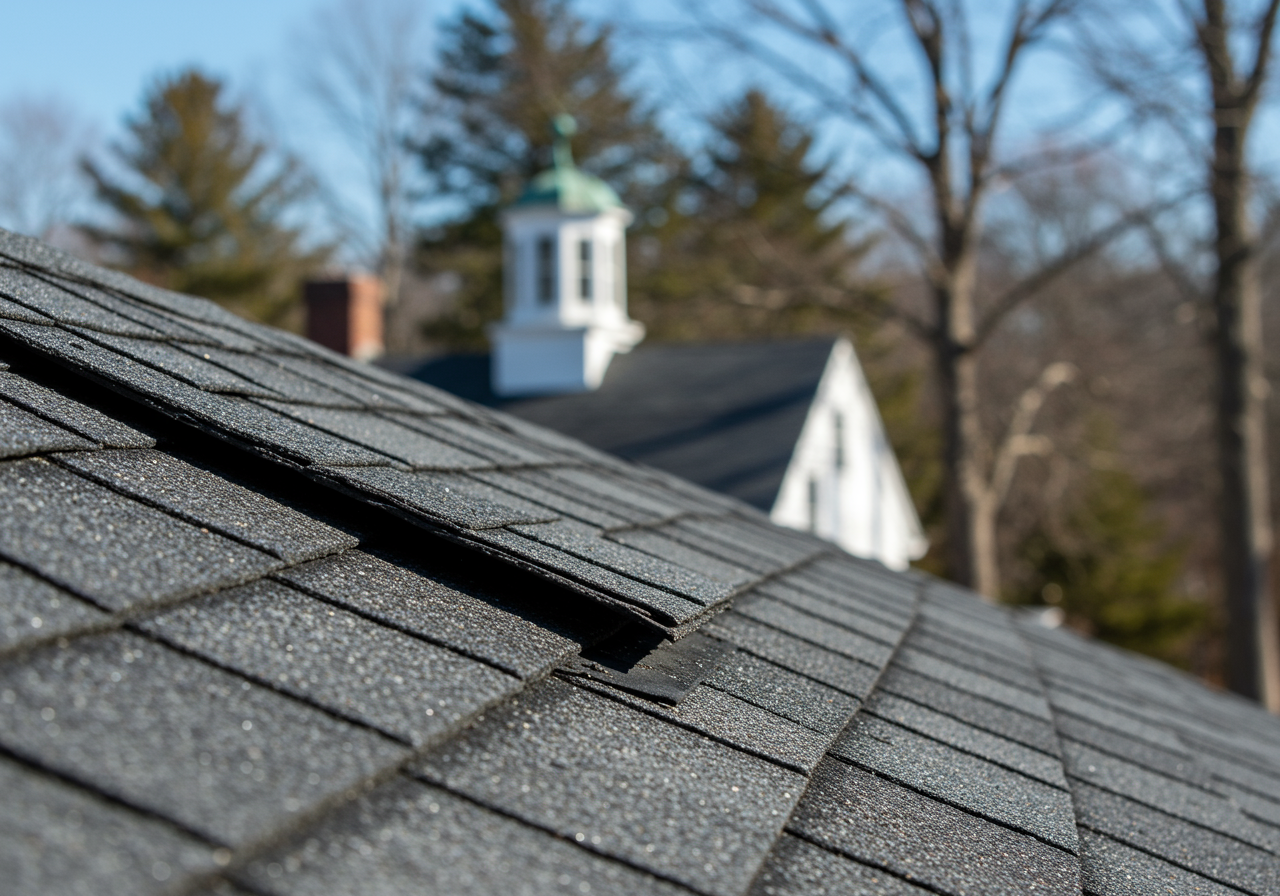
Wind Damage Assessment in Simsbury
Professional inspection reveals hidden wind damage that isn't visible from ground level, including broken adhesive seals and shingle lift.
Repair vs. Replacement: Strategic Alternatives for Homeowners
When I sit down with a homeowner to look at the numbers, the first question is always: "Can we just patch it?" The answer depends on the "brittleness factor." In our Connecticut climate, asphalt shingles lose their flexibility after about 12 to 15 years. If I try to lift a shingle to nail a new one underneath and it cracks, a repair is no longer a viable alternative. You're just creating a new leak to fix an old one.
For roofs under 10 years old, a targeted repair is often the smartest financial move. I've seen repairs ranging from $640 to $1,350 save homeowners from a $16,000 replacement for several years. However, if the wind has caused widespread "creasing"—where the shingle has folded back and created a permanent line across the top—the fiberglass mat is fractured. At that point, you aren't just looking at a cosmetic issue; you're looking at a structural failure.
Wind Damage Strategy: Repair vs. Full Replacement
Pros
- Repair is 90% cheaper than replacement
- Can be completed in a single afternoon
- Maintains existing home aesthetic
Cons
- Color matching aged shingles is nearly impossible
- Does not reset the 'clock' on your roof's lifespan
- May not be covered by insurance if damage is localized
The Technical Specs: Why Simsbury Roofs Need Higher Standards
If you do decide on a replacement or a major repair, the installation method matters more than the brand of shingle. According to the International Code Council (ICC), specific fastening patterns are required for high-wind zones. In many parts of Simsbury, I recommend a 6-nail fastening pattern instead of the standard 4-nail approach. Those two extra nails increase the wind rating of a standard architectural shingle from 110 mph to 130 mph.
The math is simple: for an extra $300 to $500 in labor and material on an average-sized roof, you're gaining a massive safety margin. Look, I've seen "value" contractors skip this step because it takes 15% longer to install, but in the Farmington Valley, that's a recipe for a callback after the next nor'easter. We also see better performance from "cool roofs" that reflect UV rays, as heat is what ultimately degrades the adhesive seals that wind loves to break. Energy Star data confirms that reflective materials stay more flexible over time, resisting that brittleness I mentioned earlier.
Projected Lifespan of Wind-Resistant Materials
Navigating the Insurance and Repair Process in Hartford County
One thing many Simsbury residents don't realize is that Connecticut insurance law regarding "matching" can be a double-edged sword. If your roof has significant wind damage and the shingle is no longer manufactured (a common occurrence with older IKO or CertainTeed lines), you might be entitled to a full replacement even if only one slope is damaged. This is because the carrier is often required to provide a reasonably uniform appearance.
But don't just take the first check the adjuster cuts. I always tell my clients to have a professional roofer present during the adjustment. We speak the same language as the adjusters—we talk about "effective age," "mechanical damage," and "thermal splitting." Having that technical advocate can be the difference between a $2,000 patch job and a $14,800 full restoration. If you're unsure where to start, you can get an instant roof estimate to see what the baseline costs look like for your specific square footage in the 06070 zip code.
Safe Ground Inspection
Walk the perimeter and look for shingle 'tab' pieces on the lawn.
Check the Gutters
Excessive granule loss indicates the shingles are being scrubbed by wind-driven rain.
Attic Observation
Use a flashlight to check for water staining on the rafters—wind often pushes water 'up' under shingles.
Professional Assessment
Have a contractor perform a 'lift test' to check adhesive bond integrity.
Documentation
Capture high-resolution photos for insurance before any emergency tarps are applied.
Don't let a small breeze turn into a basement flood
Connect with verified Simsbury contractors who know how to build for Connecticut weather.
No credit card required • Free to use
Moving Forward with Your Simsbury Roof
Simsbury is a beautiful place to live, but our unique topography means our roofs work harder than those in other parts of the state. Whether you're dealing with a few missing tabs or widespread sealant failure, the key is to act before the next cycle of freeze-and-thaw sets in. A proactive repair today is almost always cheaper than a structural deck replacement next year.
The best move you can make is to gather data. Understand your roof's current health, know your material options, and never settle for a contractor who cuts corners on fastening patterns. Your roof is the first line of defense for your biggest investment; make sure it's reinforced for whatever the Farmington Valley throws at it next.
Get Your Free Roof Quote
Enter your zip code to get started