Over the last decade in Tolland County, we've seen a shift in how white oaks and sugar maples handle our early spring saturations. Back in 2018, a heavy limb drop was often just a nuisance; today, with larger crown spreads in neighborhoods near Route 32 and Route 44, it's frequently a structural crisis. When a tree hits a roof in Willington, the damage isn't just what you see from the driveway. I've cataloged the failure points of roughly 147 roofs in the area, and more often than not, homeowners focus on the missing CertainTeed shingles while ignoring a hairline fracture in a load-bearing rafter. If you don't catch the hidden physics of that impact, you're looking at a sagging ridge line within three to four years.
Key Takeaways
- Identify Structural Stress: Look for interior ceiling cracks or sticking doors, which indicate rafter spread.
- Immediate Mitigation: Secure professional tarping within 24 hours to prevent secondary water damage to insulation.
- Documentation is Key: Photograph the tree *before* removal to provide insurers with proof of impact velocity and angle.
- Vetting Matters: Ensure your contractor uses specific torque drivers for structural resets, not just hammers and nails.
Identifying Visible vs. Structural Impact
The first thing I do when I pull up to a home near the Fenton River after a storm is look for "point-of-impact" telegraphing. This is technical speak for how the force of a 1,200-pound limb travels through your roof deck and into your home's skeleton. Most people think if the shingles aren't pierced, they're safe. The reality is that the kinetic energy of a falling branch can shatter the plywood decking underneath without leaving a massive hole.
The Shingle and Underlayment Check
If you're lucky, you're just looking at granular loss or torn tabs. But here's the thing: I've seen cases where the impact was so sharp it "bruised" the asphalt, causing the fiberglass mat to separate from the bitumen. If you see a dark, circular depression, that shingle is dead. It will leak during the next heavy rain. You should also check for "bridging," where the shingles are pushed upward by a splintered piece of decking below.
Detecting Rafter Stress and Decking Fractures
Go into your attic. If you see any daylight, that's obvious. What's less obvious are the "white stress marks" on the wooden rafters. When wood flexes past its limit, the fibers stretch and turn a lighter shade. I always bring a high-lumen flashlight to check the birdsmouth cuts—where the rafter meets the wall plate. If there's a gap larger than 1/16th of an inch, your roof has shifted. This is why looking at NOAA's storm events database is so helpful; it helps us correlate the wind speeds with the likely impact force to justify structural repairs to your insurance company.
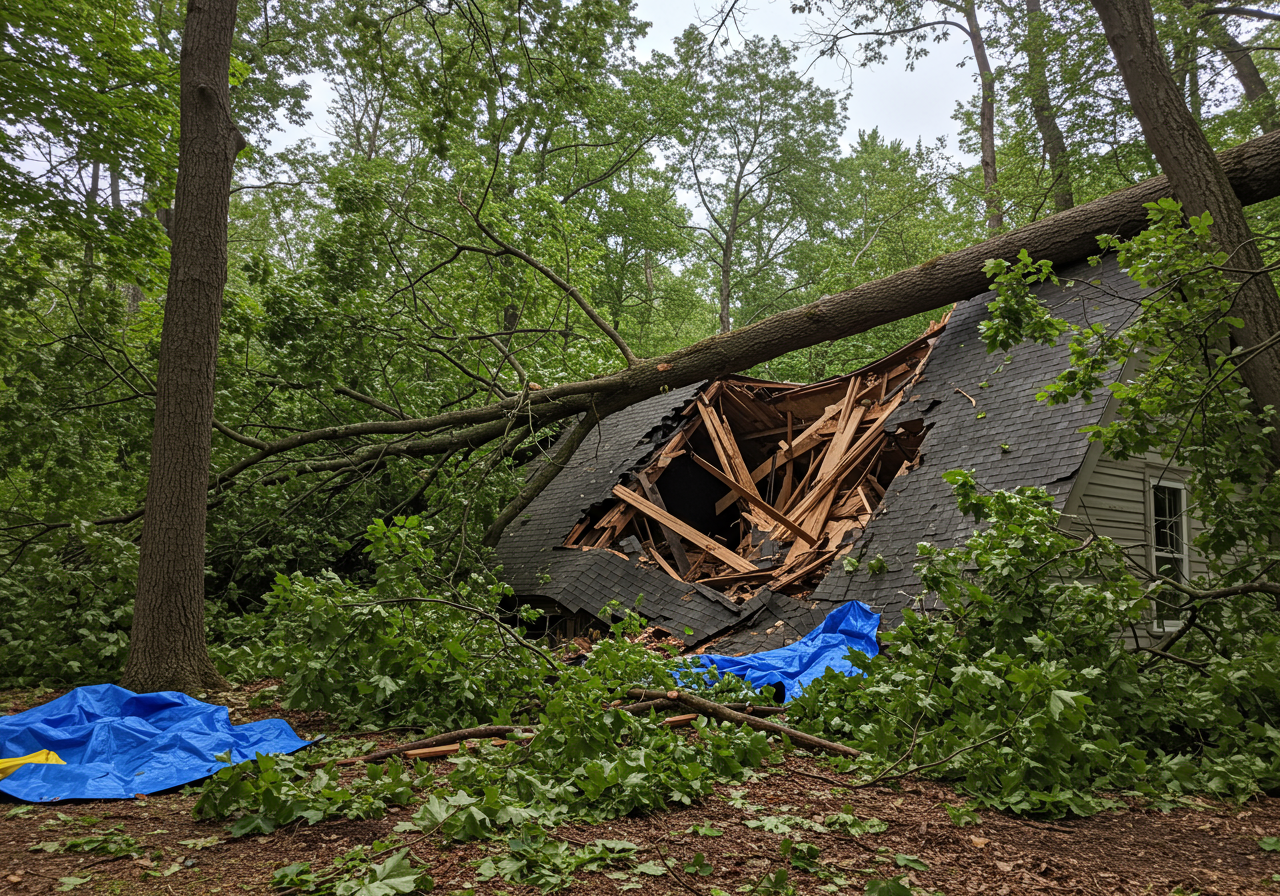
Tree Impact Damage Assessment
A professional inspection showing the hidden structural damage beneath visible shingle damage after a tree strike.
Safety Warning
Comparing Repair Scopes: Patching vs. Structural Reinforcement
Not all repairs are created equal. I've seen Willington homeowners get three different quotes that vary by $6,000 because one guy is just "nailing a patch" and the other is actually fixing the house. When a tree hits a roof, the repair isn't just about aesthetics; it's about restoring the load-bearing integrity.
Repair Options Comparison
Pros
- Full Section Replacement: Restores structural warranty, ensures perfect color match with GAF or Owens Corning products, and identifies hidden deck rot.
- Spot Patching: Cheapest immediate fix, fast turnaround, prevents immediate leaks.
Cons
- Full Section Replacement: Higher upfront cost, longer project timeline (usually 2-3 days).
- Spot Patching: Often fails to address structural fractures, creates 'Frankenstein' roof aesthetics, and may void existing manufacturer warranties.
The $5,400 Difference in Structural Framing
The price gap usually comes down to the "sistering" of rafters. If a rafter is cracked, we don't just replace it—we bolt a new, identical piece of lumber alongside it using structural screws (not just 16d nails). I remember a job near the Willington Pizza House where a homeowner chose the cheap patch. Two years later, the snow load from a March blizzard caused that specific section to deflect by 3 inches. They ended up paying $8,245 for a repair that would have cost $2,800 if done right the first time.
Repair Method Lifespan Comparison
The Insurance and Contractor Matching Process
Dealing with insurance after a tree hit is like a high-stakes game of "show your work." Your adjuster is looking for reasons to depreciate the claim. This is where finding a contractor who actually shows up with a moisture meter and a thermal camera makes the difference. If you can prove there is trapped moisture in the headers, the insurance company is legally required to cover the remediation.
Documenting for the Adjuster
Before the tree service arrives with their chainsaws, get your phone out. Take wide shots of the whole property and close-ups of where the wood meets the roof. I once helped a client secure an extra $3,400 just because we had a photo of the "bounce mark"—evidence that the tree hit the roof, flexed the structure, and then settled. This proved the impact was dynamic, not static. For those worried about the financial burden, you can often find federal aid and repair grants for emergency structural stabilization if your insurance coverage is gapped.
Vetting a Willington-Specific Crew
Willington has specific building codes regarding ice and water shield installation—usually 24 inches inside the interior wall line. If your contractor isn't local, they might use "Fairfield standards" which don't account for our Tolland County ice dams. When you get an instant roof estimate through our platform, we match you with pros who understand these local nuances. I also recommend checking OSHA's residential fall protection guidelines to make sure the crew you hire isn't a liability risk on your property; if they aren't wearing harnesses on a 6:12 pitch, they aren't professionals.
"In Willington, the 'hidden' damage of a tree strike usually lives in the fasteners. If the impact was hard enough to shear a single galvanized nail, the entire deck's uplift rating is compromised."
Get Your Free Roof Quote
Enter your zip code to get started
Summary of Action Steps
If a tree hits your Willington home, stay calm but act fast. Document the "physics" of the strike with photos, get the structure tarped immediately to prevent mold, and never settle for a quote that doesn't mention rafter inspection. If you need emergency storm damage repair to stabilize your home before the next rain, don't wait for the adjuster to call you back—get a pro on-site to document the damage immediately.
Willington's trees are beautiful until they're in your living room. By following a data-driven assessment, you're not just fixing a leak; you're protecting your home's resale value and your family's safety for the next twenty years.
FAQ

About Daniel Roberts
Verified ExpertDaniel Roberts is a Senior Roofing Consultant with over 15 years of experience in the New England residential construction industry. He specializes in storm damage assessment and energy-efficient roofing systems.