I was out on a job site near the Fenton River in Willington last October, standing on a steep-slope saltbox that had just been re-shingled two years prior. The homeowner was excited; he had a solar crew scheduled for Monday. But as soon as I pulled a few shingles back to check the flashing near the chimney, I saw the problem. The previous roofer had used standard 7/16-inch OSB decking and skipped the reinforced eave protection. While that technically meets code, it's a nightmare for a solar array that adds roughly 2.8 pounds per square foot of dead load. He was about to bolt $30,000 of glass onto a foundation that would flex under the first heavy Tolland County snow. It's a heartbreaking conversation to have—telling a neighbor their "new" roof needs $4,200 in structural bracing before the first panel can be laid.
Key Takeaways
- Structural Integrity: Ensure your decking is at least 5/8-inch plywood to handle the added 3-lb-per-sq-ft load of solar racking.
- Material Lifecycle: Match your roof's lifespan to the solar panels (25+ years) to avoid the 'deactivation cost' of removing panels for repairs.
- Flashing Priority: Use integrated flashing systems like Quick Mount PV rather than standard 'caulk-and-pray' methods.
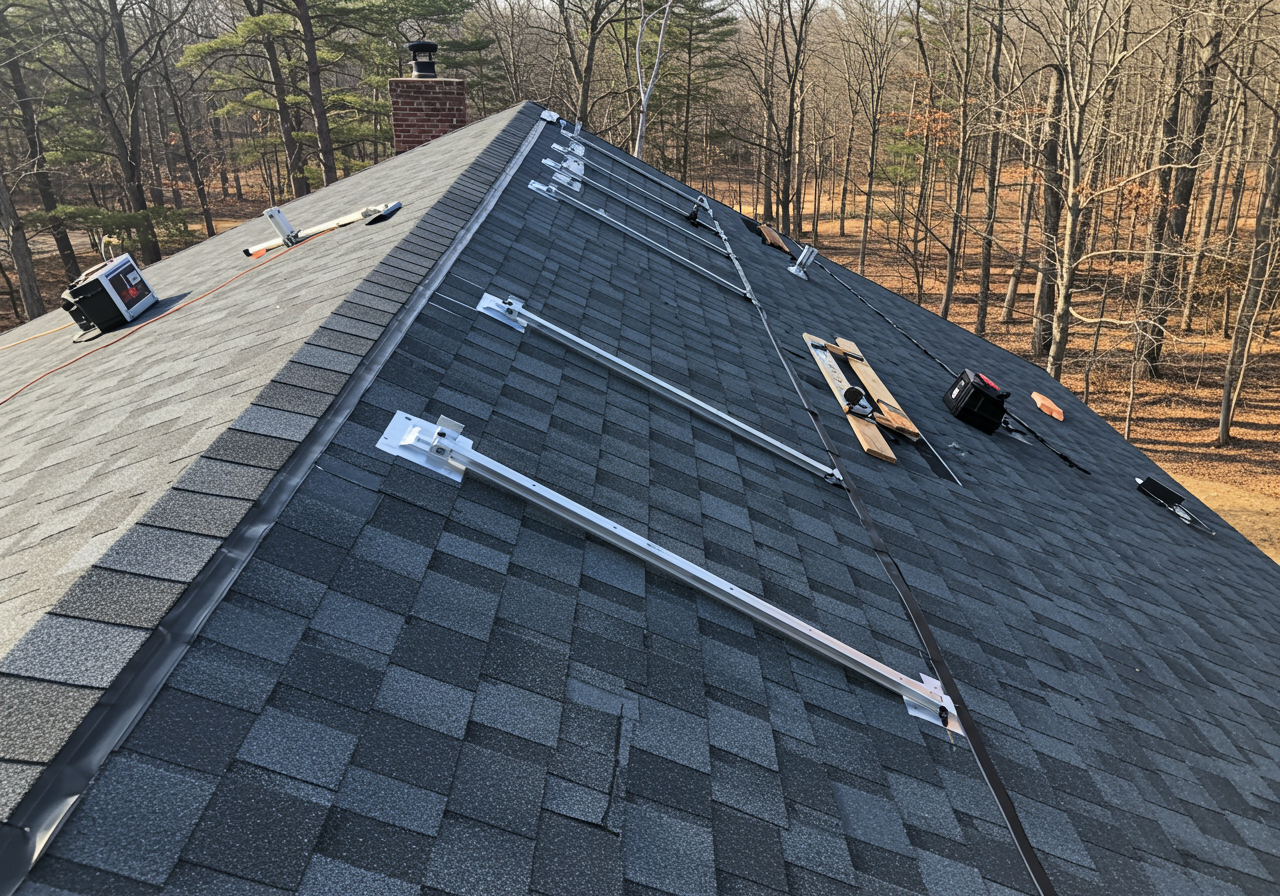
Solar-Ready Roofing Installation
Proper structural reinforcement and integrated flashing systems are essential for a solar-ready roof in Willington.
The Structural "Solar-Ready" Standard
The reality is that "solar-ready" isn't a marketing buzzword; it's a technical specification. In Willington, we deal with significant snow loads that can linger on a roof for weeks. When you add solar panels, you aren't just adding the weight of the hardware—you're creating a shelf that can trap snow and change how wind uplift affects your shingles.
Decking and Rafter Reinforcement
Most older homes in Tolland County were built with rafters spaced 24 inches on center. While that's fine for a standard asphalt shingle, it can struggle with the concentrated point loads of solar feet. I always recommend 5/8-inch CDX plywood for any solar-ready project. If your current decking is thin OSB, you're looking at potential sagging over a 20-year period. It is also vital that your contractor adheres to OSHA's fall protection guidelines during this phase, as the extra weight and specialized materials require professional-grade safety setups.
Choosing the Right Underlayment
I've seen crews use cheap #15 felt under solar-ready roofs, and it's a recipe for disaster. Solar panels create a "micro-climate" on your roof; it stays hotter in the summer and holds moisture longer in the winter. You need a high-temp synthetic underlayment (like Grace Ice & Water Shield or GAF Tiger Paw) that won't degrade when trapped under a 140°F solar array.
Material Showdown: What Actually Holds Up?
Not all roofing materials are created equal when it comes to supporting an array for two decades. You want a material that requires zero maintenance because once those panels are up, you won't see that section of the roof again until 2050.
Solar-Ready Material Comparison
| Feature | Architectural Shingles | Standing Seam Metal |
|---|---|---|
| Average Lifespan | ||
| Solar Mounting Style | ||
| Heat Resistance | ||
| Ease of Panel Removal | ||
| Willington Snow Shedding |
Standing Seam Metal: The Gold Standard
If your budget allows, standing seam metal is the undisputed king of solar-ready options. Here's the data: you can use S-5! clamps to attach the panels directly to the ribs of the roof. This means zero penetrations. No holes, no leaks. I've documented cases where this setup saved homeowners $2,100 in labor during the initial install because the solar crew didn't have to spend hours finding rafters and flashing individual bolts.
High-Definition Asphalt Shingles
If metal is out of reach, a heavy-weight architectural shingle (at least 340 lbs per square) is your next best bet. Avoid the "bargain" 3-tab shingles at all costs. They will brittle out under the solar heat in 12 years, forcing you to pay a solar company $3,000 to $5,000 just to take the panels down so you can replace the roof underneath them. You can see what other CT homeowners experienced when they opted for higher-grade materials versus the cheapest bid.
The Flashing and Waterproofing Trap
The most common mistake I see in Willington is the "lag and caulk" method. A solar installer drills a hole, squirts some silicone in it, and drives a lag bolt home. In our freeze-thaw cycle, that silicone will fail in 5 to 7 years.
Integrated Flashing Systems
A truly solar-ready roof includes pre-installed flashing points. Companies like GAF and CertainTeed now offer integrated systems where the mounting brackets are part of the roofing system's warranty. This is a game-changer. If you have a flat or low-slope section on a modern home, refer to FEMA's low-slope protection guide to ensure the membrane can handle the specialized footings required for tilted solar racks.
The Warranty Gap
Financial Planning for 2026
In Willington, the ROI on a solar-ready roof is bolstered by Connecticut's aggressive energy incentives. However, the upfront cost can be a hurdle. I always tell my clients to look for federal aid or state-level grants that specifically target energy-efficient "envelope" upgrades, which often include the roof deck.
Long-Term Cost Breakdown
When you're crunching the numbers, don't just look at the $14,800 or $18,300 price tag of the roof. Look at the "avoided cost."
The 'Hidden' Retrofit Tax
Don't guess on your structural readiness— verify their contractor's license and find a pro who understands the Willington snow load.
Get Your Free Roof Quote Today
Connect with verified CT pros in minutes.
No credit card required • Free to use
The biggest mistake I see isn't choosing the wrong shingle; it's failing to plan for the "marriage" of the two systems. A roof is a 25-year investment, and a solar array is a 25-year investment. If they aren't installed to the same standard, one will eventually kill the other. If you're still weighing your options, our blog library has deeper dives into specific CT material performance data.
Conduct a structural load-bearing attic inspection.
Have a professional assess your current rafter spacing, decking thickness, and overall structural capacity before committing to solar.
Upgrade decking to 5/8-inch CDX plywood if necessary.
This is the minimum standard for solar-ready roofs in Connecticut's snow load zones.
Install high-temperature synthetic underlayment.
Standard felt will degrade under solar panels. Use synthetic materials rated for high temperatures.
Select 50-year architectural shingles or standing seam metal.
Match your roof's lifespan to your solar panels to avoid costly removal and reinstallation.
Coordinate with a solar provider for integrated flashing points.
Pre-install mounting brackets during roof replacement to maintain warranty coverage and prevent leaks.
Get Your Free Roof Quote
Enter your zip code to get started
FAQ

About Daniel Roberts
Verified ExpertDaniel Roberts is a Senior Roofing Consultant with over 15 years of experience in the New England residential construction industry. He specializes in storm damage assessment and energy-efficient roofing systems.