Most folks in Rocky Hill think that as long as a shingle has a "30-year warranty" stamped on the wrapper, they're set for the next three decades. That is the biggest myth in the Hartford County roofing business. I've seen "lifetime" roofs in the West Hill neighborhood give up the ghost after just 14 years because the material wasn't built to handle the specific thermal expansion we get here in Connecticut.
The reality? That warranty often only covers the material cost—not the $8,000 in labor it takes to strip and replace it when the seal fails. If you want a roof that actually survives the heavy snow loads and the humidity swings near the Connecticut River, you have to look past the marketing jargon. You need to look at the chemistry of the shingle and the weight of the deck.
Key Takeaways
- Weight Matters: In Rocky Hill, 'Heavyweight' architectural shingles (over 240 lbs per square) are the bare minimum for snow-load durability.
- Metal's True ROI: While 2.5x the cost of asphalt, metal roofs in CT often pay for themselves in 18 years through energy savings and zero leak repairs.
- Ventilation is King: The best material in the world will fail in 10 years if your attic isn't breathing correctly.
- Vetting is Non-Negotiable: Always verify your contractor's license before discussing material brands.
The Asphalt Reality: Why "Builder Grade" is a Rocky Hill Trap
I recently looked at a project near Silas Deane Highway where the homeowner was quoted $11,400 for a "standard" architectural roof. On paper, it looked fine. But when I dug into the spec sheet, the shingles were a low-density 210-lb product. In our climate, that's basically a recipe for granule loss by year seven.
If you're going with asphalt, you need to demand a SBS-modified shingle. These are "rubberized" shingles. They don't get brittle when the temperature drops in January, and they don't crack when the sun beats down in July.
Why Weight is Your Best Friend
A heavier shingle has a higher "tear strength." When we get those nasty gusts that come whipping across the valley, a cheap shingle will lift. Once it lifts, the seal is broken, and you're one storm away from a bucket in the living room. I tell my clients to aim for at least 250 lbs per square. It costs about $400 more for the whole house, but it adds a decade to the lifespan.
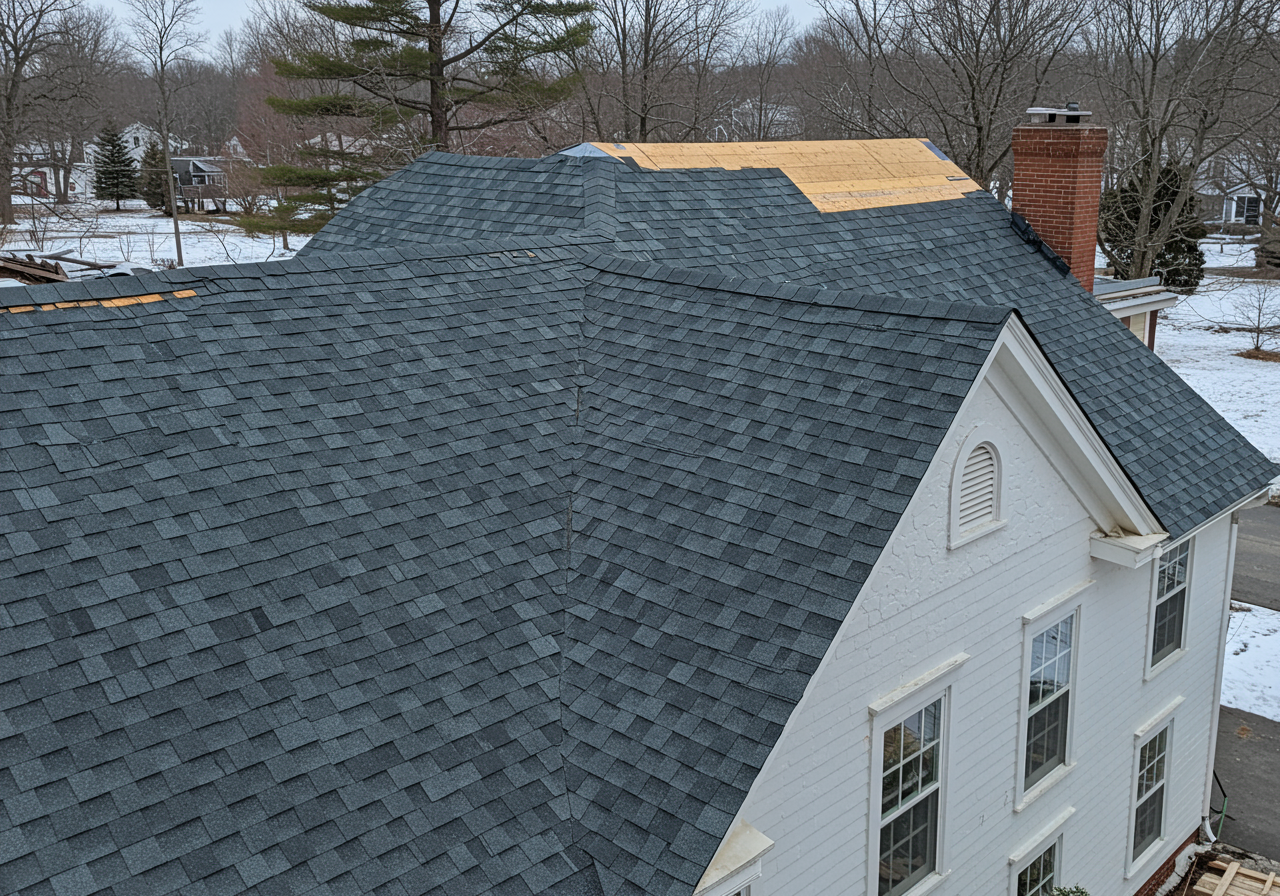
Storm-Ready Roofing Materials for Rocky Hill
Understanding material weight and durability is crucial for Connecticut's variable climate.
Metal Roofing: The 50-Year Math for Hartford County
I get a lot of emails asking if metal roofs are "too loud" or "too expensive." Let's talk numbers. A high-quality standing seam metal roof for a 2,200-square-foot colonial in Rocky Hill might run you $28,700, whereas asphalt sits around $14,400.
But here is the kicker: that asphalt roof will need replacing at least twice in the time it takes the metal roof to even think about showing its age. Plus, metal sheds snow. You won't be out there with a roof rake at 6:00 AM wondering if your rafters are about to snap under three feet of wet powder.
Projected Lifespan by Material (CT Climate)
The Synthetic Slate Secret: Style Without the Structural Stress
If you live in one of the more historic-looking pockets of Rocky Hill, you probably love the look of slate. But real slate is heavy—like, "your-house-needs-extra-steel-beams" heavy. It's also incredibly pricey.
Synthetic slate, made from recycled polymers, gives you that Dividend Pond aesthetic without the $60,000 price tag. I've helped homeowners find installers for these systems who see what other CT homeowners experienced with the same materials. The beauty of synthetic is that it's Class 4 impact rated. If we get a freak hail storm, these shingles bounce the ice right off while asphalt gets bruised.
"We almost went with the cheapest bid, but Dana showed us the math on the 'lifetime' cost. Choosing the synthetic shake saved us from a $4,200 ice dam repair two winters later."
Why Material Choice Fails Without Proper Ventilation
I don't care if you buy the most expensive copper roof on the planet; if your contractor skips the ridge vent or blocks your soffits, that roof is toast. In Rocky Hill, we deal with massive temperature differentials. If heat gets trapped in your attic, it melts the snow on your roof, which then freezes at the eaves. That's an ice dam.
The Ice Dam Warning
Negotiation Scripts: How to Talk to Your Contractor
When the salesman sits at your kitchen table, don't ask "How much?" Ask "What is the weight per square of this shingle?" and "Is this an SBS-modified product?"
If they start stammering, they're trying to sell you whatever they have the highest margin on. Here is a script I give my clients:
"I've reviewed the Connecticut consumer protection guidelines, and I want to see the manufacturer's spec sheet for this material included in the written estimate. I also need the permit fee listed as a separate line item, not rolled into 'miscellaneous costs.'"
This lets them know you aren't a mark. It tells them you're looking at the line-item math, not just the monthly payment.
Comparing the High-Performance Options
Not every material fits every budget. If you're planning on moving in five years, don't buy a 50-year metal roof. You won't recoup that investment. But if this is your "forever home" near the high school, investing upfront saves you the headache of dealing with the NWS historical storm events that seem to get more frequent every decade.
Initial Cost Comparison (2,500 sq ft Roof)
Note: While metal has a higher initial cost, it typically pays for itself over 18 years through energy savings and requires zero leak repairs. Basic asphalt may need replacement twice in the same timeframe, bringing total 30-year costs to approximately $31,000.
The Final Receipt: What You Should Actually Pay
In Rocky Hill, for a standard 2,500 square foot roof, a fair price for a high-quality architectural shingle (including tear-off, disposal, and new flashing) sits between $13,850 and $17,200. If someone quotes you $9,000, they are cutting corners—usually on the underlayment or the labor.
The best way to ensure you're getting a fair shake is to look at our blog library for more deep dives into specific material brands. Don't let a "one-day-only" discount pressure you into a material that isn't right for your specific roofline.
Get Your Free Roof Quote
Enter your zip code to get started
The bottom line is simple: Connecticut weather is moody. Your roof shouldn't be. Spend the extra 10% now on a material that can handle a Nor'easter, and you'll save yourself 50% in repair costs down the road. If you've noticed a few shingles in your yard after the last wind storm, don't wait for a leak to start. You might just need a simple repair service rather than a full replacement, but you won't know until you get an honest set of eyes on it.
Frequently Asked Questions

About Dana Jackson
Verified ExpertDana Jackson is a Homeowner Advocate & Cost Analyst who helps Connecticut families navigate the financial aspects of roofing projects. She specializes in finding the best value and avoiding common pricing pitfalls.