
Key Takeaways
- Verify Material Requirements: Not all historic zones require authentic slate or cedar; synthetic alternatives can save you $12,000+.
- Structural Math: Expect a $4,500 to $7,000 "surprise" if your original skip-sheathing isn't compatible with modern shingles.
- Contractor Vetting: Only use crews with documented experience in steep-slope historic preservation and OSHA-compliant safety setups.
- The "January Advantage": Booking during the off-season in Cromwell can sometimes shave 8% off the labor quote.
Walking through the Main Street Historic District in Cromwell during January always reminds me why "standard" roofing advice fails here. You're looking at these stunning Queen Annes and Italianates, thinking about preservation, while a contractor is likely thinking about how to upcharge you for "complexity." I've seen homeowners in Middlesex County handed estimates that look like phone numbers just because their gables have a bit of personality.
But here's the reality: a historic roof doesn't have to be a financial black hole if you know which line items are legitimate and which are just "historic fluff." I've spent the better part of my career looking at these quotes, and most of the time, the "historic premium" is a lack of transparency. If your home was built before 1920, you aren't just buying shingles; you're buying a specialized labor plan.
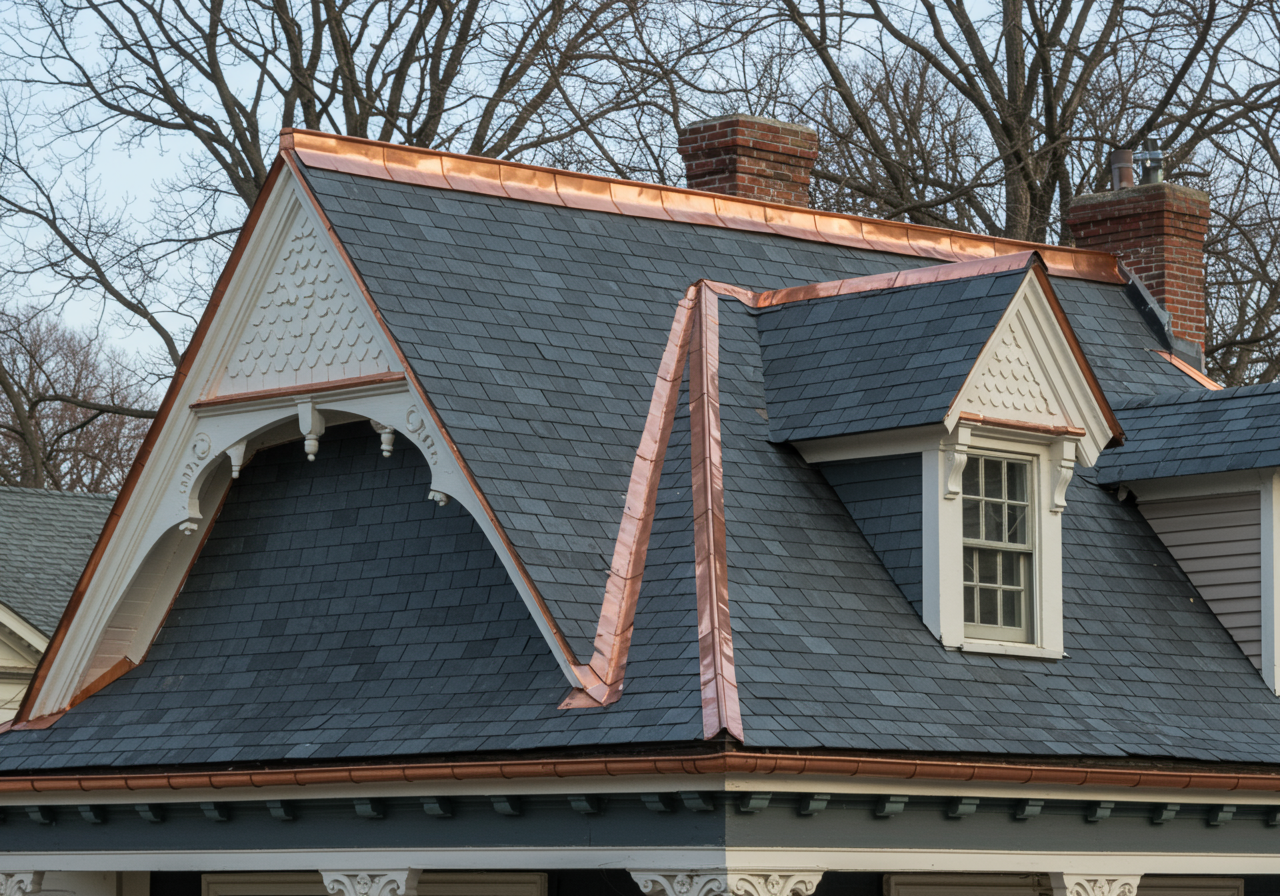
Historic Cromwell home with ornate roof details
Historic homes require specialized roofing approaches, but that doesn't mean you should pay inflated prices without understanding the breakdown.
The Cromwell Historic District Premium: What's Real?
In Cromwell, the "historic" label often adds a silent 15% to 42% markup on labor. Why? Because a crew can't just "rip and flip" a roof with six different dormers and a 12/12 pitch. I recently reviewed a quote for a home near the Cromwell Landing where the contractor added a $3,200 "difficulty fee" without explaining what was difficult.
When you see a lump sum like that, you need to push back. Ask for the "man-hour" estimate. If a standard ranch takes 40 man-hours and your Victorian takes 110, the math should reflect that labor—not a vague "complexity" tax. I always tell people: if they can't explain the fee in hours or specific materials, it's probably a "because I can" charge.
Understanding Labor Intensity
Historic roofs often require hand-nailing or specialized flashing work that takes three times longer than a standard install. In Cromwell, where we have a lot of transitional styles, you might have one section of the roof that is relatively flat and another that is nearly vertical. For those lower slopes, you should check out FEMA's guidelines on low-slope protection to ensure your contractor isn't cutting corners on the transition zones.
Material Wars: Cedar Shake vs. Synthetic Realities
One of the biggest financial decisions you'll make is choosing between "authentic" and "architecturally accurate." Authentic cedar shakes in Connecticut are currently running about $950 to $1,200 per square (a 10x10 area). Meanwhile, high-end synthetics that look identical from the street cost about $600 to $800 per square.
I worked with a homeowner last year who was told by a local Cromwell contractor that they "had" to use real slate to maintain property value. We did the math: the slate was $48,000, while a high-end synthetic slate was $24,500. The appraisal difference? Less than $5,000.
Tax Credits and Incentives
Don't forget that your material choice might qualify for federal help. If you're opting for energy-efficient materials that meet certain criteria, you might be eligible for the Energy Efficient Home Improvement Credit. You can find the specific requirements in the IRS Instructions for Form 5695. It's not a huge amount, but it's money that belongs in your pocket, not the government's.
Estimated Cost per Square (Cromwell Market)
Structural Integrity: The $4,800 "Unexpected" Decking Cost
Here is where Cromwell homeowners get blindsided. Many of our older homes use "skip-sheathing"—boards with gaps between them meant to let cedar shakes breathe. If you switch to asphalt or synthetic, you can't nail them into air. You have to "re-deck" the entire house with plywood or OSB.
I've seen quotes where the contractor "forgot" to mention this until the old roof was off. Suddenly, you're hit with a $5,240 change order. Here's my rule: if your house was built before 1950, your contract must include a "per sheet" price for plywood and a clear estimate of how many sheets are anticipated.
Why the Decking Matters
If you don't address the substrate, your new $20,000 roof will look like a wavy mess within three years. It's better to find local roofing pros who will pull a few shingles back during the estimate to see what's actually underneath.
Navigating Cromwell's Historic Preservation Requirements
If you're in the designated historic district, the Town of Cromwell has a say in what your roof looks like. I've seen homeowners buy $15,000 worth of materials only to have the building inspector halt the project because the color wasn't "period-appropriate."
But here's a tip: "Period-appropriate" is often subjective. If you can show that a certain shingle color was common in the 1890s, you can often win the argument. Don't let a contractor tell you "the town won't allow that" without seeing the code yourself. Usually, they just want to install the material they have in stock.
Identify if your home is in the Main St or Jenneys District.
Check the Cromwell Historic District map to determine if your property falls within a regulated area.
Obtain a Certificate of Appropriateness from the Historic District Commission.
Submit your roofing plans and material samples for approval before starting work.
Request a detailed material sample from your contractor.
Ensure the exact color and style match what you're being charged for.
Submit your permit application to the Cromwell Building Department.
The Historic District Commission approval must be included with your permit application.
Ensure the contractor posts the permit before the first dumpster arrives.
This protects you from fines and ensures all work is properly documented.
The Winter Installation Myth (Why January Matters)
Most people think roofing in January is impossible in Connecticut. It's not. In fact, if you have a historic home with a massive attic, doing the work now prevents the "attic bake" that happens in July. Shingles can be installed in cold weather as long as the contractor uses "hand-tabbing" (adding a bit of roofing cement to each shingle) since the self-sealing strips won't activate until it hits about 45-50 degrees.
I've seen January quotes come in $1,500 lower simply because the crews are looking for work. However, you must ensure they are following OSHA safety standards for ice and frost. A fall on a 12/12 pitch Victorian is a liability nightmare you don't want.
Negotiation Script: How to Talk to Specialized Contractors
Stop asking "What's the total?" and start asking "How did you get to this number?" Specialized contractors expect to be challenged; the bad ones will get defensive, and the good ones will show you their math.
The Script:
"I see the labor is quoted at $12,000 for 18 squares. That's about $660 per square in labor alone. Can you walk me through why this specific roof requires double the standard Middlesex County labor rate? Is it the flashing, the pitch, or the tear-off of multiple layers?"
If they mention "multiple layers," ask how many. If they find a third layer they didn't account for, that's a legitimate cost. If they just say "it's an old house," they're trying to hide a 20% margin.
Flashings and Finials: The High-Cost Details
On a historic Cromwell home, the "details" aren't just for looks—they are the most common leak points. I'm talking about copper valleys, ornate chimney flashings, and those beautiful ridge crestings.
A lot of contractors will try to swap copper for "copper-colored aluminum" to save money. Aluminum is fine, but it shouldn't be priced like copper. Copper is a forever metal; aluminum has a 25-year life in our CT winters. If you're paying for the "Historic Look," make sure the materials match the price tag. I always demand a separate line item for "Specialty Metal Work."
The Magnetic Test
Protecting Your Investment: Long-Term ROI in Middlesex County
A roof on a historic home isn't just a maintenance item; it's a "curb appeal" asset. In a town like Cromwell, where people pay a premium for "the look," a cheap 3-tab shingle roof on a Victorian can actually drop your home's value by more than the cost of the roof.
Investing in a high-quality architectural shingle or synthetic slate pays off during the home inspection. When a buyer sees a 50-year roof on an 1880s house, they stop worrying about the "old house" headaches. Before you sign anything, make sure you understand how our matching process works to ensure you aren't just getting the cheapest bid, but the one that protects your equity.
"In historic preservation, the most expensive roof is the one you have to install twice because the first contractor didn't understand 19th-century rafters."
Get Your Free Roof Quote
Enter your zip code to get started