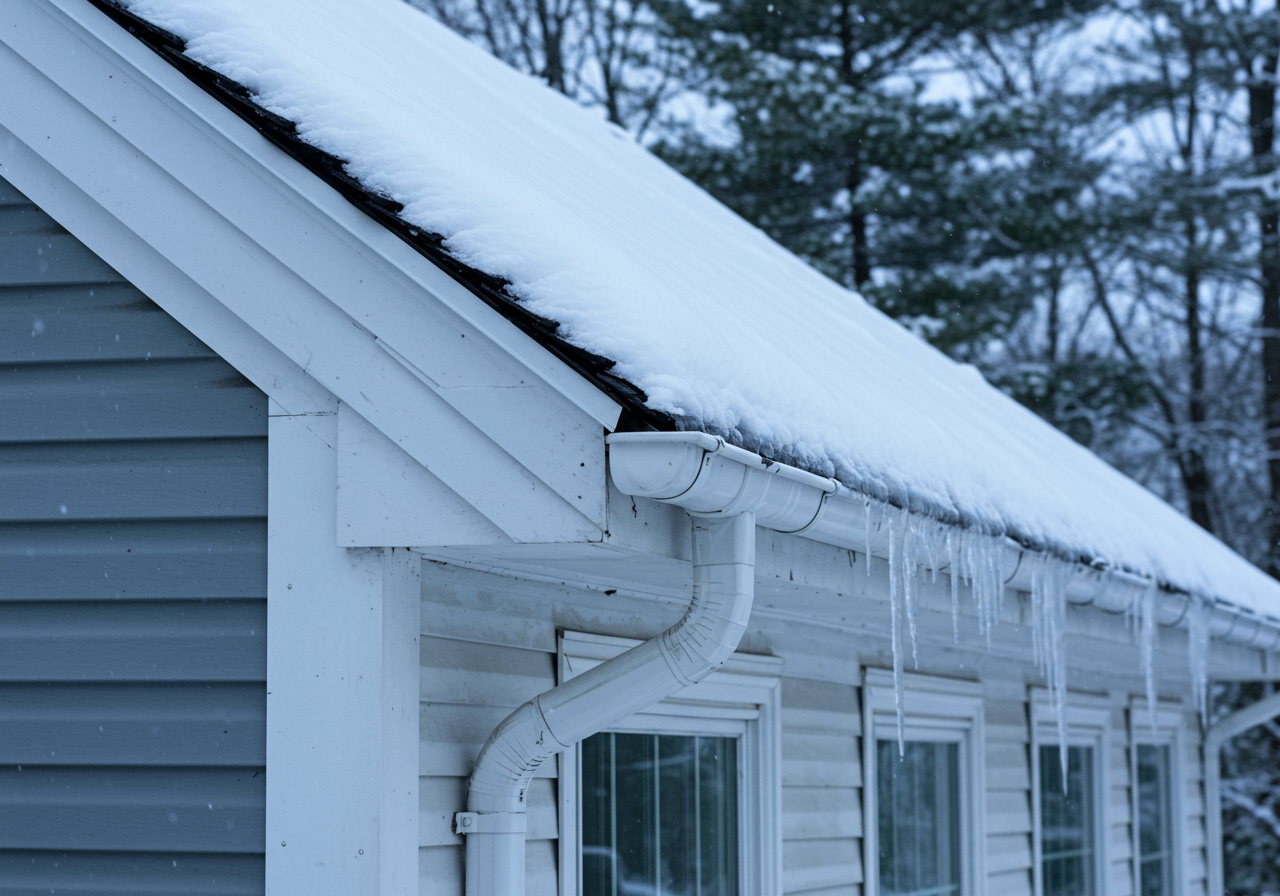
Ice Dams on Colchester Homes
Massive ice formations hanging from eaves indicate structural failure in progress, not just winter aesthetics.
If you've spent any time driving past the historic Colonials near the Colchester Town Green in February, you've seen the "ice daggers." Those massive, glistening formations hanging from the eaves might look like a New England postcard, but to a consultant, they look like a structural failure in progress. I've spent countless hours in attics across New London County, and the story is almost always the same: a homeowner buys a brand-new roof, but within two winters, the leaks are back.
The oversight isn't the shingles; it's the thermal envelope. In Colchester, we deal with a specific cocktail of humid air from the Sound and cold drafts from the north. When your attic isn't properly isolated from your living space, that expensive heat you're paying for escapes, warms the roof deck, and creates a cycle of melting and freezing that no gutter can handle. If you're tired of "poking" at the problem with salt pucks, we need to talk about the actual physics of your home.
Key Takeaways
- Most Colchester homes built before 2000 have R-19 insulation when they need R-49 to R-60.
- The 1/300 ventilation rule requires one square foot of vent area per 300 square feet of attic floor space.
- Ice and water shields only mitigate damage after dams form—they don't prevent the dams themselves.
- A single unsealed attic bypass can vent 110-degree air directly against the roof deck, causing ice dams.
1. The R-Value Deficiency in New London County
Most homes in our area built before 2000 were insulated to standards that are now laughably obsolete. I recently inspected a 1980s ranch near Hayward Lake where the attic had about six inches of settled fiberglass batts—roughly an R-19 value. According to current federal home repair efficiency guidelines, Connecticut homes should ideally aim for R-49 to R-60.
When your insulation is thin, heat "washes" through the ceiling. But the real killers are attic bypasses—hidden gaps around chimney chases, plumbing stacks, and recessed lights. I've seen thermal imaging where a single unsealed light fixture was venting 110-degree air directly against the plywood roof deck. No amount of "magic shingles" will prevent an ice dam if your roof deck is 20 degrees warmer than the outside air.
Common Sources of Attic Heat Loss (%)
2. The Math of Proper Roof Ventilation
Look, the goal of a winter roof is to stay cold. To achieve that, you need a balanced flow of air. We use the 1/300 rule: for every 300 square feet of attic floor space, you need one square foot of net free vent area. Half of that should be at the intake (soffits) and half at the exhaust (ridge vent).
I've walked onto jobs where a contractor installed a high-end ridge vent but forgot to check if the soffits were actually open. In many Colchester homes, generations of DIY painters have accidentally painted the soffit vents shut, or a previous insulation crew blew cellulose right over the intake baffles. Without intake, your ridge vent is just a decorative plastic strip. When air stagnates, it holds moisture and heat—the two ingredients for a $4,000 ice dam repair. If you suspect your airflow is choked, verifying your contractor's technical knowledge is the first step before signing any maintenance contract.
3. Why Ice and Water Shields Aren't Enough
There is a common myth that "ice shield" (the sticky bitumen membrane) prevents ice dams. It doesn't. It only mitigates the damage after the dam has formed. In Connecticut, code requires this membrane, but many crews take shortcuts. I've seen "pros" only run one three-foot course at the edge.
In our climate, especially on lower-pitched roofs found on many Colchester additions, you need at least two courses. The membrane must extend at least 24 inches past the interior wall line. I've got a digital folder of photos from the 2018 winter where dams backed up four feet onto the roof. If that membrane stopped at the wall line, the water just found the first nail hole and poured into the drywall. Using our automated matching system can help you find crews who don't skimp on these critical underlayments.
Did You Know?
A single cubic foot of ice weighs approximately 57 pounds. On a standard 50-foot gutter run, a massive ice dam can add over 1,500 pounds of dead weight to your eaves, risking structural collapse.
4. The Gutter Misconception and Emergency Risks
I hear it every year: "My gutters are clogged, that's why I have ice dams." While clean gutters help, they aren't the primary cause. An ice dam forms on the roof deck, usually right above the wall plate, because the snow melts on the warm upper roof and freezes on the cold overhang. The gutter just happens to be the "bucket" that catches the mess.
However, if your gutters are full of frozen debris, they become a lever that can pull the fascia board right off the house. If you see your gutters sagging or water backing up under the shingles, you've moved past "maintenance" and into "crisis." In those moments, you need emergency leak mitigation rather than a standard quote. I've seen homeowners try to climb ladders in February to chip ice with a hammer—please, don't. According to OSHA safety standards for residential work, frozen roofs are among the most lethal environments for non-professionals.
Check attic insulation depth
Aim for 15-20 inches of loose-fill insulation to achieve R-49 to R-60 values.
Inspect soffit vents from the outside
Ensure they aren't painted shut or blocked by debris.
Verify rafter baffles
Ensure baffles are installed to keep insulation from blocking airflow at the eaves.
Seal attic 'bypasses'
Use fire-rated foam to seal gaps around wires, pipes, and recessed lights.
Ensure proper exhaust venting
Bathroom exhaust fans must vent through the roof, not into the attic space.
5. Moving Toward a "Cold Roof" Strategy
The ultimate solution for Colchester homeowners is a "cold roof" strategy. This means creating a complete thermal break between your heated rooms and the roof deck. It's a combination of air sealing, high-R-value insulation, and unobstructed airflow.
I always tell people to check the NWS Historical Storm database to see the frequency of "freeze-thaw" cycles in New London County. We get dozens of them every winter. Every time the temperature fluctuates across that 32-degree line, a poorly ventilated roof is under attack. If your roofer isn't talking about "intake-to-exhaust ratios" or "attic bypasses," they aren't giving you a solution—they're just selling you shingles.
Get Your Free Roof Quote
Enter your zip code to get started
Conclusion
Addressing ice dams requires looking at your home as a system, not just a surface. By focusing on insulation and ventilation first, you protect your biggest investment and keep your winter energy bills from disappearing through the roof.
FAQ

About Daniel Roberts
Verified ExpertDaniel Roberts is a Senior Roofing Consultant with over 15 years of experience in the New England residential construction industry. He specializes in storm damage assessment and energy-efficient roofing systems.