
Key Takeaways
- Nearly 40% of storm-related insurance claims involve secondary damage from 'limb-drop' that homeowners miss during initial inspection.
- Tree impacts can cause structural fractures invisible from the ground—always get a professional assessment before accepting insurance estimates.
- The average cost to repair localized tree damage in Middlesex County ranges from $2,800 to $6,400, but can climb to $12,000+ if decking is pierced.
- A proactive $800 pruning job by a local arborist is much cheaper than a $1,000 insurance deductible and a month of construction stress.
Did you know that in Middlesex County, nearly 40% of storm-related insurance claims involve secondary damage from "limb-drop" that homeowners completely miss during their first walk-around? It's a staggering figure, but it makes sense when you look at our beautiful, tree-lined streets in Durham. We love our towering oaks and maples—they give our town its character—but when a March wind gust sends a heavy branch toward your shingles, the problem is rarely just "surface deep."
I remember helping a friend over near the Durham Fairgrounds last spring. A massive white oak limb had come down right over her kitchen. From the driveway, it looked like a few mangled shingles and a gutter that had seen better days. But once we got a professional eye on it, the story changed. The impact had actually jarred the ridge beam, creating a structural headache that would have stayed hidden until the next heavy rain. As homeowners, we tend to focus on what we can see from the curb, but the real "decision" involves understanding the trauma beneath the surface.
The Instant Triage: Safety Over Shingles
When a tree makes contact with your home, your first instinct is usually to grab a ladder or run outside to survey the mess. Here's the thing: stop. If a limb larger than your arm has hit the roof, the structural integrity of those rafters is officially a question mark. I've seen Durham homes where the impact didn't punch a hole through the ceiling, but it did crack the underlying supports.
Before you even think about calling an adjuster, walk through your top floor. Are the doors sticking suddenly? Do you see new cracks in the drywall tape near the ceiling? These are the "tells" of a home that has shifted under weight. We often think of our roofs as solid shields, but they are actually complex systems designed to distribute weight evenly. A sudden, localized impact from a tree throws that balance off completely.
If you're unsure where to start, I always recommend you verify your contractor's license before letting anyone climb up there. A professional knows how to spot "deflection"—that subtle bowing of the roofline—that a standard handyman might miss while he's busy quoting you for a shingle patch.
Beyond the Surface: Identifying Hidden Trauma
In Durham, we deal with a lot of colonial and cape-style homes where the attic is a tight squeeze. However, that's exactly where the real assessment happens. When a tree hits, the energy travels through the shingles, through the plywood decking, and directly into the rafters.
Check your attic for "daylight holes," obviously, but also look for "splintering" along the wood beams. Sometimes the wood doesn't break; it just compresses. This compression can compromise your home's ability to handle the next heavy snow load. Furthermore, impact damage often crushes the baffles used for attic ventilation. According to the Department of Energy's insulation guidelines, proper airflow is what prevents ice dams and mold. If a tree limb flattened your vents, you're not just looking at a leak—you're looking at a future rot problem.
Minor vs. Major Impact Assessment
| Feature | Minor Scuff | Structural Trauma |
|---|---|---|
| Shingle Condition | ||
| Interior Signs | ||
| Attic View | ||
| Urgency |
The Durham Aesthetic: Curb Appeal vs. Patchwork
As someone who obsesses over how a roof meets the sky, I have to talk about the visual "scarring" of tree damage. Durham has a very specific neighborhood feel—whether you're on Main Street or tucked back near Miller Pond. A bright, brand-new patch of shingles in the middle of a 12-year-old weathered roof is an eyesore that can actually ding your home's value.
When a tree takes out a section of your roof, you're faced with the "Replacement Ripple Effect." If your shingles are older, the manufacturer might not even make that specific color blend anymore. Even if they do, the new ones won't have the "patina" of the sun-faded originals. I recently saw a beautiful colonial where the owner tried to save money by just replacing a 10x10 square. From the street, it looked like a giant dark band-aid.
If you're worried about how a repair might impact your home's look, our blog library has some great deep dives on color matching and when it's actually more cost-effective to replace the entire slope for the sake of uniformity. Sometimes, the insurance payout for a large repair is only a few thousand dollars away from covering a full replacement that resets your roof's lifespan to year zero.
Ensure everyone is safe and the structure is stable from inside.
Check for structural damage signs like stuck doors or new ceiling cracks before going outside.
Document the damage with photos from the ground (don't climb!).
Take comprehensive photos from multiple angles before any debris is moved or removed.
Contact a tree removal service to safely clear the debris.
Get professional help to remove the tree safely without causing additional damage.
Get a professional roofing assessment for hidden structural cracks.
Have a licensed contractor inspect the attic and roof decking for invisible damage.
Contact your insurance provider with the contractor's detailed report.
Submit a comprehensive claim with professional documentation to ensure full coverage.
Navigating the Insurance and Estimate Maze
Let's talk numbers. In Middlesex County, the average cost to repair localized tree damage typically ranges from $2,800 to $6,400. However, if the decking is pierced or the gutters are ripped off, that can easily climb toward $12,000.
The biggest mistake I see Durham homeowners make is accepting the first check the insurance company offers. Adjusters are often looking at the "depreciated value" of your shingles, not the "replacement cost" of the labor in Connecticut. Our local labor rates are higher than the national average, and your estimate needs to reflect that.
I always tell my neighbors: don't just take the insurance company's word for it— see what other CT homeowners experienced when dealing with storm claims. Using a contractor who knows how to document "supplemental" damage—the stuff found after the tree is removed—is the difference between paying $500 out of pocket (your deductible) and paying $5,000 because the "hidden" rafter damage wasn't in the original claim.
"A tree impact is a dynamic load. The damage isn't just where the branch sits; it's everywhere the energy traveled through the frame of the house."
Material Choices for a Wooded Lot
If you live in a part of Durham where the trees are particularly close to the house, this repair is the perfect time to rethink your materials. If a falling limb just shredded your standard three-tab shingles, maybe it's time to look at architectural shingles or even metal.
While no roof is "tree-proof," some materials handle impact much better. Class 4 impact-rated shingles are designed to withstand hail, but they also offer a higher level of tear resistance against falling branches. Alternatively, if you're looking at a full replacement, you might consider the EPA's research on cool roofing to see how modern materials can also lower your summer cooling bills while providing better protection.
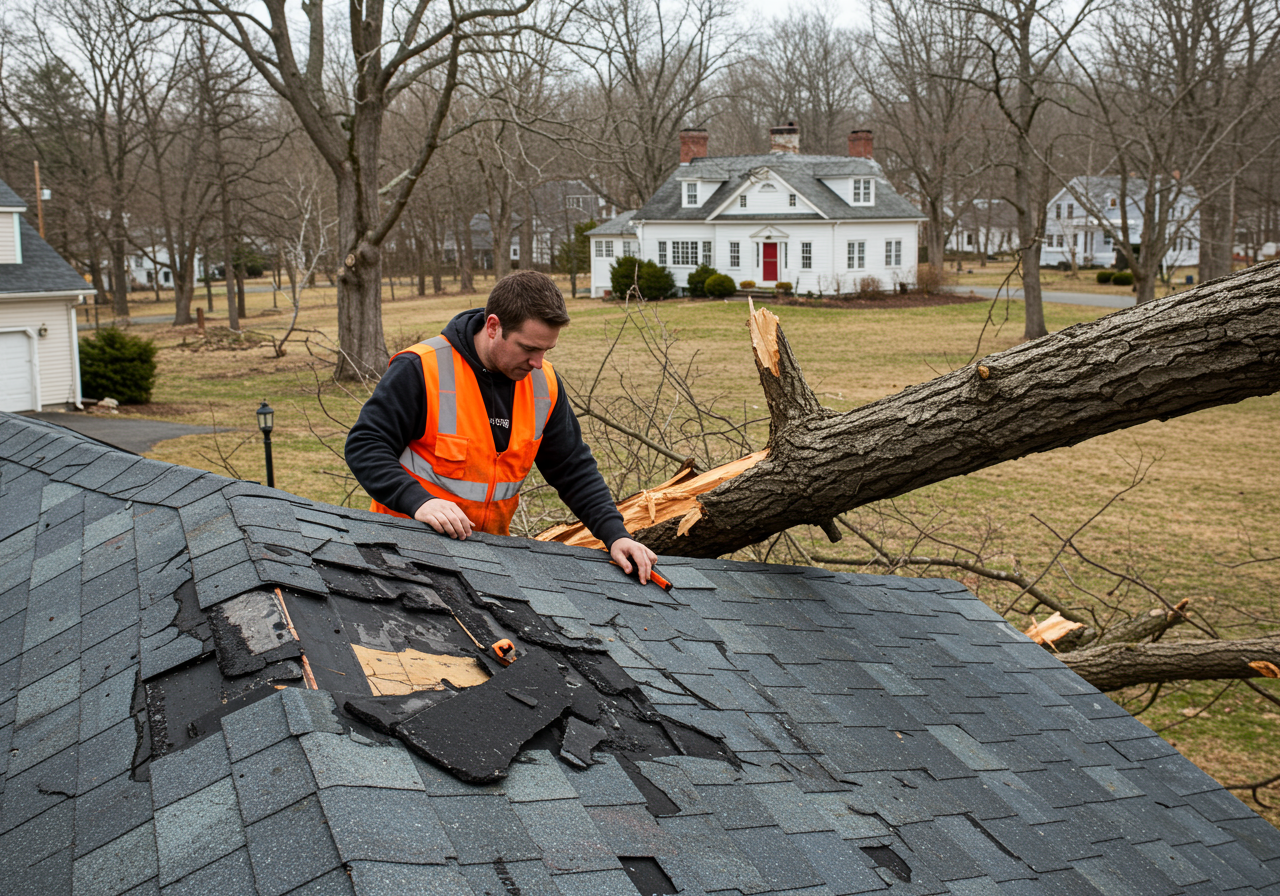
Structural Assessment in Progress
A professional contractor inspecting a Durham roof for hidden rafter damage after a storm.
Future-Proofing Your Durham Home
The best way to "solve" tree damage is to prevent the second act. After the roof is fixed, look at the remaining canopy. March in Connecticut is notorious for "heavy" winds that prey on trees already weakened by winter ice.
I've found that a proactive $800 pruning job by a local arborist is much cheaper than a $1,000 insurance deductible and a month of construction stress. Look for "included bark"—those V-shaped crotches in the tree limbs—and branches that hang directly over your peak. For low-slope sections of your home, like a back porch or garage, consult the FEMA structural protection guide to understand how to reinforce those areas against future impacts.
Repairing a home after a tree fall is emotional. It's loud, it's intrusive, and it's a lot of paperwork. But if you take it step-by-step—focusing on the structure first, then the aesthetics—you can turn a disaster into an opportunity to strengthen your home for the next twenty years.
Ready to see how much those repairs should actually cost?
Use our instant estimator to get matched with verified Durham pros who know how to handle storm damage correctly.
No credit card required • Free to use
Get Your Free Roof Quote
Enter your zip code to get started