
Key Takeaways
- The Neoprene Lifecycle: Standard rubber pipe boots in Connecticut usually fail between year 10 and 12, often long before the shingles do.
- The 'Squirrel Factor': Farmington's wooded neighborhoods mean lead boots are often chewed by rodents, leading to immediate leaks.
- Cost vs. Value: A proactive $415 repair can prevent a $5,000 mold remediation project in your attic.
- Proper Fixes: Avoid the 'caulk-only' approach; true repairs require integrated flashing and shingle weaving.
I was out near the Farmington River last week, not far from the Hill-Stead Museum, looking at a beautiful colonial that had what the owner called a "ghost leak." The water would appear in the upstairs bathroom ceiling after a steady rain, then vanish for a month. She was already bracing for a $17,000 roof replacement. But look, I've seen this movie before. I climbed up, moved a few soggy leaves, and found the culprit in about thirty seconds: a cracked neoprene gasket on a vent pipe boot.
It's a common story in Hartford County. Homeowners see a water stain and immediately think the shingles have failed. In reality, the most vulnerable parts of your roof aren't the shingles themselves—it's where the roof is "punctured" for plumbing vents. These pipe boots (the flashing around those black pipes sticking out of your roof) are often the first thing to fail. In my 17 years in the field, I've found that these small rubber rings are responsible for a staggering amount of preventable interior damage.
The Anatomy of a Failure: Why Farmington Pipe Boots Give Out
Most builders in the Farmington area use standard "no-caulk" neoprene boots because they are cheap and fast to install. They look great on day one. But Connecticut weather is a beast. We deal with massive temperature swings that cause your roof deck to expand and contract. This "thermal shock" puts immense pressure on the rubber gasket. Over a decade, the sun's UV rays bake the oils out of that rubber, making it brittle.
When that rubber cracks—even a hairline fracture—capillary action pulls water right down the side of the PVC pipe. This water doesn't always hit the floor; it often runs down the outside of the pipe, behind your drywall, and settles on a ceiling joist. By the time you see a brown circle on your ceiling, that water has likely been rotting your plywood for months.
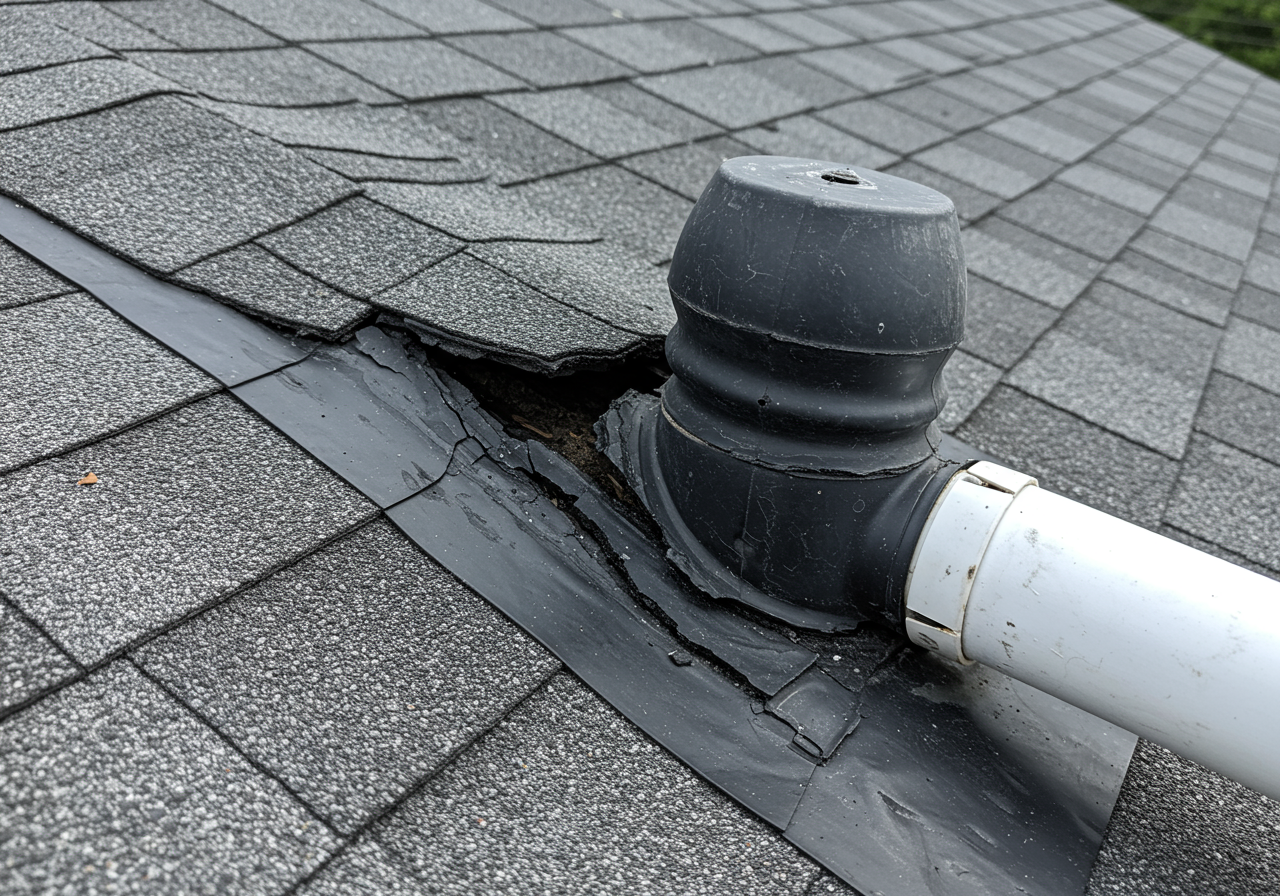
A cracked neoprene pipe boot gasket on a Farmington roof
This small rubber ring failure is responsible for 82% of localized attic leaks in Hartford County homes.
I've torn apart roofs in neighborhoods like Devonwood where the shingles were pristine, but the plywood around the vent pipes was so soft you could stick a screwdriver through it. If you're noticing moisture, it's worth checking these penetrations before assuming you need a full replacement. You can connect with verified contractors who specialize in these targeted repairs rather than jumping into a total overhaul.
The Farmington "Mystery Leak" Case Study
Let's look at a real job I handled on High Street. The homeowner had three different "handymen" come out to slop roofing cement around a leaking vent pipe. Each time, the leak stopped for a few weeks, then returned. Why? Because roofing cement (that black tar in a tube) dries out and pulls away from the PVC pipe. It's a temporary Band-Aid, not a fix.
When we arrived, we found that the repeated "repairs" had trapped moisture against the roof deck, causing a $2,400 repair to balloon because we had to replace three sheets of rotted OSB decking. According to FEMA's guidelines on roof systems, proper flashing at penetrations is the single most important factor in preventing interior water damage during storm events.
In Farmington, we also have a unique problem: squirrels. If your home has lead boots (common on older or high-end installs), squirrels love to sharpen their teeth on the soft metal. I've seen lead boots in the Talcott Mountain area that looked like they'd been through a paper shredder. If you have lead, you need a protective cap or a switch to a high-quality silicone-based boot.
Repair vs. Replacement: Making the $600 Call
The question I get most is: "Daniel, can I just fix the boot, or is it a sign the whole roof is toast?"
It depends on the age of your shingles. If your roof is only 12 years old and the shingles are still supple, a boot replacement is a "no-brainer." We typically charge between $375 and $625 for a professional boot replacement, depending on the pitch of the roof and the type of material used. However, if your shingles are curling and losing granules, the act of prying them up to install new flashing might cause more harm than good.
Standard Neoprene Boot vs. High-Performance Silicone/Lead
| Feature | Standard Neoprene Boot | High-Performance Silicone/Lead |
|---|---|---|
| Average Cost | $250 - $400 | $450 - $650 |
| Lifespan in CT | 10-12 Years | 25-30 Years |
| Squirrel Resistance | High | Low (unless capped) |
| UV Resistance | Moderate | Excellent |
If you're unsure where your roof stands, you can get an instant roof estimate to see if a full replacement makes more financial sense than a series of expensive repairs. Sometimes, stacking up three or four $500 repairs over two years is just throwing good money after bad.
The Proper Fix: Beyond the Caulk Gun
If a contractor shows up to fix a pipe boot and only brings a ladder and a tube of caulk, send them home. A real repair requires "weaving." We have to carefully remove the shingles surrounding the pipe, install a new flashing unit (I prefer brands like Perma-Boot or high-gauge lead with a rain shield), and then install new shingles over the flange.
My crews bring torque drivers and specialized pry bars to ensure we don't break the seal of the surrounding shingles. We also check the "boots" on the plumbing side. Sometimes the leak isn't the roof at all—it's the PVC coupling inside the attic that has cracked due to house settling.
Debris Clearing
Remove all old roofing cement and brittle shingles around the pipe base.
Deck Inspection
Check the underlying wood for 'soft spots' or mold.
Flashing Installation
Slide the new boot over the pipe, ensuring a tight seal at the base.
Shingle Integration
Hand-nail new shingles over the flange using a 4-nail pattern.
Sealant Application
Use a high-grade polyurethane sealant (not silicone) on exposed nail heads.
Look, you don't need to be a roofing expert to protect your home. Just twice a year, grab a pair of binoculars and look at your roof pipes from the driveway. If you see the rubber "collar" pulled away from the pipe, or if the metal looks crushed, you're on borrowed time. Taking care of it now is the difference between a minor maintenance bill and a major insurance claim. For more roofing maintenance tips, check out our complete guide library. For those looking for long-term efficiency, Energy Star's guide to cool roofs notes that maintaining your roof's integrity is the first step toward a more energy-efficient home.
Expert Tip
Get Your Free Roof Quote
Enter your zip code to get started