
Key Takeaways
- Thermal Cycling: Rapid temperature swings in Stafford Springs cause shingles to expand and contract, leading to premature granule loss.
- The Ventilation Myth: Many local homes have 'dead air' zones in their attics that reach 150°F, literally baking the roof from the inside out.
- ROI Protection: Implementing reflective technology and proper airflow can extend roof life by 7–11 years.
- January Planning: Securing a contractor during the winter lull ensures your cooling upgrades are active before the first June 'heat dome.'
I was standing in a driveway off Orcuttville Road last July, watching a homeowner named Gary stare at his roof with a look of pure confusion. It was one of those stagnant Connecticut afternoons where the air feels like a damp wool blanket. Gary had replaced his shingles only eight years prior, but they were curling at the edges like overcooked bacon. "Noah," he asked me, "how is a '30-year shingle' giving up the ghost before its tenth birthday?"
The answer wasn't a manufacturing defect or a bad install. It was the thermal trap Gary had inadvertently built. While we spend most of January worrying about ice dams and the weight of wet snow near the Stafford Speedway, the silent killer of Tolland County roofs is actually the radiation we'll be soaking in six months from now. Most folks here think heat protection is about the shingles themselves, but it's a much more complex—and expensive—misunderstanding.
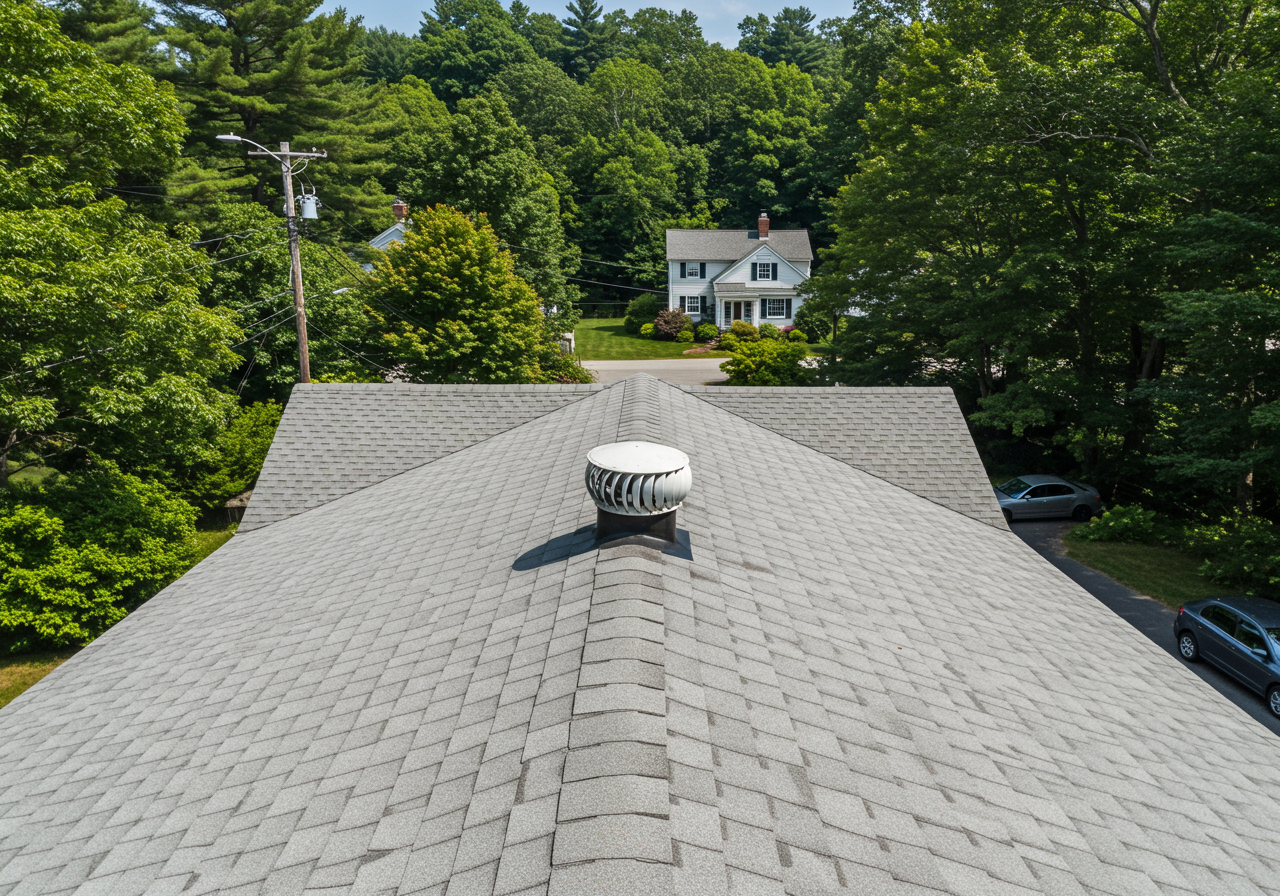
Heat Damage on Stafford Springs Roof
Premature shingle curling caused by excessive attic heat buildup
The Thermal Trap of Tolland County
Stafford Springs has a unique geographic profile. We aren't the shoreline, and we aren't the Litchfield Hills. We sit in a pocket where humidity from the Middle River can linger, creating a greenhouse effect on residential properties. When the sun beats down on a dark asphalt roof, the surface temperature can easily soar 50 to 60 degrees higher than the ambient air.
Why Your Shingles Are "Cooking"
Shingles are essentially mats of fiberglass soaked in oil-rich asphalt. Under intense UV radiation, those oils begin to dissipate. It's a process called "volatilization." Once those oils are gone, the shingles become brittle. In Stafford, I've seen roofs that look decades old simply because they lacked the proper reflective granules to bounce that energy back into the atmosphere.
The Expansion Gap Issue
Think about the temperature swing from a 40°F January night to a 90°F July afternoon. Your roof deck is constantly "breathing." If your protection strategy doesn't account for this movement, those shingles will eventually tear away from their fasteners. This is why finding local roofing pros who understand our specific Tolland County climate is so vital—they know to leave the right tolerances for our wild seasonal shifts.
Beyond Shingles: The Ventilation Equation
Most of the homeowners I talk to in the Stafford Library parking lot think a "cool roof" is just a lighter color of shingle. That's only half the battle. The real problem Stafford Springs homeowners don't expect is that their attic is acting like a convection oven.
"A roof is a system, not a lid. If you don't have a balanced intake of cool air from your soffits and an exhaust at the ridge, you're essentially asking your shingles to survive a slow-cooker environment every summer."
The Soffit Trap
I once inspected a beautiful colonial near the Mineral Springs where the owner had stuffed fiberglass insulation right up against the eaves. He thought he was being energy efficient. In reality, he had choked off the intake air. Without that fresh air flowing in from the bottom, the hot air at the top had nowhere to go. We measured his attic temperature at 152°F on a day when it was barely 88°F outside.
Passive vs. Powered Venting
In our neck of the woods, ridge vents are usually the gold standard because they don't require electricity and they aren't prone to mechanical failure during a summer thunderstorm. However, for some of the older, steeper Victorians in town, a solar-powered attic fan can be a game-changer. These fans kick on exactly when the UV index peaks, pulling that stagnant heat out before it can migrate into your living room.
Reflective Technology and Modern Solutions
We've come a long way from the basic black shingles of the 1990s. Today, "Cool Roof" technology involves specialized granules that reflect Infrared (IR) radiation. This isn't just about comfort; it's about the law.
Standard Asphalt vs. Reflective 'Cool' Shingles
| Feature | Standard Asphalt | Reflective 'Cool' Shingles |
|---|---|---|
| UV Resistance | ||
| Low Heat Absorption | ||
| Expected Lifespan in CT | ||
| Tax Credit Eligible |
Note: The comparison shows that reflective shingles have high UV resistance and low heat absorption (35-50% vs 80-90%), leading to longer lifespans (28-32 years vs 18-22 years) and tax credit eligibility.
The "Albedo Effect" on Your Electric Bill
By switching to a highly reflective surface, you can reduce your peak cooling demand by about 10–15%. In a town like Stafford where Eversource rates can be a bit of a headache, that adds up. According to the IRS instructions for Form 5695, certain energy-efficient roof replacements may even qualify for federal tax credits, making the "upgrade" more affordable than a standard replacement.
Radiant Barriers: The Hidden Shield
For those not ready for a full tear-off, I often suggest looking into radiant barriers. This is a thin layer of reflective foil applied to the underside of the roof rafters. It doesn't stop heat from entering the shingles, but it stops that heat from radiating into your attic. It's a "Stage 2" defense that many contractors in Tolland County forget to mention.
Noah's Pro Tip
The Real Cost of "Baking" Your Attic
The financial impact of poor heat protection isn't just a higher AC bill in August. It's the massive loss of ROI on your home's most expensive component. I've seen $16,450 roof installations fail in twelve years because the owner ignored heat mitigation.
Estimated Roof Lifespan vs. Attic Temperature
Protecting Your Sheathing
When an attic stays too hot for too long, it doesn't just hurt the shingles. It dries out the plywood sheathing underneath. I've walked on roofs in Stafford that felt "spongy." That's not always rot; sometimes it's the wood fibers becoming so brittle from heat that they lose their structural integrity. Replacing that plywood can add $3,200 to $5,800 to a standard job.
Moisture and Heat: The Dangerous Duo
It sounds counterintuitive, but a hot attic in the summer often leads to mold in the winter. The heat causes any moisture in the house (from showers or cooking) to stay in a vapor state. When that vapor hits the underside of the roof deck at night, it condenses. Proper summer heat protection—specifically ventilation—is actually your best defense against winter mold. If you're struggling with these costs, USA.gov offers resources for home repair assistance that can sometimes help with critical structural upgrades.
Get Your Free Roof Quote Today
Connect with verified CT pros in minutes.
No credit card required • Free to use
Planning Your Summer Defense in Mid-Winter
Why are we talking about the sun in the middle of a Connecticut January? Because by the time you're sweating in July, every reputable roofer in Tolland County will be booked through October.
Why January is the Best Time to Quote
Right now, contractors are looking at their spring and summer calendars. You have the leverage. You can take the time to learn how ZikQuote works and get matched with a pro who actually understands thermal dynamics, rather than just the guy who happened to be available during a leak emergency.
The Inspection Checklist
Before the spring rains hit, grab a flashlight and head into your attic.
Check for Light
Can you see daylight at the eaves? (That's good—it means your soffits are open).
Feel the Air
Is it significantly stuffier than the rest of the house?
Inspect the Nails
Are there 'shingle pops' where nails are pushing upward? This is a classic sign of heat-related deck expansion.
If you see these signs, don't wait for the mercury to hit 90. The best way to save $7,500 on a roof is to ensure the one you have doesn't cook itself to death. You can get an instant roof estimate right now to see where your budget stands for a "cool roof" upgrade.
Get Your Free Roof Quote
Enter your zip code to get started
January is for planning; July is for enjoying the shade. Let's make sure your roof is ready for both.