
Key Takeaways
- February is the strategic month for equity audits before spring competition drives up rates.
- Local credit unions often offer 6-8% APR compared to contractor financing at 9-14% APR.
- Federal energy credits can save $1,200+ on qualifying roofing materials in 2026.
- HELOCs provide flexible funding for historic homes that may need unexpected structural repairs.
Last February, I spent a snowy afternoon with a family living in a beautiful, breezy colonial near Sound View Beach. They knew their roof was on its last legs—those coastal winds had done a number on their shingles over the last 18 years—but they were staring at a $24,650 estimate that felt like a mountain they couldn't climb. They had the savings for about half, but the "math" of traditional financing felt like a maze of high interest rates and hidden fees. We sat down with their quotes and mapped out a strategy that combined a local credit union's terms with some overlooked federal credits. By the time the spring thaw hit, they weren't just "getting by" with a patch; they had a full replacement scheduled without draining their retirement fund. That's the thing about roofing in Old Lyme: the salt air doesn't wait for your bank account to catch up, so you have to be smarter than the storm.
1. Why February is the Strategic Month for Equity Audits
While most of your neighbors are focused on heating bills or planning summer trips to the Point, February is actually the "golden window" for sorting out your roofing math. If you wait until April to look for a loan, you're competing with everyone else in Connecticut who just noticed a leak during the spring rains.
By starting now, you have the luxury of time to audit your home equity. In New London County, property values have shifted enough that you might have more "borrowing power" than you did three years ago. I always tell homeowners to look at their roof as a design investment that protects that equity. If you're curious about how a new architectural shingle might change your home's profile, our blog library has some great visual guides on curb appeal that go beyond just the price tag.
2. The Local Credit Union vs. National Contractor Trap
Here is a reality I see far too often: a homeowner signs a contract with a big national roofing firm because they offer "easy financing" right at the kitchen table. It sounds convenient, right? But if you look at the fine print, those "zero-down" deals often bake a 5% to 10% "dealer fee" into the actual project price.
Before you sign anything, take a trip down to a local credit union right here in New London County. Local lenders often have "Green Energy" or "Home Preservation" loans with lower rates because they actually care about the housing stock in our community. I've seen Old Lyme residents save upwards of $2,300 just by choosing a local bank over the contractor's third-party lender. It's worth the extra afternoon of paperwork.
Local Bank vs. Contractor Financing
| Feature | Local Credit Union | Contractor 'Easy' Finance |
|---|---|---|
| Interest Rates | ||
| Hidden Fees | ||
| Approval Speed | ||
| Local Impact |
3. Shaving $1,200+ Off with Federal Energy Credits
If you are planning to upgrade to reflective "cool" shingles or a metal roof this year, you aren't just saving on your summer A/C bills. Under current 2026 guidelines, certain materials qualify for the Energy Efficient Home Improvement Credit.
According to the IRS instructions for Form 5695, you can often claim a credit for a percentage of the material costs. This isn't a deduction—it's a direct credit against the taxes you owe. On a typical $18,000 roof where materials make up half the cost, that's a significant chunk of change back in your pocket. I always suggest picking a color that meets Energy Star's cool roof requirements to maximize these benefits. Not only does it help the planet, but a lighter-toned roof can actually make a smaller Cape-style home look more expansive and modern from the street.
4. The HELOC Strategy for Historic Old Lyme Homes
Living in a town with as much history as ours means we often deal with "surprises" behind the rafters. If you own a home built before 1940, a standard personal loan might not cover the structural "oops" moments—like finding rotted decking or ancient masonry issues—that pop up once the old shingles are off.
A Home Equity Line of Credit (HELOC) is often the best fit for these projects because it acts like a credit card backed by your house. You only pay interest on what you actually spend. If the project goes smoothly, you only use the $15,000 for the roof. If the contractor finds $3,000 worth of "New England character" (aka rot) under the eaves, you have the funds ready to go. I've seen this save dozens of projects from stalling mid-way through.
Always ask your contractor for a 'contingency line item' in the quote
5. FHA Title I Loans: The Lifeline for Newer Homeowners
What if you just moved to Old Lyme and haven't built up enough equity for a HELOC? This is the "hidden gem" I wish more people knew about. FHA Title I Home Improvement Loans are backed by the government and don't require you to have a ton of equity in the home.
They are specifically designed for essential repairs—and in Connecticut, a functioning roof is definitely essential. You can borrow up to $25,000 for a single-family home. It's a fantastic way to handle a crisis without resorting to high-interest credit cards. If you're still weighing whether you need a full replacement or just a few patches to get through the season, see what other CT homeowners experienced when they had to make that same tough call.
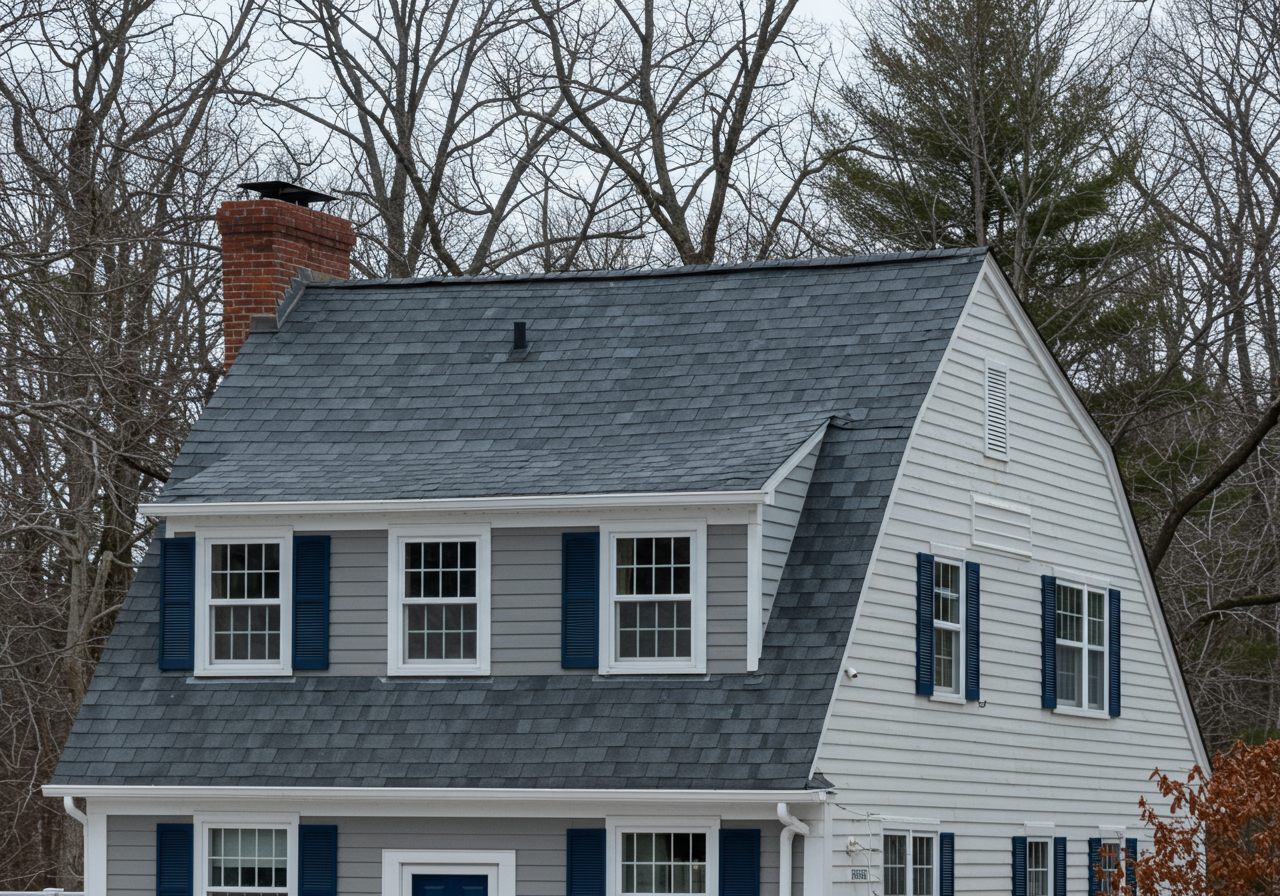
Investing in Curb Appeal
A charcoal gray architectural shingle roof on a colonial home in Old Lyme, providing both protection and classic New England style.
6. Navigating Insurance Claims and Financing Gaps
In our neck of the woods, we get our fair share of wind. If you're looking at a roof replacement because of storm damage, your insurance check might only cover the "actual cash value" rather than the full replacement cost. This leaves a "gap" that you have to fund yourself.
I've seen homeowners use a small 0% APR personal loan to bridge that $4,000 or $5,000 gap. This allows you to upgrade to a higher-quality shingle or add FEMA-recommended hurricane straps during the install, which can actually lower your future insurance premiums. It's about spending a little more now to stop the "bleeding" of your bank account later. If you find a leak and aren't sure if it's a full-roof situation, you can always start by looking into professional roof repairs to buy yourself some time.
Get a detailed inspection and quote from a verified local contractor.
Start with a thorough assessment of your roof's condition and get multiple quotes to compare.
Check your current credit score and home equity balance.
Understanding your financial position helps you choose the best financing option.
Apply for a pre-approval from a local New London County lender.
Pre-approval gives you negotiating power and helps you understand your borrowing capacity.
Review the quote for energy-efficient material options to trigger tax credits.
Look for Energy Star certified materials that qualify for federal tax credits.
Schedule your install for the early spring window.
Timing your project for early spring can help you avoid peak season pricing and delays.
7. The Hidden Cost of "Waiting for Next Year"
I'll be blunt: the most expensive way to finance a roof is to wait until it fails completely. When a roof leaks, it's not just the shingles you're replacing; it's the insulation, the drywall, and potentially the electrical system.
The cost of roofing materials typically rises by 3% to 5% every year. If you finance an $18,000 roof today at 7%, your monthly payment might be around $300. If you wait two years, that same roof might cost $20,000, and you'll have the added cost of interior repairs. I care about how your home meets the sky, but I also care about your peace of mind when those February Nor'easters start rattling the windows. Taking action now, even with financing, is almost always the cheaper route in the long run.
Ready to see what a new roof actually looks like for your budget?
Get an instant, honest estimate tailored to your Old Lyme home.
No credit card required • Free to use
Get Your Free Roof Quote
Enter your zip code to get started
Thinking about financing can feel overwhelming, but remember that you're not just buying shingles—you're buying ten years of not worrying every time the wind picks up off the Sound. Start by getting your numbers on paper. Whether you choose a HELOC, a local credit union loan, or a tax-credit-eligible material, the goal is to make a decision that fits your life as well as your house. You've got this!