While some Guilford homeowners are busy worrying about the next potential dusting of slush, others are looking at the long game of coastal survival. There is a massive disconnect between the current 41°F gray sky we're seeing today and the violent, humid reality of a New England hurricane. Right now, the air is still, the wind is a negligible 4 mph, and the humidity sits at 69%—conditions that feel like the "off-season." But in the roofing world, February is actually the starting gun.
The reality is that the contractors who are best equipped to handle hurricane-rated reinforcements are booked months in advance. If you wait until the first tropical outlook from the National Hurricane Center drops in June, you're already behind the curve. In Guilford, we have a unique geographic "fetch" across Long Island Sound that allows wind to accelerate over open water before slamming into our coastal colonial and ranch-style homes. I've seen 17 years of these patterns, and the homes that survive intact aren't the ones that got lucky—they're the ones that took advantage of the winter thaw to tighten their shells.
Key Takeaways
- February's 41°F temperatures provide the perfect conditions for roof inspections—shingles are firm but not brittle.
- Waiting until hurricane season means paying 'panic tax' premiums and facing contractor shortages.
- Guilford's coastal 'fetch' across Long Island Sound creates unique wind acceleration patterns that test roof integrity.
- Most roof failures start with a single weak link—a loose ridge cap or lifting corner—that can be fixed now for a fraction of the cost.
1. The False Security of the February Quiet
It's easy to feel safe when the biggest threat outside is a slippery driveway on Whitfield Street. But the 41°F temperature we're seeing right now is actually a gift for your roof's structural integrity. At this temperature, asphalt shingles are firm but not brittle. It's the perfect time for a physical inspection because you aren't dealing with the 140°F surface temperatures of July that make shingles soft and prone to scuffing under a technician's boots.
Most people think hurricane prep happens in the summer. That's a myth that costs New Haven County homeowners thousands of dollars in emergency premiums. When the barometer starts dropping and a storm is tracking up the coast, the price of plywood and labor doesn't just go up—it evaporates. By handling minor roof repairs during these quiet February weeks, you're avoiding the "panic tax" that hits the shoreline every time a storm gets named.
I remember a specific case in 2021 after Henri. Two neighbors in the Mulberry Point area had identical roofs installed in 2012. One had a specialist out in the late winter to check the perimeter flashing and seal the rake edges. The other waited. When the wind kicked up, the first house lost three shingles. The second house lost a 10-foot section of the roof deck because a tiny gap in the drip edge allowed the wind to get underneath and create a "parachute effect." The difference in repair costs was staggering—nearly $14,230 in interior restoration for the neighbor who waited.
"In the Connecticut climate, the most dangerous thing a homeowner can do is assume that a roof that doesn't leak during a snowstorm will hold up against a 95-mph wind gust. They are two entirely different physical stressors."
2. The Science of Wind Uplift on the Guilford Coast
We need to talk about physics, specifically Bernoulli's principle. When a hurricane-force wind hits your house, it doesn't just push against the walls. As the wind rushes over the peak of your roof, it speeds up, creating a zone of low pressure. Meanwhile, the air inside your attic is at a higher pressure. This creates a massive "sucking" force—uplift—that tries to rip the roof right off the rafters.
In Guilford, the "fetch" (the distance wind travels over water) is a major factor. Because there are no hills or trees on the Sound to break the wind's momentum, our coastal homes take the full brunt of the energy. According to FEMA's hurricane mitigation research, wind speeds can be significantly higher at the corners and ridges of a roof.
I've spent hours looking at NOAA radar data during past nor'easters, and the wind patterns in New Haven County are notoriously erratic. If your roof was installed with the standard "four-nail" pattern instead of the hurricane-recommended "six-nail" pattern, your shingles are essentially just waiting for the right gust to become frisbees. At 41°F, those nail heads are stable. It's the time to ensure your shingles are actually fastened to the deck, not just resting on it. If your shingles are already showing signs of aging, you might want to check the cost of a full replacement before the hurricane season demand makes prices spike.
The Drip Edge Danger
3. Four Vulnerability Signs Hidden in Plain Sight
You don't need a ladder to spot some of the most critical hurricane risks. Grab a pair of binoculars and stand on your lawn near the Green. What you're looking for isn't just a missing shingle—it's the subtle signs that the "glue" of your roof is failing.
First, look at the "tabs" of your shingles. Are any of them slightly lifted? Even a quarter-inch gap is enough for a 70-mph wind to catch. Once one shingle lifts, it creates a domino effect. Second, check the flashing around your chimney and vent pipes. In New Haven County, the constant freeze-thaw cycles we see in January and February (like the 41°F shift we have today) can pull the sealant away from the brick.
Third, look at your gutters. This might sound like a drainage issue, but in a hurricane, it's a structural one. If your gutters are sagging or pulling away, they can catch the wind and act like a lever, prying the fascia board off. Finally, check for "granule loss" in your downspouts. If you see what looks like coffee grounds, your shingles have lost their protective coating. This makes them lighter and more brittle—two things you definitely don't want when the humidity hits 90% and the wind starts howling.
DIY vs. Professional Hurricane Inspection
Pros
- Zero cost for basic visual check
- Identify obvious debris issues immediately
- Peace of mind regarding gutter clogs
Cons
- Cannot verify nail patterns or deck attachment
- Safety risks on steep coastal rooflines
- Missing micro-cracks in flashing that lead to major leaks
4. Comparing Retrofit Costs vs. Catastrophic Loss
Let's look at the math, because the numbers in Guilford don't lie. A standard roof installation in Connecticut often uses the bare minimum code requirements. But "up-coding" your roof for hurricane resistance isn't as expensive as you might think if you do it before the storm season.
One of the most effective upgrades is a "secondary water barrier." This is a peel-and-stick membrane that goes over the seams in your roof deck. If your shingles blow off, this barrier keeps the water out of your attic. According to Energy Star's research on durable roofing, these materials don't just protect against water; they can also improve the overall thermal envelope of your home.
The cost of adding these reinforcements is usually around 10-15% of the total project cost. However, the insurance savings and the prevention of a $50,000 "total loss" claim make it the smartest investment you can make in New Haven County. If you're curious about the specific numbers for your home's square footage, you can use a roofing cost calculator to see how hurricane-rated shingles and underlayment fit into your 2026 budget.
Standard vs. Hurricane-Rated Systems
| Feature | Standard Roof | Hurricane-Ready Roof |
|---|---|---|
| Nail Pattern | ||
| Underlayment | ||
| Wind Rating | ||
| Starter Strip |
5. The 2026 Guilford Action Plan
So, what should you do while the weather is 41°F and the wind is just a 4 mph whisper? You start with a "Vulnerability Audit." This isn't just a sales pitch; it's a technical review of your roof's "attachment points." In Guilford, we have many historic homes that were built long before modern wind codes. These houses often have "spaced decking" or 1x6 boards instead of solid plywood, which makes them incredibly vulnerable to uplift.
Step one is securing the perimeter. This involves checking the "rake" edges—the sloped sides of your roof. In high-wind events, these are the first areas to fail. A professional can apply a bead of roofing cement under the first two courses of shingles to provide an extra layer of wind resistance. This is a low-cost repair that can save your entire roof structure.
Step two is checking the attic. You want to see if your roof deck is actually nailed to the rafters with 8d ring-shank nails. If you see staples or smooth-shank nails, your roof is essentially held on by friction alone. Correcting this from the inside using hurricane clips is one of the most effective ways to ensure your home stays in one piece when the next "Big One" hits the Connecticut shoreline.
Schedule a 'Quiet Season' inspection
Book while local contractors have February availability and before hurricane season demand spikes.
Verify your current shingle wind rating
Check against the New Haven County 110-mph design standard to ensure your roof meets local requirements.
Apply high-wind sealant
Seal roof perimeters and ridge caps to prevent wind from getting underneath shingles.
Clear overhanging tree limbs
Remove branches that could become projectiles in a 70+ mph gust, protecting both your roof and your neighbors.
Document your roof's condition
Take photos and notes for insurance purposes before the June 1 hurricane season start.
The current cloudy skies and 69% humidity might feel like a reason to stay inside and wait for spring, but the atmosphere is never truly "off." The energy is building, and the coastal patterns we've seen over the last decade suggest that 2026 will not be a year for complacency. According to the EPA's data on coastal resilience, reinforcing your home now is the only way to mitigate the rising intensity of Atlantic storms.
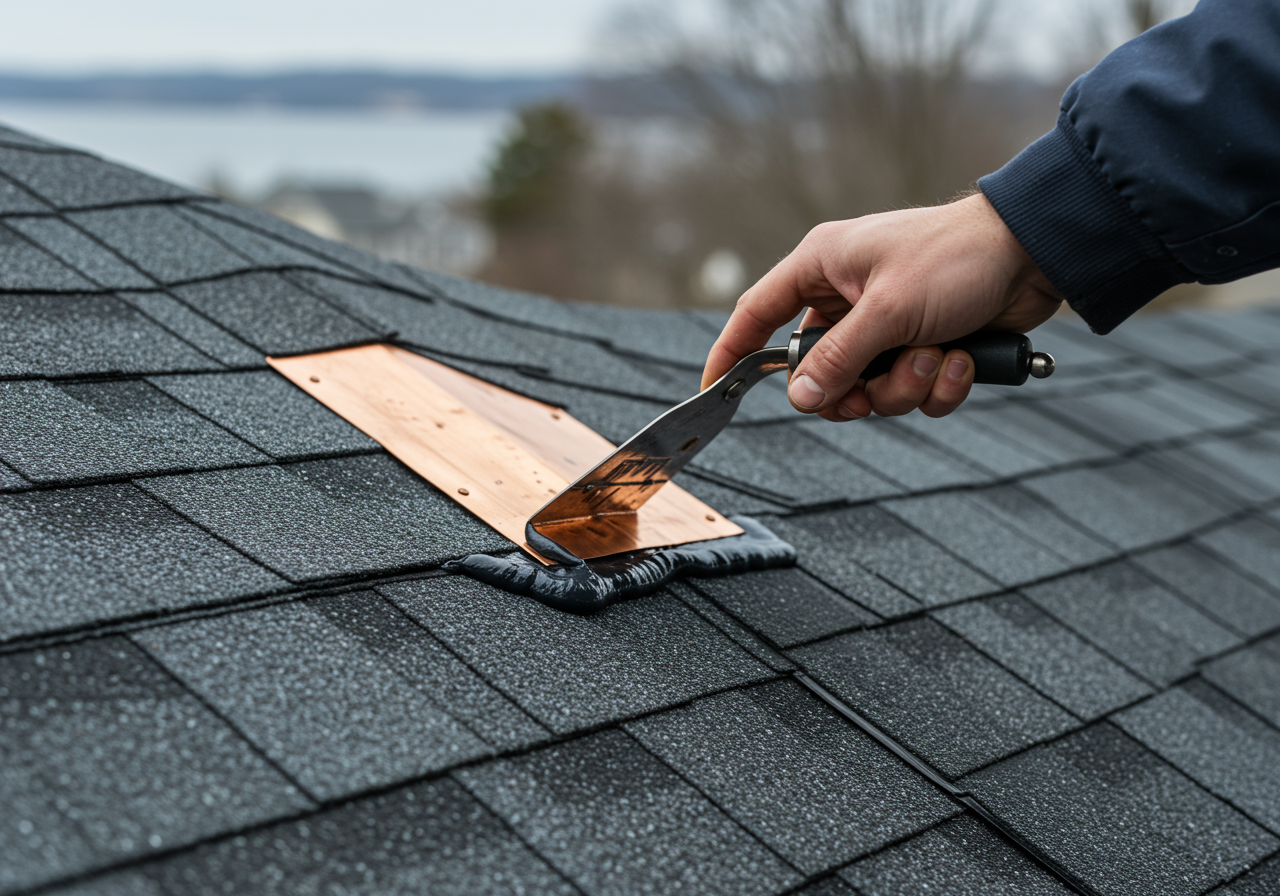
Guilford Coastal Roof Preparation
Understanding wind patterns and roof vulnerabilities specific to Long Island Sound's unique coastal conditions.
The Path Forward for Guilford Homeowners
Don't let the 41°F chill fool you into thinking your roof is safe. The "February Thaw" is the most honest time to look at your home's exterior. You aren't fighting the heat of summer or the ice dams of January. You're in the sweet spot of home maintenance.
If you're worried that your roof might be reaching the end of its 20-year lifespan, or if you simply don't know if your shingles are rated for the wind speeds we see on the New Haven County coast, now is the time to act. A few reinforced nails and a better grade of flashing can be the difference between a minor storm story and a major insurance nightmare. Take a look at your options, get your numbers in order, and make sure your home is the one that stays standing when the wind finally decides to wake up.
Get Your Free Roof Quote
Enter your zip code to get started
Frequently Asked Questions

About Noah Knight
Verified ExpertNoah Knight is a Connecticut Weather & Climate Specialist who helps homeowners understand how New England's unique weather patterns affect their roofing systems. He combines meteorological knowledge with practical home maintenance advice.