While some New Milford neighbors assume their roof is indestructible if the ceiling isn't dripping after a summer storm, others realize that the "quiet" damage from a stray Litchfield County hailstorm is often what kills a roof three years early. I've seen it happen dozens of times along the Housatonic—a homeowner ignores a heavy storm because the shingles look fine from the driveway, only to face a $15,000 replacement bill when the "bruises" finally turn into rot. The difference between a simple repair and a total loss usually comes down to how fast you get a set of eyes on those shingles. But here is the thing: not all eyes are created equal, and in New Milford, our specific topography makes hail impact patterns as unpredictable as a February thaw.
Key Takeaways
- Hail damage in Litchfield County is often 'invisible' from the ground, manifesting as granule loss rather than immediate leaks.
- Most Connecticut insurance policies have strict filing deadlines, often requiring an inspection within 12 months of the storm event.
- Professional inspections focus on 'soft metals' like gutters and flashing, which serve as the 'canaries in the coal mine' for shingle health.
- Modern impact-resistant shingles can lower long-term costs, but only if installed correctly before the next storm season hits.
1. The "Bruise" Phenomenon and Invisible Granule Loss
When hail hits an asphalt shingle, it doesn't always punch a hole straight through to your attic. In fact, that rarely happens unless we're talking about "golf ball" sized stones, which aren't as common here as they are in the Midwest. Instead, the hail creates what we call a "bruise." It's a localized compression of the asphalt mat that knocks the protective ceramic granules loose.
I remember walking a roof near Lover's Leap State Park last year. From the ground, the roof looked pristine. But once I got up there, I could see hundreds of tiny circular depressions. Without those granules, the sun's UV rays bake the underlying asphalt, making it brittle in months rather than years. And once that mat cracks, the Litchfield Hills' winter moisture gets in, freezes, and expands. It's a slow-motion disaster that starts with a single storm. According to the EPA's research on sustainable roofing, maintaining the integrity of your roof surface isn't just about leaks—it's about the thermal health of your entire home.
Local Pro Tip
2. Why "Soft Metals" are the Canary in the Coal Mine
Before I even look at a shingle, I look at the "soft metals" around a New Milford home. This includes your gutters, the flashing around your chimney, and those aluminum ridge vents. These materials are much softer than asphalt shingles and act as a historical record of every storm that has passed over Litchfield County.
If your gutters have small, round dings, the hail was large enough and falling fast enough to damage your shingles. It's physics, really. A shingle is designed to absorb impact, so it might hide the damage, but aluminum doesn't lie. I've had cases where an insurance adjuster tried to deny a claim until I pointed out the "pockmarks" on the furnace cap. That was the proof we needed. If you're worried about your roof's integrity, finding a contractor who actually shows up to look at these details is the first step toward a successful claim.
Professional vs. DIY Inspection
Pros
- Professional: Access to high-resolution moisture sensors, knowledge of insurance 'magic words,' safety equipment for steep Litchfield pitches.
- DIY: Zero cost, immediate 'peace of mind' (even if potentially false).
Cons
- Professional: Can be hard to schedule after a major town-wide storm.
- DIY: Extremely dangerous on wet or steep roofs, easy to miss subtle bruising, no official documentation for insurance.
3. The Insurance Window and the New Milford Clock
Here is a reality check that most contractors won't mention until it's too late: your insurance company doesn't give you forever to report hail damage. In Connecticut, many policies have a one-year "statute of limitations" for storm damage claims. If a storm rips through New Milford in June and you don't notice the damage until the following July, you might be footing the entire bill yourself.
I once worked with a couple near the Village Green who waited two years to address some "minor" shingle displacement. By the time they called, the decking underneath had started to delaminate. The insurance company denied the claim, citing "negligent maintenance" rather than storm damage. It was a heartbreaking $12,400 lesson. I always tell folks to pull the historical radar data for Litchfield County or check the NOAA records if they suspect a storm was particularly nasty.
4. Understanding Impact Velocity and Shingle Resilience
Not all hail is created equal. The damage potential is a mix of size, density, and wind speed. Because New Milford is tucked into the hills, we often get "wind-driven hail" that hits at an angle. This can actually be more damaging than hail falling straight down because it catches the edges of the shingles, lifting them and breaking the sealant strips.
When the wind picks up off Candlewood Lake, it can turn a half-inch hailstone into a projectile. This is where material choice matters. If you're replacing a roof, looking into Class 4 impact-resistant shingles is a smart move for our area. Research from FEMA's hurricane and storm mitigation guides shows that reinforced roofing systems significantly reduce the likelihood of "breach" during severe weather events.
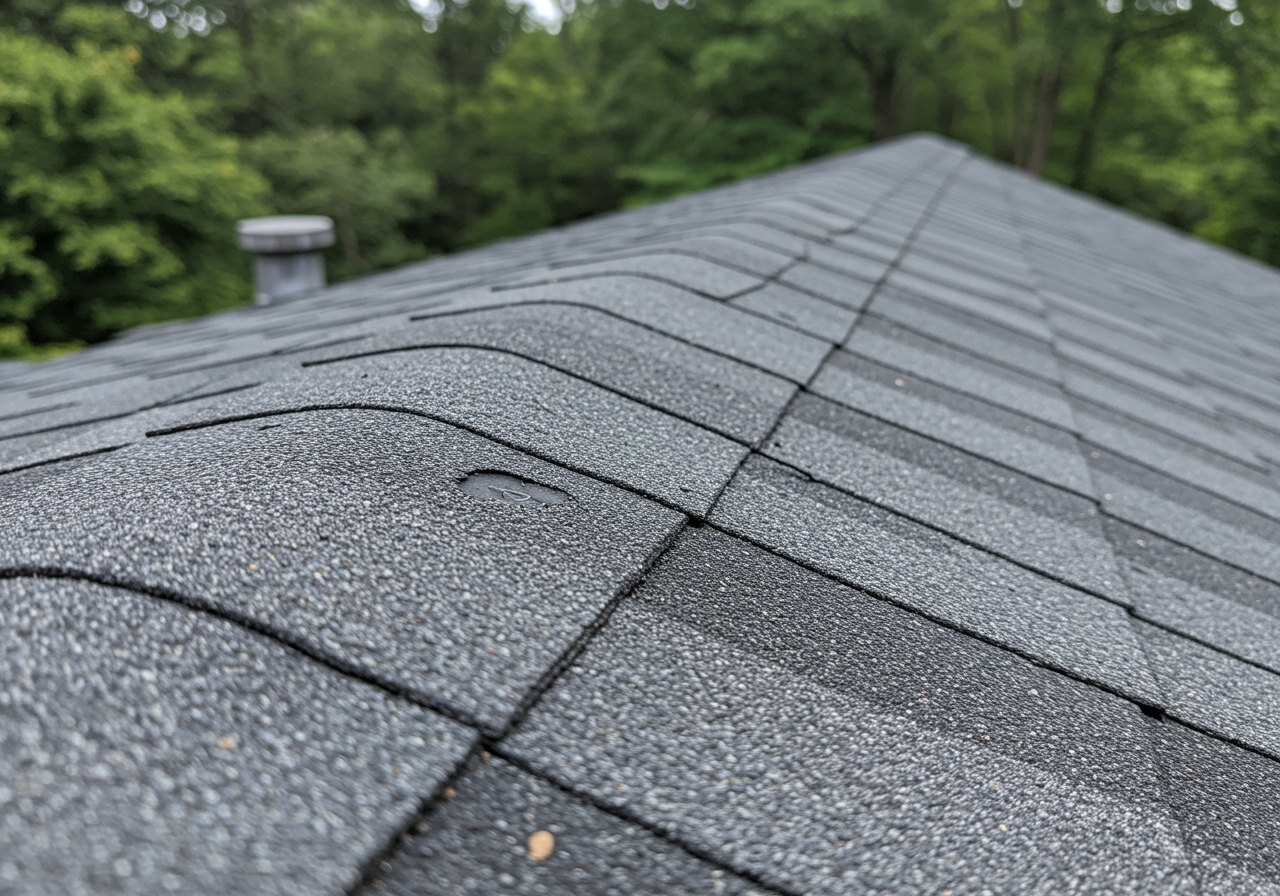
Hail Damage Inspection in New Milford
Professional roof inspection reveals hidden hail damage that isn't visible from the ground.
5. The Hidden Cost of Waiting: Mold and Decking Rot
The most expensive mistake you can make is thinking that "no leak" means "no problem." Hail damage is a gateway drug for mold. Once the shingles are compromised, moisture seeps into the plywood decking. In our humid Connecticut summers, that moisture becomes a breeding ground for black mold before you ever see a brown spot on your bedroom ceiling.
I've walked into attics in Litchfield County that smelled like a damp basement because the roof had "micro-leaks" from a hailstorm two seasons prior. The repair for a few bruised shingles is relatively cheap; the repair for a mold-remediated attic and new plywood is a nightmare. If you suspect your roof was caught in a recent cell, getting an instant roof estimate can help you budget for the necessary repairs before they spiral.
6. Comparing Repair Costs vs. Total Replacement
Sometimes, a hailstorm only damages one slope of your roof—usually the one facing the wind (often the west or south-facing side in New Milford). In these cases, a full replacement might not be necessary. However, matching aged shingles is an art form, and if the roof is more than 15 years old, the shingles might be too brittle to "tie into" with a repair.
If the damage covers more than 25-30% of the roof surface, most Connecticut adjusters will lean toward a full replacement. This is actually a win for the homeowner, as it resets the clock on your home's most important protective layer. But you need a contractor who can speak the adjuster's language.
Hail Damage Severity Comparison
| Feature | Minor Bruising | Significant Granule Loss | Structural Breach |
|---|---|---|---|
| Visible from Ground | |||
| Insurance Likely to Cover | |||
| Immediate Leak Risk | |||
| DIY Repair Possible |
7. Finding a Local Expert Who Understands Litchfield Weather
New Milford isn't Hartford or New Haven. Our weather patterns are dictated by the hills and the river. You want someone who knows that a storm hitting Northville might completely miss Gaylordsville. When you're looking for a pro, don't just hire the guy with the loudest truck—hire the one who knows how Litchfield County roofs age.
I always suggest that homeowners verify their contractor's license and check specifically for experience with storm restoration. A general roofer might be great at laying shingles, but a storm specialist knows exactly where to find the hidden "bruises" that insurance adjusters sometimes overlook. If your roof has been through the wringer recently and you're seeing shingles in your yard, don't wait—look into Emergency Roofing Services to get a tarp up before the next rain.
"In my 18 years inspecting Litchfield County homes, I've found that 60% of hail damage is missed by the untrained eye. It's not about the holes you see; it's about the protection you've lost."
Get Your Free Roof Quote
Enter your zip code to get started
In the end, your roof is your home's first line of defense against everything Connecticut throws at us. Whether it's a sudden June hail cell or a heavy February snow load, the integrity of those shingles is what keeps your family dry. Don't let a "quiet" storm turn into a loud financial disaster. Take twenty minutes to walk around your house, look at your gutters, and if anything looks off, call in a pro. You'll sleep a lot better the next time the clouds turn that ominous shade of green over the hills.
FAQ

About Noah Knight
Verified ExpertNoah Knight is a Connecticut Weather & Climate Specialist who helps homeowners understand how New England's unique weather patterns affect their roofing systems. He combines meteorological knowledge with practical home maintenance advice.