Over the last century, Stafford has transformed from a bustling textile hub into one of the most beautifully wooded corners of Tolland County. If you look back at historical photos of Stafford Springs from the early 1900s, the hillsides were often cleared for industry and farming. Today, those same hills are thick with mature White Pines, Red Oaks, and Maples. While this gives our town its quintessential New England charm, it has fundamentally changed how we have to care for our homes. I've spent years observing how the shift from open fields to dense forest canopy has turned "simple" gutter cleaning into a high-stakes game of protecting your home's structural integrity.
In Stafford, we don't just deal with "leaves." We deal with a specific cocktail of organic debris that changes depending on whether you're living in a historic Victorian near Main Street or a modern ranch tucked away near the Nipmuck State Forest. Understanding this local context is the difference between a dry basement and a $14,600 surprise repair bill.
Key Takeaways
- The Pine Needle Trap: Stafford's abundance of White Pines creates a nesting effect in gutters that standard screens can't handle.
- Drip Edge Integrity: Neglected gutters let water back up under the first row of shingles, rotting the roof deck from the inside out.
- Structural Weight: Wet organic debris can add over 240 pounds of tension to fascia boards, leading to gutter detachment.
- Design-First Protection: Maintenance isn't just about function—it's about preserving curb appeal at the roofline and architectural details.
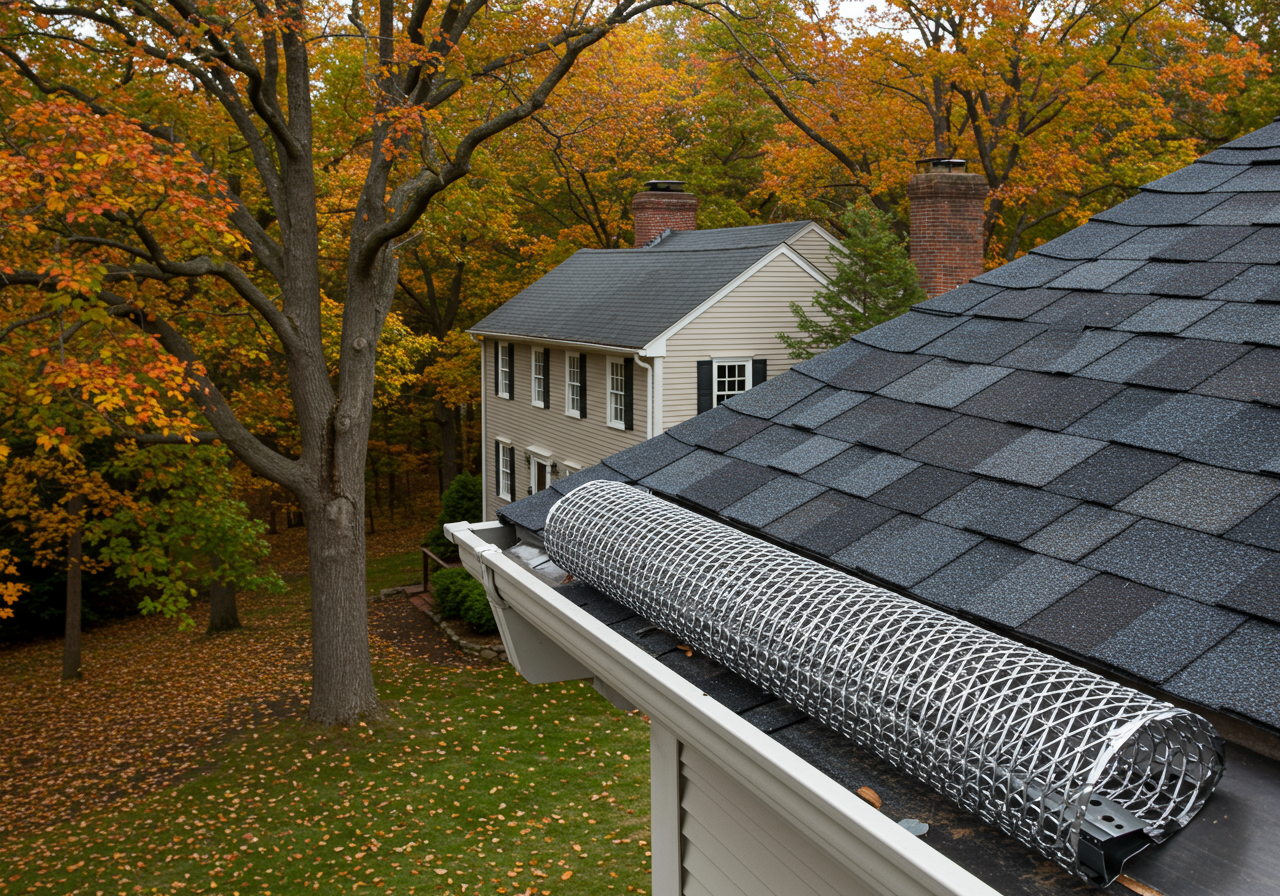
Stafford's Canopy and Your Roofline
Fall prep means matching gutter strategy to pine, oak, and maple debris
The Stafford Debris Dilemma: Why Your Neighborhood Trees Matter
When I walk through neighborhoods like West Stafford or Staffordville, I'm always struck by the variety of the canopy. It's not a one-size-fits-all situation. If you're surrounded by those towering White Pines, your maintenance schedule is going to look vastly different than someone in a newer subdivision with only young ornamental trees.
The White Pine Problem
White Pines are notorious in Tolland County. Their needles are thin, oily, and incredibly flexible. Standard big-box gutter guards with large holes are practically useless against them. The needles slide right through, weave themselves into a mat, and create a waterproof seal inside your gutter. I've seen cases where a homeowner thought their gutters were clear because the top looked clean, but a 4-inch thick pine dam was hidden underneath, forcing water to pour directly into their foundation.
Deciduous Dangers in Stafford Springs
In the more densely packed areas of Stafford Springs, we deal with the canyon effect. Wind whips through the narrow streets and lofts heavy Oak and Maple leaves onto roof valleys. These leaves are large and flat. When they get wet, they act like wet blankets. If they sit on your shingles for more than a few weeks, they trap moisture, which encourages lichen growth. I've noticed that homes near the Willimantic River tend to have higher humidity levels, which makes this organic decay happen even faster.
The Hidden Weight Factor
See What Local Pros Quote for Gutter & Roof Prep
Compare vetted Connecticut contractors without the runaround.
No credit card required • Free to use
Gutter Guards vs. Manual Cleaning: A Design and Function Showdown
I often get asked if gutter guards are actually worth the investment. It's a classic debate. From a design perspective, some guards look clunky and ruin the clean skyline of a beautiful slate or architectural shingle roof. But from a functional standpoint, the right system can save your roof's life.
Screen Styles vs. Micro-Mesh
Most Stafford homeowners start with basic screens. They're cheap and easy to install. But honestly? They often cause more headaches than they solve. The helmet-style guards—those solid covers that use surface tension—look much cleaner on a colonial-style home. They follow the roofline and don't interrupt the visual flow. However, they struggle with high-volume runoff during those intense April downpours we've been seeing lately.
The Micro-Mesh Advantage
For my money, a high-quality stainless steel micro-mesh is the gold standard for Stafford. It's nearly invisible from the curb, so it doesn't mess with your home's aesthetic. More importantly, it's the only thing that actually stops those pesky pine needles. Here is how the options stack up when you look at long-term performance (relative scores, not dollar amounts):
Gutter Protection Performance in Stafford
Relative effectiveness against pine needles, leaves, and spring downpours
The Roof-Gutter Connection: How Hidden Shingle Damage Starts
We often think of the roof and the gutters as two separate systems. They aren't. They are a partnership. When the gutters fail, the roof is the first thing to suffer.
Granule Loss and Silt Build-up
Have you ever looked inside your gutters and seen what looks like heavy, dark sand? Those are asphalt granules. If you see more than a light dusting, your shingles are reaching the end of their life cycle. This silt doesn't just wash away; it settles at the bottom of the gutter, creating a muddy sludge that traps moisture against the bottom edge of your roof. I recently helped a friend over on Chestnut Hill Road who couldn't figure out why her gutters were sagging. It turned out she had nearly 85 pounds of shingle sand weighing them down. If you're seeing this, it's time to ballpark how much life your roof has left before the next big storm hits.
Drip Edge Integrity
The drip edge is that small piece of metal flashing that hangs over the edge of your roof. Its job is to bridge the gap between the shingles and the gutter. In many older Stafford homes, the drip edge is either missing or installed incorrectly. When gutters clog, the water wicks upward. It finds that gap, soaks into the plywood roof deck, and starts the rotting process. You won't see it from the ground, but you'll definitely feel it when your roofer's foot goes through the board during a repair.
If you've noticed small leaks or water stains on your ceiling, don't wait for a total collapse. Often, fixing the drip edge and localized damage early can stop edge failure from spreading through the whole structure.
DIY vs. Professional Maintenance: Risk/Reward for Stafford Homeowners
Stafford is a town of do-it-yourselfers. We take pride in our cordwood piles and our garden plots. But gutter and roof prep is one area where I've seen some pretty scary mishaps.
Safety and Topography
Stafford isn't flat. Many of our homes are built on inclines, meaning a one-story house on the front might be two and a half stories in the back. Setting up a ladder on uneven Tolland County soil is dangerous. The CDC guidance on preventing falls is worth reading before you climb. Beyond the physical risk, there's the eyes-on factor: a professional isn't just scooping out leaves; they are looking for cracked caulking, loose brackets, and the early signs of pest intrusion.
What Professionals See That You Might Miss
I remember a homeowner near the Stafford Motor Speedway who was adamant about cleaning his own gutters. He did a great job keeping them clear of leaves, but he missed the fact that the pitch had shifted. The gutters looked clean, but water was pooling in the middle because the house had settled. A pro would have caught that with a simple level check.
"In Stafford, the problem isn't just the height of the trees; it's the acidity of the oak leaves. If they sit in a metal gutter for years, they'll literally eat through the aluminum."
If you're worried about the cost of professional help, some households may qualify for assistance. The federal home repair programs overview on USA.gov explains options that can help seniors and lower-income homeowners keep critical maintenance from sliding.
Long-term Protection: When Maintenance Isn't Enough
Sometimes, no amount of cleaning can save a failing system. If your gutters are pulling away from the house, or if you see tiger striping—dark streaks down the front of the metal—the system is likely compromised.
Signs of Systemic Failure
Look at your fascia boards—the wood behind the gutters. If you see peeling paint or soft spots, the water has already won. At this point, you aren't just looking at a gutter job; you're looking at a structural repair. When I see this on the beautiful historic homes near the center of town, it breaks my heart because it was so preventable.
Upgrading for Resilience
If you find yourself in a position where repairs are no longer cost-effective, it might be time to plan a coordinated roof and gutter upgrade. Modern systems are light-years ahead of what was installed 20 or 30 years ago. We now have seamless gutters that eliminate leak points and heavy-duty hangers that can withstand the weight of a Connecticut ice storm.
For flat or low-slope sections on modern additions or commercial buildings in town, drainage is even more critical. FEMA's fact sheet on low-slope roof systems walks through how ponding and failed drainage accelerate damage when gutters or internal drains back up.
Downspout flow
Inspect downspouts for clear exit flow at ground level and where they discharge away from the foundation.
Granule sludge
Check for heavy granule accumulation in gutter sludge—that dark sand is often a shingle wear signal.
Pitch check
Verify gutter pitch with a level so water moves toward outlets instead of pooling mid-run.
Seal leaks
Seal any leaking miters or end caps before freeze-thaw cycles widen the gaps.
Hanger security
Secure loose hidden hangers before ice and debris load pulls the run away from the fascia.
Stafford is a town that values its history and its natural beauty. Taking the time to properly prep your roof and gutters is how we ensure our homes stay as resilient as the people who live here. It's not just a chore; it's a design choice that protects the face of your home and keeps your curb appeal something to be proud of for decades to come.
Get Your Free Roof Quote
Enter your zip code to get started
FAQ

About Sheri Wilde
Verified ExpertSheri Wilde is a Home Improvement Editor with a background in interior design and sustainable living. She helps Connecticut homeowners make informed decisions about their biggest investments.