"In New Canaan, we aren't just dealing with old wood; we're dealing with structural history that doesn't follow modern rules," says Elias Thorne, a preservation specialist I've consulted with for years. He's right, but there is a financial side to that sentiment that most contractors won't mention. When you own a home near Waveny Park or a classic Colonial in the Silvermine area, "historic" often becomes a keyword for "double the estimate."
In February, while the ground is still frozen and the spring rush hasn't quite hit the Fairfield County Gold Coast, it's the right time to look at why these specialized systems fail. It isn't usually the age of the materials that causes a $22,000 surprise—it's the mismatch between 1920s architecture and 2026 building techniques. Most New Canaan homeowners are overpaying for "solutions" that actually accelerate rot because the math behind the ventilation was never updated.
Key Takeaways
- Improper ventilation in historic attics causes 40% of premature shingle failure in New Canaan.
- Synthetic slate offers a 50-year lifespan at roughly 45% of the cost of natural stone.
- Detailed line-item bids prevent "historic home" surcharges from creeping into your final bill.
- Use the winter off-season to negotiate better labor rates before the April surge.
The Material Mismatch: Slate vs. Synthetic Realities
The biggest failure I see in New Canaan isn't a leak; it's a weight problem. I once reviewed a contract for a homeowner near Smith Ridge Road who was quoted for authentic Buckingham Slate. The contractor "forgot" to mention that the original rafters, dating back to 1912, couldn't support the 1,200 pounds per square that natural slate requires.
If you try to force a heavy material onto a frame designed for cedar shakes, you aren't just buying a roof; you're buying a structural collapse. The numbers on the page might look impressive, but the long-term liability is a nightmare. This is why many are now upgrading to a new roof system that utilizes synthetic composites. These mimic the aesthetic of the "Gold Coast" look without requiring $15,000 in structural reinforcement.
Historic Roof Material Comparison
Understanding the weight and cost differences between natural slate and synthetic alternatives for New Canaan's historic homes
Natural Slate vs. High-End Synthetic Comparison
| Feature | Natural Slate | Synthetic Composite |
|---|---|---|
| Requires Structural Reinforcement | ||
| Suitable for Historic Frames | ||
| Long-Term Cost Efficiency | ||
| Aesthetic Match to Original |
Key Differences:
- Weight: Natural Slate (800-1,500 lbs/sq) vs Synthetic Composite (200-300 lbs/sq)
- Material Cost: Natural Slate ($1,100-$1,800/sq) vs Synthetic ($450-$750/sq)
- Lifespan: Natural Slate (75-100 years) vs Synthetic (50 years)
Ventilation Ghosting: The Silent Killer of Old Rafters
Most historic New Canaan homes were built to "breathe" through drafty windows and uninsulated attics. The moment you add modern insulation and a tight roof, you create an oven. I've seen $40,000 roofs in Fairfield County fail in under 12 years because the contractor didn't account for the change in airflow.
The heat builds up, fries the shingles from the underside, and voids your warranty. If your contractor isn't talking about "intake vs. exhaust" math, they are guessing with your money. I always tell people to demand a calculation of the Net Free Venting Area (NFVA) before the first nail is driven. But honestly, most crews just want to slap shingles down and move to the next job. You have to be the one to insist on the technical details.
"If a contractor tells you 'we always do it this way' on a 100-year-old home, that's your cue to find a new contractor. Historic homes require custom airflow physics, not standard suburban templates."
Flashing Failures: Where the $8,700 Leaks Hide
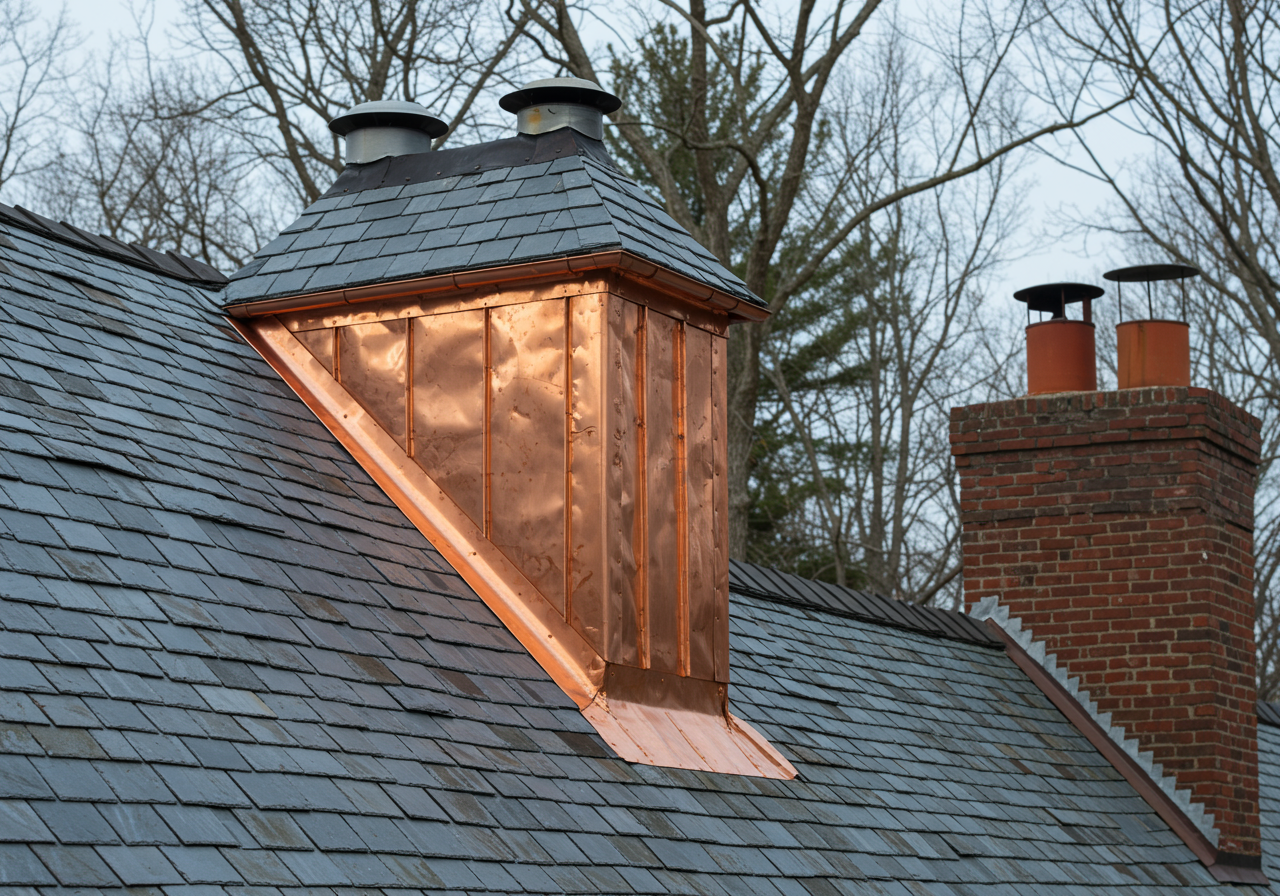
In New Canaan, it's the chimneys and dormers that bleed cash. A "cheap" bid often cuts corners on lead or copper flashing. They'll use "caulk and walk" methods that look fine for six months but fail during the first heavy March rain.
If you're looking at your estimate, look for the line item regarding "step flashing" and "counter-flashing." If it just says "replace as needed," you're being set up for a change order. Demand to know the linear footage and the material gauge. For a proper historic restoration, you want 16-ounce copper. Anything less is just a temporary patch. Even minor leak repairs on these homes can spiral if the flashing wasn't integrated into the masonry correctly.
Projected Lifespan of Roofing Materials (Years)
While the initial cost of premium materials is higher, the "cost per year" is significantly lower. Use our Roofing Cost Calculator to see how these different materials impact your 20-year home equity. You'll often find that the "expensive" option is actually the smartest financial move when you factor in the New Canaan resale market.
The "Gold Coast" Contractor Vetting Process
Don't let a contractor's shiny truck or fancy brochure distract you from the safety and legal realities. In Connecticut, if a crew member falls and the company isn't following OSHA fall protection standards, the legal headache can occasionally land on the homeowner's doorstep. Always ask for a current certificate of insurance—sent directly from their agent to you, not a grainy photocopy.
Verify the CT HIC License
Check for active complaints and verify the license is current and in good standing.
Request the 'Dry-In' specs
What underlayment is being used for ice dam protection? Get specific material names and thicknesses.
Compare the 'Cash Price' vs. the 'Financed Price'
To spot hidden interest points and financing markups that inflate the total cost.
Walk the perimeter
Identify delicate landscaping that needs protection during the project to avoid costly damage.
Finalize the 'Clean Up' clause
Who pays for the magnetic sweep of the driveway? Get this in writing before work begins.
When reviewing the final numbers, look for federal help if the "historic" nature of the home requires specific upgrades that are out of budget. The USA.gov home repair assistance portal can sometimes point you toward grants or low-interest loans for preserving structural integrity in recognized historic districts.
Get Your Free Roof Quote
Enter your zip code to get started
FAQ
The reality is that your roof is a financial instrument. If you treat it like a commodity, you'll get commodity results that fail within a decade. But if you demand the line-item math and respect the physics of an older home, you'll protect your equity. Don't let a contractor rush you into a "standard" fix for a non-standard home. Take the time to get the numbers right before the spring thaw hits Fairfield County.

About Dana Jackson
Verified ExpertDana Jackson is a Homeowner Advocate & Cost Analyst who helps Connecticut families navigate the financial aspects of roofing projects. She specializes in finding the best value and avoiding common pricing pitfalls.