Key Takeaways
- Metal roofing in Trumbull now offers a 50-year-plus lifespan, effectively ending the replacement cycle.
- Modern 'standing seam' designs provide a sleek, architectural look that complements Trumbull's Colonial and Cape Cod styles.
- While the upfront cost is higher, the long-term ROI is significantly better when factoring in energy savings and home resale value.
- Proper installation is non-negotiable; Fairfield County building codes require specific underlayment and fastening patterns.
Trumbull homeowners are hitting a wall—and usually, it's a wall covered in damp drywall because of a roof that gave up too soon. In neighborhoods from Nichols to Tashua, I'm seeing a pattern where high-end asphalt shingles, promised to last thirty years, are gasping for air after barely twelve. The Fairfield County humidity, those erratic March freeze-thaw cycles, and the salt-heavy air drifting up from the Sound create a "perfect storm" that eats through standard materials. We're tired of the "patch and pray" method every time a nor'easter rolls through. The problem isn't just the leak; it's the cycle of spending $15,000 every decade when we'd rather be investing in our kitchens or our kids' college funds.
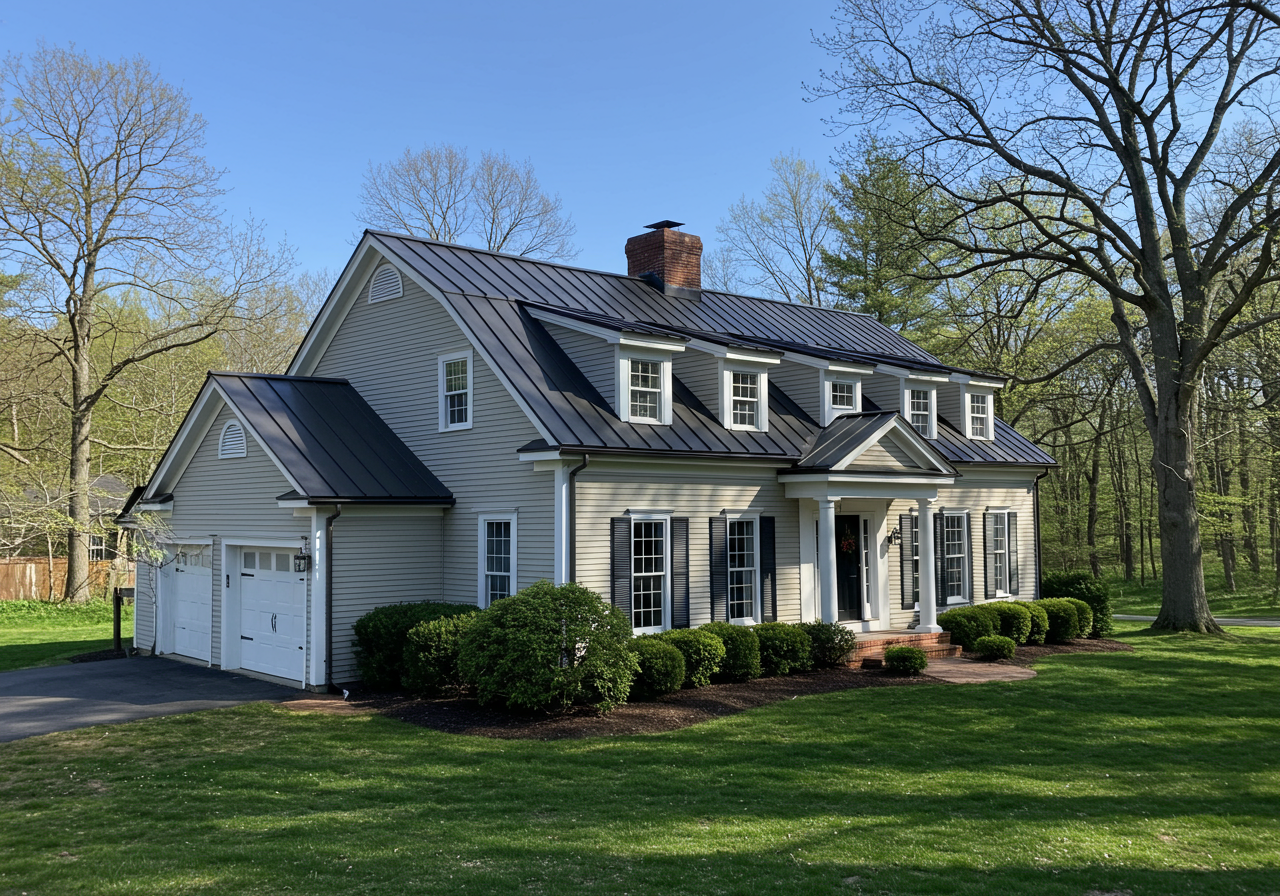
Modern Metal Roofing Blends Seamlessly
A charcoal gray standing seam metal roof on a classic Trumbull Colonial home demonstrates how modern metal roofing blends seamlessly with Trumbull's traditional architecture while providing superior protection.
Why Traditional Roofing is Failing Our Neighborhoods
I was chatting with a neighbor near Twin Brooks Park last week who was on his third roof in twenty-four years. Think about that. He's spent enough on asphalt to have bought a small boat. The reality is that our local climate is getting harder on organic-mat shingles. When the sun beats down in July and the ice damming hits in February, asphalt expands and contracts until it simply cracks.
The Lifecycle Gap
Most homeowners think they are buying a "30-year" roof, but in Trumbull, the average asphalt lifespan is closer to 16.2 years. Metal, specifically aluminum or high-gauge steel, doesn't suffer from this "thermal shock." It stays stable. It doesn't rot, it doesn't grow moss (a huge win for those of us with lots of oak trees), and it doesn't lose its granules in the gutter every time it rains.
The Hidden Cost of "Cheap"
Every time you replace a roof, you aren't just paying for shingles. You're paying for the tear-off, the disposal fees at the local transfer station, and the labor. By the time you do that twice, you've far exceeded the cost of one permanent metal installation. If you're currently dealing with a failing system, finding a contractor who actually shows up to give you a straight answer on metal vs. asphalt is the first step toward breaking the cycle.
The Aesthetic Shift: From Industrial to Elegant
There's a common misconception that a metal roof will make your house look like a tool shed. I'm here to tell you that's ancient history. Modern metal roofing is a design chameleon. I've seen stunning matte black standing seam roofs on white 1940s Colonials that look absolutely editorial.
Choosing the Right Profile
For our area, the "Standing Seam" profile is king. It features vertical ribs with hidden fasteners. This is vital because the fasteners are protected from the elements. If you prefer a more traditional look, "Metal Shingles" are available that mimic the texture of slate or wood shakes but offer the durability of steel.
Neighborhood Context and Colors
In Trumbull, we tend to lean toward classic palettes. Bronze, charcoal gray, and forest green are the big winners. These colors don't just look good; they help your home sit naturally among the heavy foliage we love in Fairfield County. I always tell homeowners: your roof is about 40% of your home's visible exterior. Don't treat it like an afterthought; treat it like a design choice that talks to the rest of the block.
Metal vs. Asphalt in Trumbull
Pros
- Lifespan of 50-70 years
- Fire, wind, and hail resistant
- 100% recyclable at end of life
- Reflects solar heat (lower AC bills)
Cons
- Higher initial investment
- Requires specialized labor
- Can be noisier if not properly insulated
Resilience Against the Connecticut Seasons
We all know the March "fake-out" in CT. One day it's 55 degrees, the next we're getting six inches of slush. This is where metal shines. Because it's a smooth surface, snow slides off much more easily, preventing the dreaded ice dams that plague the Nichols area.
Wind and Storm Defense
Metal roofs are frequently rated for winds up to 140 mph. While we don't get Category 4 hurricanes every day, we do get those nasty microbursts and nor'easters. I've seen metal roofs stay perfectly intact while the asphalt neighbors are losing tabs like they're shedding leaves. If a tree limb comes down—a common occurrence in our wooded town—a heavy-gauge metal roof is far more likely to dent than to puncture. If you've had a sudden impact, it's worth checking out urgent leak repairs to ensure your decking hasn't been compromised.
"In twenty years of design consulting, I've never had a homeowner regret the switch to metal. The peace of mind during a heavy CT storm is something you can't put a price on."
Navigating the Technical Specs and Local Codes
This is the part where things get a bit "inside baseball," but it's where your money is protected. You can't just slap metal over old shingles and call it a day—at least, you shouldn't. Connecticut building codes are very specific about how these systems are integrated into your home's structure.
Code Requirements and Decking
According to the International Code Council (ICC), your roof deck must be in good structural shape to support the fastening system of a metal roof. In Trumbull, we often find older homes with spaced "skip sheathing." To do metal right, we usually need to install a solid plywood deck first. This adds cost, but it ensures the roof doesn't become a kite in high winds.
The Importance of Underlayment
I always look for a high-temperature synthetic underlayment. Metal gets hot, and standard felt paper can actually bake and stick to the underside of the panels. A quality synthetic layer acts as a secondary water barrier—a "safety net" for your attic.
Full tear-off of old shingles and inspection of the wood deck.
Complete removal ensures a clean slate and allows for proper deck inspection.
Installation of high-temp synthetic underlayment and drip edges.
Protects against water intrusion and handles the heat generated by metal panels.
Precision cutting of panels to fit gables and dormers.
Custom fitting ensures a watertight seal around all roof features.
Securement of standing seam panels using hidden clips.
Hidden fasteners prevent water penetration and allow for thermal expansion.
Installation of Z-bars and ridge vents for proper attic breathing.
Ensures proper ventilation to prevent moisture buildup and extend roof life.
The Financial Reality of a "Forever Roof"
Let's talk about the elephant in the room: the price tag. Yes, a metal roof in Fairfield County can cost 2.5 to 3 times more than a basic asphalt roof. But we have to look at the "Cost of Ownership" over thirty years, not just the "Cost of Acquisition" today.
Breaking Down the ROI
When you sell a home in Trumbull, a metal roof is a massive selling point. It's like having a brand-new furnace or a finished basement—it's one less thing the buyer has to worry about for the next half-century. Real estate data often shows that homeowners recoup about 60-70% of the metal roof cost in immediate home value. Add in the 20% savings on your summer cooling bills, and the numbers start to look very friendly.
Projected Lifespan (Years)
Tax Credits and Insurance
Don't forget that many metal roofs qualify for federal energy tax credits. Furthermore, some Connecticut insurance providers offer discounts on homeowners' premiums because the fire and wind risk is so much lower. Before you commit, I highly suggest you get a real-time estimate to see how these numbers play out for your specific square footage.
Vetting Your Metal Specialist
Here is my biggest warning: a great asphalt roofer is not necessarily a great metal roofer. The skill sets are entirely different. Metal requires precision cutting, specialized bending tools, and an understanding of thermal expansion.
Check the Credentials
Before you sign anything, head over to the Connecticut's eLicense portal to make sure the contractor's Home Improvement Contractor (HIC) registration is active. I also recommend checking the Better Business Bureau (BBB) to see how they handle complaints. A "cheap" metal roof is almost always a disaster—it usually means they used exposed fasteners or didn't flash the chimneys correctly.
The Interview Process
Ask them: "How do you handle the expansion and contraction of the panels?" If they don't mention "thermal movement" or "clips," keep looking. You want a team that treats your home like a piece of precision engineering, not a weekend DIY project.
Making the leap to metal is a big move. It's a commitment to your home's future and a way to finally stop worrying about the sky falling. If you're ready to see if your roofline is a good candidate, take a breath and do the research. Your future self—the one not worrying about leaks in ten years—will thank you.
Get Your Free Roof Quote
Enter your zip code to get started
Frequently Asked Questions

About Sheri Wilde
Verified ExpertSheri Wilde is a Home Improvement Editor with a background in interior design and sustainable living. She helps Connecticut homeowners make informed decisions about their biggest investments.