In Kent, we often joke that the wind coming off the Housatonic has a way of finding every single crack in a house. But the data for 2026 shows a sobering reality: nearly 27% of a typical Litchfield County home's heat escapes directly through a poorly managed roof system. That isn't just a draft; it's the financial equivalent of leaving a window wide open from November through April. When we look at the rising costs of heating oil and propane in our corner of Connecticut, the roof stops being just a structural necessity and starts looking like your home's most important thermal barrier.
Key Takeaways
- Proper attic ventilation can reduce winter heat loss by up to 18% in older Kent Colonials.
- Modern 'cool roofs' aren't just for summer; specific 2026 material tech helps retain internal heat during Northwest Hill winters.
- Increasing attic insulation to R-60 standards is the most cost-effective companion to a roof replacement.
- Hidden 'thermal bridges' in common Litchfield County roof designs are responsible for those stubborn ice dams.
The Litchfield Hills Insulation Gap
Many of the beautiful homes lining North Main Street or tucked away near Kent Falls were built in eras when heating fuel was cheap. Back then, we didn't worry much about R-values or thermal breaks. Today, however, we see a massive gap between what a modern roof can do and what most Kent homes are actually doing.
I recently visited a 1940s Cape Cod where the homeowner couldn't understand why their second floor was always five degrees colder than the first. We found that while their shingles looked fine from the curb, the lack of a modern radiant barrier was letting heat soak right through the roof deck. It's a common story in our area. If you want to see how other locals have tackled these upgrades, it's always smart to see what other CT homeowners experienced when updating their older properties.
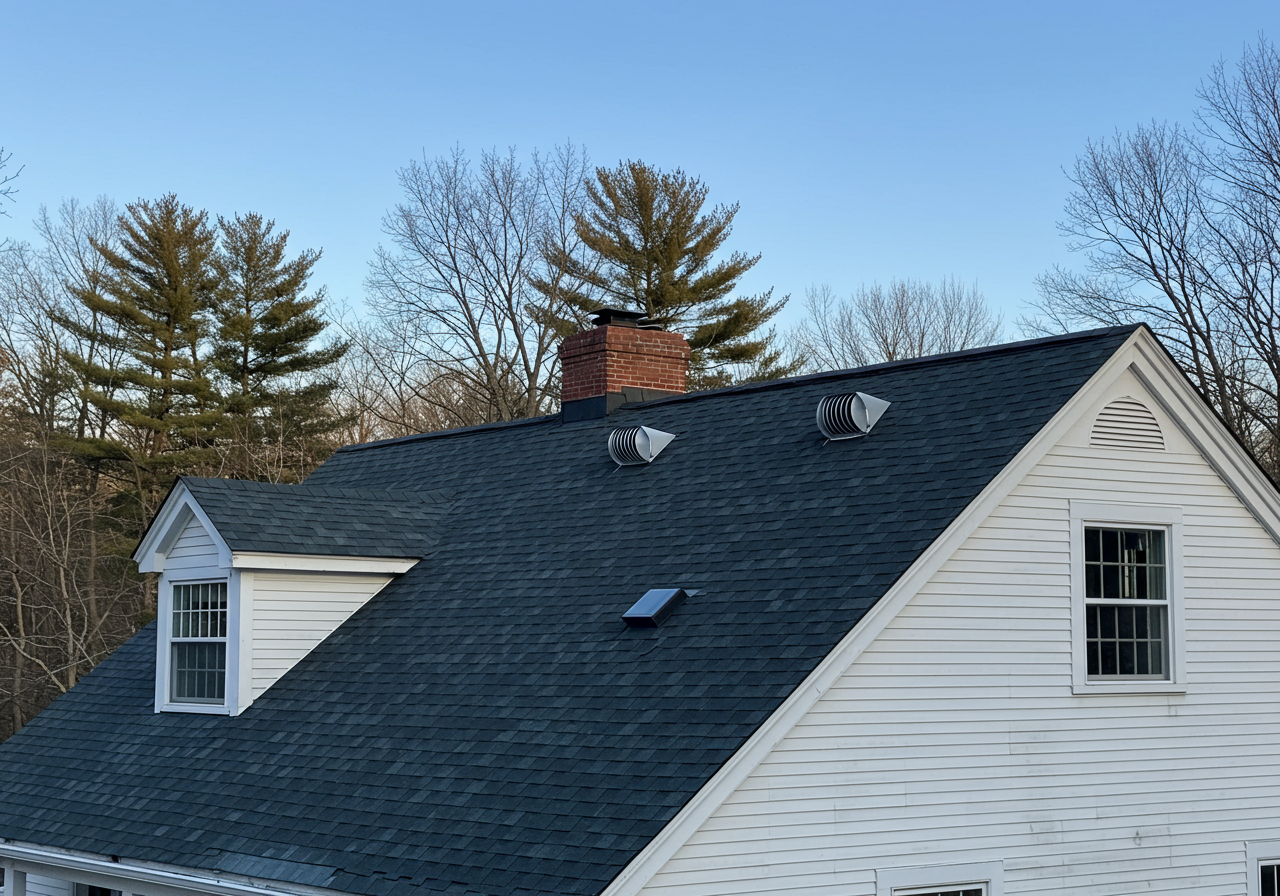
Efficiency Meets Aesthetics
A deep charcoal architectural shingle roof on a Kent home, designed for maximum thermal retention and snow shedding.
Why Your Roof Deck Temperature Matters in Kent
The temperature of your roof deck—the wooden boards your shingles are nailed to—is the "ground zero" of heat loss. In a perfect world, your attic would be the same temperature as the outside air, kept separate from your living space by a thick blanket of insulation.
But in the Northwest Hills, our complex rooflines often lead to "hot spots." When heat leaks from your bedroom into the attic, it warms the roof deck, melts the snow above, and creates the dreaded ice dam cycle. According to the Department of Energy's insulation guide, maintaining a consistent thermal envelope is the only way to break this cycle. I've seen homeowners spend $3,200 on heat cables when a $1,400 insulation and venting upgrade would have solved the problem permanently.
Modern Materials: Shingles That Act Like Blankets
We've come a long way from the basic asphalt tabs of the 1990s. The 2026 material trends show a massive shift toward "active" shingles. These aren't just waterproof covers; they're designed with granules that reflect UV rays in the summer while providing a denser thermal mass for the winter.
For those of us who love the look of a classic New England home, you don't have to sacrifice style for savings. I'm seeing more Kent residents opt for stone-coated steel or high-density composite slates. These materials have a higher "thermal resistance" than traditional asphalt. While the upfront cost might be 22% higher, the reduction in monthly Eversource bills often pays back the difference within seven years.
Material Efficiency: Heat Retention Rating
The Ventilation Myth: Why Air Flow Saves Fuel
It sounds counterintuitive, doesn't it? Why would you want cold February air blowing through your attic when you're trying to stay warm? I get this question at every neighborhood gathering. The secret is that "trapped" air is your enemy.
Stagnant air in an attic becomes humid from the moisture of our daily lives (showers, cooking, breathing). That humidity makes your insulation damp, and damp insulation has the R-value of a wet paper towel. Proper ridge vents and soffit intakes ensure that moisture escapes, keeping your "blanket" dry and effective. To understand the physics behind this, the EPA's research on roof temperatures offers some great insights into how air movement affects the whole building's climate.
Design vs. Efficiency: Picking Colors for Litchfield County
As someone who obsesses over curb appeal, I always say your roof is a conversation with your neighbors. But in Kent, that conversation should also involve your thermostat. While "cool roofs" are often associated with white or light gray finishes used in the South, 2026 technology has given us "cool darks."
These are deep bronzes, forest greens, and charcoal grays that look perfect on a wooded lot near Macedonia Brook State Park but contain specialized pigments that manage heat better than old-school black shingles. I always suggest that my neighbors explore our deep-dive blog library for more on how color choice impacts both your home's value and its energy footprint.
Evaluating Your Attic's R-Value for 2026 Standards
If you haven't looked in your attic since you moved in, you're likely under-insulated. Most older homes in Litchfield County have about 6 to 8 inches of fiberglass batts. Current 2026 standards for our climate zone suggest closer to 15-20 inches (R-60).
The 'Ruler' Test
But here's the Wilde family tip: don't just throw more pink stuff over the old stuff. You have to "air seal" the floor of the attic first. Those little holes where wires and pipes go through the ceiling are like tiny chimneys sucking the heat out of your kitchen.
Signs Your Current Roof is Hemorrhaging Cash
Sometimes the signs aren't as obvious as a puddle on the floor. I look for the "ghosting" pattern on roofs after a light frost. If you see the outline of your rafters while the rest of the roof is white with frost, that's heat escaping between the beams.
Another big one? Birds. If the local sparrows are all huddling on your roof peak in the middle of January, they've found a nice, warm heater—your attic. This is a structural red flag that your shingles are being cooked from the inside out, which will lead to premature granule loss. If you're seeing these signs, I always tell homeowners to verify their contractor's license and get a professional thermal imaging scan before the next big storm.
Financial Impact: The Long-Term ROI of an Efficient Roof
We need to stop thinking about a new roof as a "sunk cost." In Kent, a high-efficiency roof system is an investment that pays dividends. According to FEMA's sloped roof mitigation strategies, a properly reinforced and insulated roof also protects against the high-wind events we've been seeing more of in the Northwest Hills.
"The most expensive roof you can buy is a 'cheap' one that ignores the thermal envelope. You'll pay for the difference in fuel costs within five years."
When you combine the energy savings—which average about $412 annually for a 2,000-square-foot home in our area—with the increased resale value, the "real" cost of the upgrade is significantly lower than the quote suggests.
Get Your Free Roof Quote Today
Connect with verified CT pros in minutes.
No credit card required • Free to use
Conclusion
Navigating the winter in Kent requires more than just a good snowblower; it requires a home that works with the climate, not against it. By focusing on the 2026 trends of high-density materials, precision ventilation, and aggressive air sealing, you can transform your roof from a simple lid into a high-performance heat shield.
Don't wait until the next nor'easter to wonder where your heat is going. Take a look at your attic today, check your insulation levels, and consider how a modern roof system can keep your family warmer while keeping your bank account fuller. If you're ready to see how the numbers look for your specific roofline, ZikQuote can help you find a vetted local pro who understands the unique demands of Litchfield County homes.
FAQ
Get Your Free Roof Quote
Enter your zip code to get started

About Sheri Wilde
Verified ExpertSheri Wilde is a Home Improvement Editor with a background in interior design and sustainable living. She helps Connecticut homeowners make informed decisions about their biggest investments.