
Key Takeaways
- The Root Cause: Ice dams are caused by poor attic insulation and inadequate ventilation, not just heavy snowfall.
- The 6-Foot Rule: Connecticut building codes often require ice and water shields to extend further up the roof than homeowners realize.
- Prevention vs. Reaction: Permanent fixes like air sealing cost significantly less over five years than annual emergency steam removals.
- Material Matters: Certain roofing materials, like standing seam metal, handle ice far better than traditional asphalt shingles.
The ice dams building up on Vernon rooflines every March aren't actually a roofing problem; they are an attic ventilation failure that happens to manifest on your shingles. I've walked hundreds of properties from the historic colonials near Henry Park to the newer builds up on the hills by Valley Falls, and the story is almost always the same. Homeowners see a three-foot icicle and think they need a new roof. In reality, they usually need to stop the heat from their living room from migrating into their attic.
In Tolland County, our freeze-thaw cycles are particularly aggressive. When the snow on your roof melts from underneath because your attic is too warm, that water runs down to the cold eaves and freezes solid. This creates a reservoir that backs up under your shingles. If that water gets past your underlayment, you aren't just looking at a roof repair; you're looking at soggy insulation, ruined drywall, and potential mold growth in your ceiling joists.
The Physics of the Vernon "Ice Trap"
Here is the thing about our local housing stock: many of the ranches and split-levels built in Vernon during the 1960s and 70s were never designed for modern R-value standards. I often find attics with only 4 or 5 inches of old fiberglass batts. That provides an R-value of maybe R-15, which is a far cry from the R-60 we recommend today.
When your attic is under-insulated, heat escapes through "bypass" points—recessed lights, pull-down stairs, and chimney chases. I've seen attic temperatures in Rockville homes hit 50 degrees while it was freezing outside. That 18-degree difference is exactly what triggers the melt-freeze cycle. If you want to dive deeper into the technical specs of how heat moves through different materials, our blog library has several guides on thermal bridging and attic science.
Why Snow Doesn't Just Melt
On a properly functioning roof, snow should melt from the sun down, not from the shingles up. When heat leaks from your house, it creates a layer of water between the roof deck and the snowpack. This water is trapped. It has nowhere to go but down the slope until it hits the unheated overhang of your eaves.
The R-Value Gap in Tolland County
Most Vernon homeowners are surprised to learn that increasing insulation alone won't solve the problem if you don't address air sealing. You can pile three feet of cellulose in your attic, but if you haven't plugged the gaps where your interior walls meet your attic floor (the top plates), the warm air will still find a way out. I once used a thermal camera on a job near the Vernon Marsh; the heat loss from a single unsealed attic hatch looked like a bonfire on the screen.
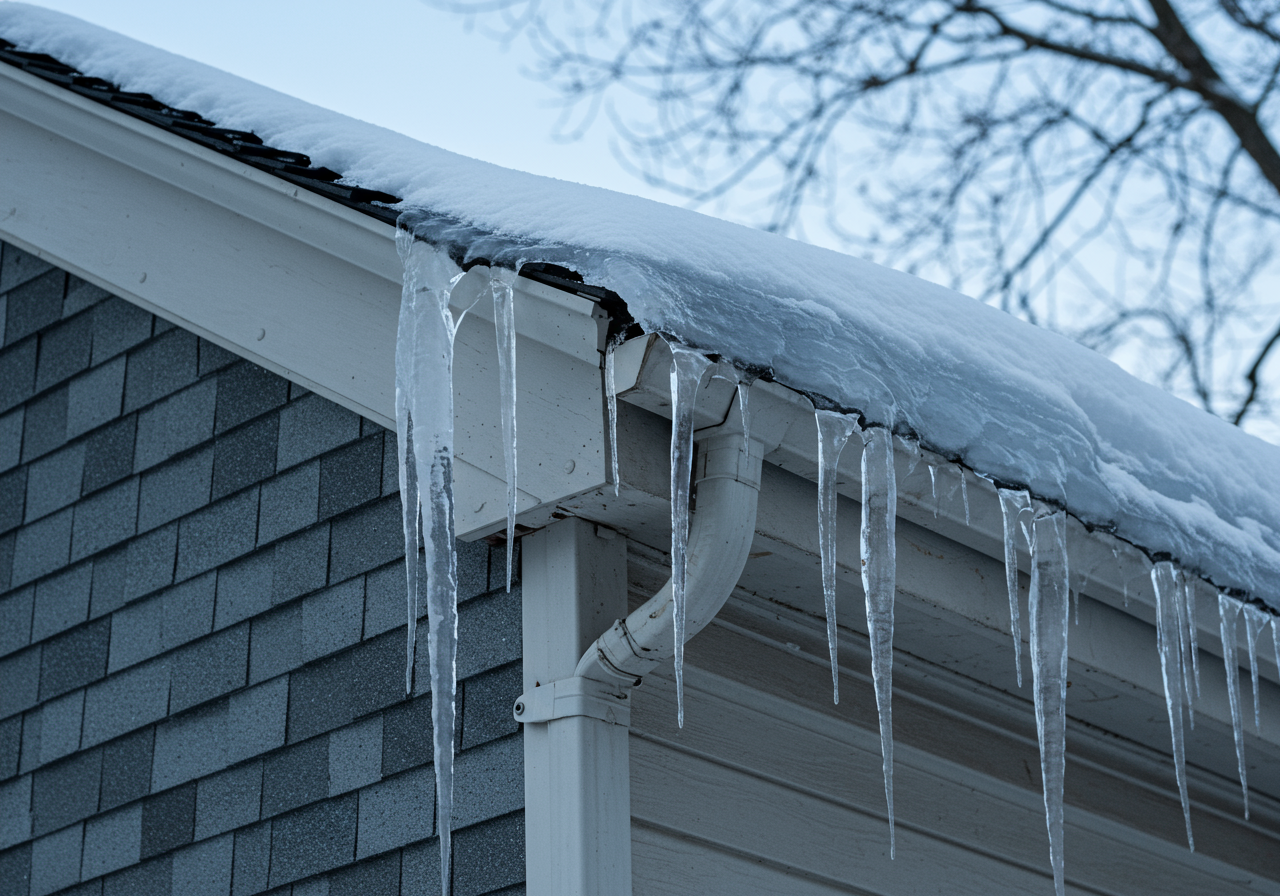
Ice dam formation on Vernon roofline
Heat escaping from an under-insulated attic causes snow to melt and refreeze at the eaves
Comparing Remediation Strategies: Heat Cables vs. Insulation
When the ice starts backing up, I see two types of responses. Some people run to the hardware store for zig-zag heat cables, while others call for a professional energy audit. In my experience, one is a temporary band-aid that costs you money every month on your Eversource bill, and the other is a permanent structural fix.
De-Icing Cables vs. Professional Air Sealing & Insulation
| Feature | De-Icing Cables (Heat Tape) | Professional Air Sealing & Insulation |
|---|---|---|
| Initial Cost | ||
| Monthly Operating Cost | ||
| Long-term Effectiveness | ||
| Aesthetic Impact | ||
| Fire Risk |
The De-Icing Cable "Band-Aid"
Look, I'm not a fan of heat cables. They are often installed incorrectly, and they only melt small channels in the ice. If the channel isn't wide enough, the water just refreezes behind it, making the dam even larger. Plus, they look terrible on a clean roofline. According to the International Code Council (ICC), proper roof preparation involves managing the thermal envelope, not just adding heat to the exterior.
Professional Air Sealing
The gold standard is a combination of spray foam air sealing and blown-in cellulose or fiberglass. By sealing the bypasses, you keep the heat in your home. This doesn't just prevent ice dams; it lowers your winter heating costs by an average of 15% to 20% in this region. I always tell homeowners to verify their contractor's license to ensure they are qualified to handle both the roofing and the attic ventilation components, as they are two sides of the same coin.
Structural Solutions: Metal Roofs vs. Shingles
If your roof is already at the end of its lifespan (roughly 20-25 years for asphalt in CT), you have a choice to make. Some materials are naturally more "ice-phobic" than others.
Pros
- Metal Roofing (Standing Seam): Snow slides off easily; no horizontal seams for water to penetrate; 50+ year lifespan.
- Asphalt Shingles (Architectural): Most affordable; easy to repair; vast color options.
Cons
- Metal Roofing (Standing Seam): Higher initial investment; can be noisy during heavy rain.
- Asphalt Shingles (Architectural): Rough texture holds snow; vulnerable to shingle lift from ice expansion.
Standing Seam Performance in March Freeze-Thaws
In Vernon, we get those nasty March days where it hits 45 degrees at noon and 20 degrees by 8 PM. On a standing seam metal roof (I'm partial to 24-gauge steel for our climate), the snow simply can't gain a foothold. The smooth surface and vertical ribs mean that as soon as a microscopic layer of water forms under the snow, the whole "blanket" slides off.
The 6-Foot Ice and Water Shield Rule
If you stick with shingles, the underlayment is your last line of defense. Connecticut code requires an ice and water shield, but I often see contractors doing the bare minimum—one 36-inch course. In Vernon, where we get heavy snow loads, I recommend at least two courses (6 feet) of a high-temp self-adhering membrane like GAF WeatherWatch. This ensures that even if a dam forms, the water can't find its way into your plywood.
Estimated Lifespan of Roofing Solutions in CT
The Role of Ventilation in Prevention
You cannot have a "cold" roof without airflow. I've inspected dozens of homes along Route 30 where the homeowner "upgraded" their insulation but accidentally covered their soffit vents in the process. This effectively turned their attic into an oven.
Check your soffit vents
Check your soffit vents from the outside to ensure they aren't painted shut or clogged with bird nests.
Inspect from inside the attic
Go into the attic (carefully!) and look for light coming through the eaves. If you don't see light, your vents are blocked.
Install baffles
Ensure 'baffles' are installed between the rafters to keep insulation from sliding over the intake vents.
Verify ridge vent clearance
Verify your ridge vent is clear and not covered by excessive layers of old shingles or debris.
Test roof deck temperature
Touch the underside of the roof deck on a cold day; it should feel close to the outside temperature.
Ridge Vents vs. Soffit Intake
Think of your attic like a chimney. You need cool air coming in at the bottom (soffits) and warm air escaping at the top (ridge vent). If one of these is missing, the system fails. I've found that many older Vernon homes rely on gable vents, which are often insufficient for the volume of air needed to keep a modern, heavily insulated house cool.
Economic Impact: Prevention vs. Emergency Steam
I've seen homeowners pay $800 to $1,200 for emergency ice dam steaming in the middle of a blizzard. It's a gut-wrenching expense because that money doesn't actually improve your home—it just stops it from being destroyed.
Energy Efficiency Credits
The good news is that the federal government actually helps you pay for the fix. Under current guidelines, you can often claim a significant percentage of your weatherization costs. I suggest checking the IRS instructions for Form 5695 to see how attic air sealing and insulation qualify for residential energy credits.
Don't just take my word for the necessity of these upgrades— see what other CT homeowners experienced when they finally stopped the cycle of winter leaks. Investing in a proper roof system—one that includes the right insulation and ventilation—is the only way to sleep soundly during a Tolland County winter.
Get Your Free Roof Quote
Enter your zip code to get started