
If you've driven down Whitney Avenue or through the quiet, tree-lined streets of Spring Glen lately, you've probably noticed those stunning Colonial and Tudor-style homes that define Hamden's architectural character. Many of these properties feature cedar shake roofs—or at least they used to. Look, I've spent more than 17 years inspecting roofs across New Haven County, and there is no denying the curb appeal of natural wood. It has a texture and a "soul" that standard asphalt shingles just can't replicate.
But here is the reality check most contractors won't give you during a 10-minute estimate. While cedar looks like a million bucks (and sometimes feels like it costs that much), it's a high-maintenance relationship. In my 15 years in the field, I've seen homeowners fall in love with the silver-gray weathered look only to realize four years later that the heavy tree canopy near Sleeping Giant State Park has turned their expensive roof into a moss farm. If you're considering this material for your Hamden home this January, you need to understand the technical trade-offs before you sign a contract for $28,450 or more.
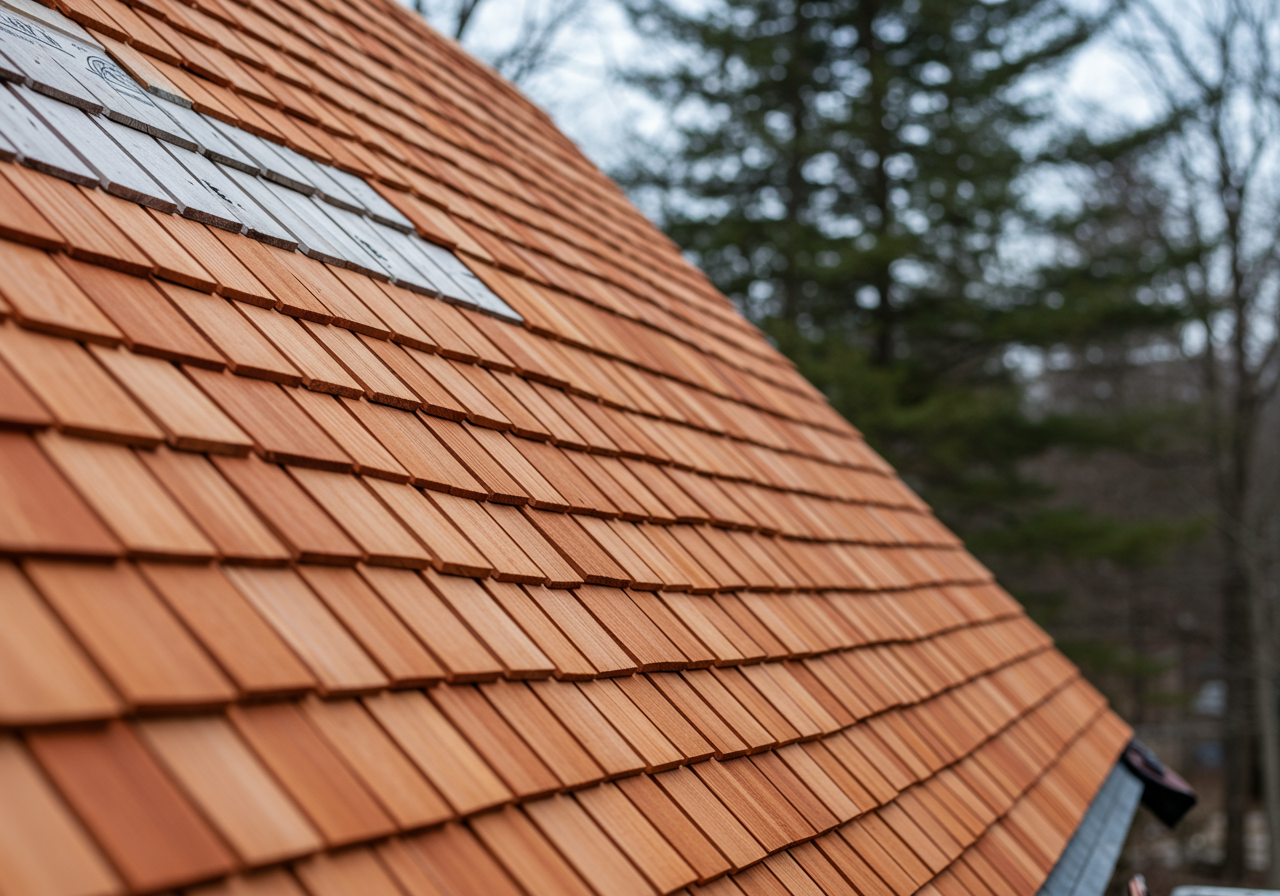
Cedar Shake Roofing in Hamden
Natural wood roofing offers timeless beauty but requires careful consideration in Connecticut's climate.
Key Takeaways
- Cedar shakes in Hamden typically last 22 to 28 years with proper maintenance, though poor airflow can cut that life by 35%.
- Expect to pay a 40% to 60% premium over high-end architectural shingles for genuine Grade 1 Western Red Cedar.
- Annual maintenance (cleaning and treating) is non-negotiable in CT's damp climate to prevent rot and insect infestation.
- Synthetic cedar alternatives now offer Class A fire ratings and 50-year warranties that natural wood simply cannot match.
The Grade Matters: Why "Cheap" Cedar is a Disaster
What most homeowners don't realize is that "cedar" isn't a single product. From a technical standpoint, the quality of the wood fiber determines whether your roof lasts three decades or starts curling in seven years. In Hamden, where we deal with significant humidity and those heavy autumn leaf-drops, you cannot cut corners on the grade of wood.
I always recommend No. 1 Grade Blue Label shakes. These are 100% heartwood, 100% clear, and 100% edge grain. Edge grain is the "gold standard" because the vertical orientation of the wood fibers makes the shake far less likely to warp or split as it cycles through Connecticut's freeze-thaw periods. I once inspected a home near Quinnipiac University where the previous roofer had used "flat grain" seconds to save the owner about $4,300. Within five years, nearly 22% of the shakes had "cupped," creating massive gaps for wind-driven rain to enter.
Look, if a quote looks too good to be true, the contractor is likely using a lower-grade wood or skipping the interlayment—the layer of felt paper required between every row of shakes to prevent water from backing up under the wood.
The Hamden Climate Factor: Moss, Mold, and Shade
Hamden presents a unique challenge for natural wood. We have a lot of "micro-climates" here. If your home is in a sun-drenched patch of Cheshire, your cedar might stay dry and healthy. But if you're tucked under the oaks in the Mount Carmel area, you're looking at a different beast.
Cedar is organic. It wants to decompose. When it stays damp because it's shaded by trees, fungi and moss take root. The data clearly shows that cedar roofs in shaded CT neighborhoods require professional cleaning every 3 to 5 years to remove lichen and debris. This isn't just about looks; moss holds moisture against the wood, which leads to "soft rot" (the breakdown of the wood's cellular structure).
Never Power Wash a Cedar Roof
From a technical standpoint, airflow is your best friend. In my experience, installing cedar on a "battens and counter-battens" system (creating a 3/4-inch air gap under the wood) can add 8 years to the lifespan of the roof. It allows the wood to dry from the bottom up, which is something many New England roofers still skip to save time.
Calculating the True Cost: Is the ROI There?
Let's talk numbers. A natural cedar shake roof in Connecticut usually runs between $16.50 and $22.00 per square foot installed. For a typical 2,400-square-foot Hamden colonial, you're looking at an investment of roughly $42,000 to $53,000.
Compare that to a high-end synthetic like DaVinci Roofscapes or Brava, which might cost $19,000 to $26,000. While the upfront cost of natural wood is high, the aesthetic value is undeniable. However, you have to factor in the "ownership cost." If you aren't prepared to spend $1,200 every few years for a professional treatment, you're better off with a different material.
Natural Cedar vs. Synthetic Alternatives
| Feature | Natural Western Red Cedar | Synthetic (Composite) |
|---|---|---|
| Expected Lifespan | 20-30 Years | 50+ Years |
| Fire Rating | Class B or C (Standard) | Class A (Highest) |
| Maintenance Needs | High (Cleaning/Oiling) | Very Low |
| Avg. CT Cost (Installed) | $18 - $24 per sq ft | $14 - $19 per sq ft |
Average Cost Comparison (2,400 sq ft home)
Interestingly, Energy Star research on cool roofs shows that while cedar has some natural insulating properties (R-value), modern synthetic shingles can actually be engineered with reflective pigments that lower attic temperatures more effectively in the summer. If you're looking for energy tax credits, you should check the IRS Form 5695 instructions, though natural wood rarely qualifies for these specific federal incentives.
The Installation Process: Why You Can't Hire "Just Anyone"
You can't nail cedar the same way you nail asphalt. It's a craft. I've seen guys use standard galvanized nails that reacted with the natural tannins in the cedar, causing ugly black streaks to run down the roof within 14 months. You must use stainless steel or high-quality hot-dipped galvanized fasteners.
Tear-off & Deck Inspection
Remove all old material and check the plywood or spaced 'skip' sheathing for any rot.
Ice & Water Shield
In CT, we legally need this 24 inches inside the warm wall line to prevent ice damming.
Interlayment Placement
Install 18-inch wide strips of 30lb felt between every row of shakes to shed water.
Shingle Spacing
Leave a 3/8-inch to 1/2-inch gap between shakes to allow for wood expansion when wet.
Stainless Steel Fastening
Drive two nails into each shake, 1 inch from the edges and 2 inches above the exposure line.
If you're ready to see how these costs look for your specific property, it's worth the time to get a quote from a verified professional who understands the local Hamden building codes. Our matching process ensures you're not dealing with fly-by-night operations that don't know the difference between a taper-sawn shake and a hand-split one.
"In the New Haven area, cedar is a prestige material. But if you aren't committed to the maintenance, it becomes a liability within a decade. I always tell my clients: buy the roof you're willing to take care of, not just the one you like the look of today."
The Future of "Faux" Cedar in Connecticut
I have to mention synthetic cedar because the technology has come so far. Brands like DaVinci use molds of real hand-split shakes, so from the curb on Whitney Avenue, nobody can tell the difference. From a technical standpoint, these are superior for the CT climate. They don't rot, they don't grow moss, and they have a Class 4 impact rating (which helps when those spring hailstorms hit New Haven County).
Also, the EPA's data on heat islands highlights how modern materials can reduce local temperatures. While natural wood is better than black asphalt in this regard, some "cool-rated" synthetics are even more efficient. If you're worried about the environmental impact, many of these synthetics are made from recycled polymers, making them a "greener" choice than cutting down old-growth Western Red Cedar.
Is Your Hamden Roof Ready for an Upgrade?
Don't guess on costs. Connect with Connecticut's top-rated roofing specialists today.
No credit card required • Free to use
Final Thoughts for Hamden Homeowners
Look, a cedar roof is a statement piece. It says you value the history and the craft of your home. But here in Hamden—with our humidity, our heavy snow loads, and our massive deciduous trees—it's a choice that comes with homework.
Here's my final advice: if your heart is set on wood, make sure you have the budget for stainless steel fasteners and a bi-annual maintenance plan. If you want the look but none of the Saturday morning stress, go with a high-end composite. Either way, make sure your contractor is pulling the correct permits from the Hamden Building Department. I've seen projects stalled for weeks because someone tried to "save money" by skipping the legal paperwork.
Get Your Free Roof Quote
Enter your zip code to get started