Key Takeaways
- Connecticut law strictly limits residential roofs to a maximum of two layers of shingles—but local wind zones often make a full 'tear-off' the only smart choice.
- Lyme falls into a high-wind zone (125-130 mph), requiring specific fastening patterns and shingle ratings that differ from inland towns.
- Ice and water shield protection must extend at least 24 inches inside the exterior wall line, a critical defense against our coastal March freeze-thaw cycles.
- A building permit is a legal requirement in Lyme for any major roofing work, and skipping it can void your manufacturer's warranty.
Did you know that in the eyes of the Connecticut State Building Code, your roof isn't just a lid for your house—it's actually classified as a structural "sail" designed to withstand the equivalent of a Category 3 hurricane? In a town like Lyme, where our homes sit nestled between the Connecticut River and the shoreline, the rules governing how that "sail" is attached are surprisingly dense. Most homeowners assume that as long as the shingles look good and the leaks stop, the job is done. But here's the reality: nearly 30% of the roofing projects I've audited in Middlesex County over the last few years had at least one technical code violation that could complicate an insurance claim or a home sale down the road.
Lyme is a special place. We value our historic aesthetics and our wooded privacy, but those very things—steep pitches on Colonials and heavy shade from our beautiful oak canopies—trigger specific requirements in the state code that often get overlooked. Whether you're looking at a minor repair or a total overhaul, understanding these "rules of the road" isn't just for the guys in the tool belts. It's for you, the homeowner, to ensure your investment is actually legal.
Lyme Roofing Code Compliance
Understanding Connecticut building codes for coastal Middlesex County homes
1. The Two-Layer Limit: Why Three is a Crowd (and a Code Violation)
One of the most frequent questions I get from neighbors near Bill Hill Road is: "Can't we just shingle over what's already there?" It's a tempting way to save about $1,800 to $2,400 in labor and disposal fees. However, the Connecticut State Building Code (based on the International Residential Code) is very clear: you cannot install a new roof over an existing roof if there are already two or more layers of any type of roof covering.
But here is the "Sheri Wilde" take on that: just because you can have two layers doesn't mean you should. I remember a beautiful saltbox house near the Lieutenant River that had two layers of asphalt over the original cedar shakes. From the ground, it looked fine. But the weight was literally bowing the rafters. When we finally stripped it down, we found that the bottom layer of shingles had trapped moisture against the deck for a decade. The wood was the consistency of a wet sponge.
In Lyme, our humidity levels are no joke. Trapping a second layer of heat and moisture between old and new shingles is like putting a plastic bag over a damp towel. It might look dry on the outside, but underneath, things are getting ugly.
Reroofing (Overlay) vs. Full Tear-Off in Lyme
| Feature | Overlay (2nd Layer) | Full Tear-Off |
|---|---|---|
| Upfront Cost | ||
| Lifespan | ||
| Deck Inspection | ||
| Code Compliance | ||
| Weight Stress |
2. Wind Zones and the 130 MPH Reality
Lyme homeowners often forget that we are technically in a "Coastal Region" according to wind-speed maps. While we aren't getting the direct salt spray of Old Saybrook, the 2022 Connecticut State Building Code (which governs projects into 2026) places us in a high-wind trigger zone. This means your shingles must be rated to withstand wind speeds of up to 125 or 130 mph, depending on your exact coordinates.
The code isn't just about the shingle itself; it's about the "attachment." For most of the country, four nails per shingle is the standard. But in our neck of the woods? The building official in Lyme is looking for a six-nail fastening pattern on every single shingle. I've seen projects delayed for days because a crew from out of state—who didn't know the local Connecticut consumer protection laws or local amendments—tried to use the standard inland nailing pattern.
If you're wondering if your current roof has ever faced those kinds of speeds, you can actually look up historical storm events in Middlesex County to see just how many high-wind warnings we've had in the last five years. It's usually more than you think, especially during those unpredictable March nor'easters.
3. Ice Dam Protection: The 24-Inch Margin of Error
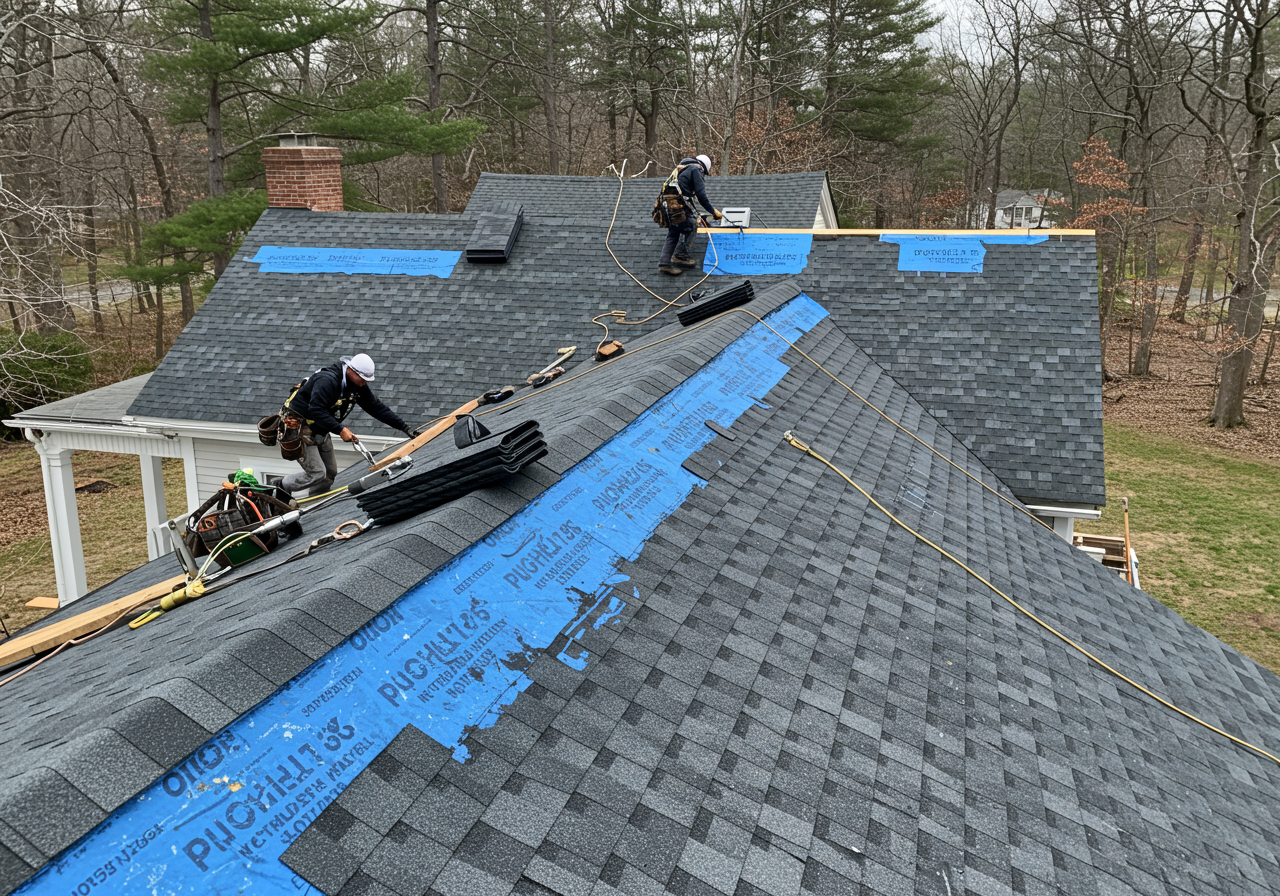
If there is one code requirement that saves Lyme homes from ruin, it's the "Ice and Water Shield" rule. Because we live in an area where the design temperature is below freezing, the code requires a self-adhering polymer-modified bitumen sheet (the "sticky stuff") to be installed at the eaves.
Here is the catch: it's not enough to just put one 36-inch wide roll down. The code dictates that this protection must extend from the lowest edge of the roof to a point at least 24 inches inside the exterior wall line. On a house with deep overhangs—which many of our beautiful Lyme Colonials have—you often need two full rows of this membrane to satisfy the rule.
I was helping a friend over by Rogers Lake last winter who had water pouring through her recessed lighting. Her roofer had installed the shield, but only one row. Because her eaves were so deep, the "ice dam" formed right above the unprotected wood, and gravity did the rest. It was a $7,500 mistake for the sake of a $100 roll of extra membrane.
The Drip Edge Requirement
4. Ventilation: Why Your Attic Needs to "Breathe"
Roofing code isn't just about what's on top; it's about what's underneath. Specifically, ventilation. The code requires a specific ratio of "Net Free Ventilating Area"—usually 1 square foot of ventilation for every 150 square feet of attic floor space.
Why does the building inspector care about your attic air? Because a "hot" roof dies young. In Lyme, our many wooded lots mean roofs stay damp longer. If your attic isn't venting that moisture out, your shingles will literally cook from the inside out. I've walked on roofs that felt like trampolines because the plywood was delaminating due to poor airflow.
When you're looking at expert roofing insights for our region, you'll see a lot of talk about ridge vents. But the code requires "balanced" ventilation. You can't just have a ridge vent; you need intake vents (soffits) at the bottom. It's a vacuum system. If one side is blocked, the whole thing fails.
Did You Know?
Over 75% of roof manufacturer warranty denials in Connecticut are caused by improper attic ventilation that doesn't meet local building codes.
5. Navigating the Lyme Permitting Process
In some parts of the country, a roof is a "handshake and a ladder" job. Not in Lyme. To be code-compliant, your contractor must pull a building permit with the Town of Lyme. This involves submitting a plan, paying a fee based on the project cost, and—most importantly—opening your project up to an inspection.
Some contractors will try to talk you out of a permit, saying it "saves time and money." My advice? Run. A contractor who wants to skip the permit is a contractor who wants to skip the rules. I always tell homeowners to verify their contractor's license before the first shingle is even ordered. A licensed pro knows that the permit is your best friend—it's an independent set of eyes ensuring the work is safe.
Submit Application
Contractor submits the application and proof of insurance to the Lyme Building Department.
Official Review
The Building Official reviews the shingles' wind-rating and the ice-shield plan.
Permit Display
The permit is issued and must be displayed on-site during the work.
Mid-Roof Inspection
The Building Official may perform a 'mid-roof' inspection to check the fastening pattern.
Final Inspection
A final inspection is completed to verify drip edge and ventilation compliance.
I've seen the heartbreak of a homeowner trying to sell their house near the village, only for the buyer's inspector to find there was no permit on file for a five-year-old roof. They ended up having to pay for a structural engineer to certify the work—a cost far higher than the original permit fee.
6. Safety Standards: More Than Just Harnesses
Finally, the "code" of a professional job includes safety. While building codes focus on the structure, federal standards like OSHA's fall protection guidelines dictate how the work is actually performed. If a crew is crawling all over your steep 10/12 pitch roof without ropes or harnesses, they aren't just risking their lives—they are putting you at legal risk as a homeowner.
I remember a project in Hadlyme where the crew looked like they were auditioning for a circus act. No anchors, no hard hats, and shingles being tossed haphazardly. It's a red flag for the quality of the work. If they are cutting corners on their own safety, they are absolutely cutting corners on your flashing and underlayment.
Before you commit to a crew, see what other CT homeowners experienced with their contractors. The best teams in our area are the ones who treat your property like a professional job site, not a playground.
Hiring a Code-Compliant Professional
Pros
- Manufacturer warranties stay valid
- Home insurance claims are easier to process
- Enhanced home resale value with 'on-file' permits
- Peace of mind during the next hurricane
Cons
- Higher upfront cost for permits and labor
- Project may take 1-2 days longer for inspections
Building a roof that meets Lyme's strict standards isn't about bureaucracy—it's about biology and physics. It's about keeping the March dampness out of your rafters and ensuring your home stands strong when the wind whistles off the Sound. Don't settle for "good enough" when the code is there to ensure "built to last."
Get Your Free Roof Quote
Enter your zip code to get started
FAQ

About Sheri Wilde
Verified ExpertSheri Wilde is a Home Improvement Editor with a background in interior design and sustainable living. She helps Connecticut homeowners make informed decisions about their biggest investments.