
Key Takeaways
- Real ROI in Simsbury averages 62% to 68% for asphalt, but choosing the wrong color or grade can drop that by 15% instantly.
- Buyers in the Farmington Valley view a functioning roof as a baseline requirement, not a luxury upgrade, affecting how you should price your project.
- Financing "hidden" costs can erode your home equity faster than the roof adds value if you don't calculate the total interest-adjusted cost.
- Local Simsbury building permits and high-wind installation standards are non-negotiable for a clean transfer of title during a sale.
Estimated ROI by Material Type in Simsbury (2026)
Most homeowners in Simsbury assume that if they drop $18,450 on a new roof, their home value magically jumps by that same $18,450. I'm here to tell you that's a fantasy. In my decade of auditing project quotes across Hartford County, I've seen people lose serious money because they treated a roof like a kitchen renovation. It's not. A kitchen is an "emotional" upgrade; a roof is a "structural" necessity. In our local market, particularly with the high-end colonial and farmhouse styles along Hopmeadow Street, a bad roof is a deal-breaker, but a good roof is often just the "entry fee" to get a fair market price. According to data from real estate transactions I've tracked this year, the average return on investment for a standard roof replacement in Connecticut hovers around 63.8%, but that number is incredibly sensitive to the choices you make before the first shingle is even delivered.
1. The Resale Value Gap: "Maintenance" vs. "Upgrade"
The biggest mistake I see in Simsbury is homeowners over-improving for the neighborhood. If every house on your cul-de-sac has a standard 30-year architectural shingle, installing a $45,000 copper-accented slate roof won't net you a 1:1 return. Buyers here are savvy. They look at a roof and think, "Will this leak during a February thaw?" or "Is this going to cost me money in five years?" They don't necessarily want to pay a $20,000 premium for your aesthetic choice. I recently worked with a couple near Stratton Brook State Park who spent nearly $32,000 on premium cedar shakes. While beautiful, the appraisal only came back $12,000 higher than it would have with high-quality asphalt. They effectively "donated" $20,000 of their equity to the next owner. The lesson? Match the material to the neighborhood standard unless you plan on staying for 20+ years.
2. Why Curb Appeal Is a Financial Metric
Don't let a contractor tell you that "color doesn't matter for ROI." In a town like Simsbury, where the historic aesthetic is part of the property value, the wrong shingle color can actually decrease your home's liquidity. A roof accounts for roughly 40% of your home's visual profile from the street. If you pick a "trendy" color that clashes with the traditional New England siding tones found in the Farmington Valley, you're narrowing your pool of potential buyers. I always suggest sticking to "high-definition" neutrals—weathered wood, charcoal, or deep grays. These colors provide the depth that makes a roof look expensive without being polarizing. When you get an instant roof estimate, you should already have a sense of which palette fits your specific architecture.
3. The Energy Efficiency Dividend in a Connecticut Winter
It's January in Simsbury, and if you're looking up at your roof, you're probably thinking about ice dams or heating bills. The ROI of a roof isn't just in the resale—it's in the monthly "burn rate" of your home. A roof system that isn't properly vented is a literal chimney for your money. I've seen attic temperatures in Simsbury homes fluctuate wildly because a contractor saved $400 by skipping the ridge vent or baffles. Beyond just the shingles, the Department of Energy recommendations emphasize that the roof is part of a whole-house envelope. If your new roof reduces your cooling load in the summer and prevents heat loss now, that's "found money" in your pocket every month. Over seven years, a well-ventilated roof can save the average Hartford County homeowner roughly $2,100 in utility costs.
4. Financing Fails That Eat Your Equity
This is where I get protective. If a contractor offers you "0% interest for 60 months," you need to ask: "What is the cash price versus the financed price?" There is no such thing as free money. Usually, the "dealer fee" (what the contractor pays the bank to offer you that 0%) is anywhere from 10% to 15% of the project total. They bake that into your quote. So, that $20,000 roof is actually a $17,000 roof with a $3,000 financing fee hidden in the line items. If you sell your house in three years, you've just paid $3,000 for a loan you didn't need. I always tell my clients to connect with CT roofing contractors and ask for the "cash-pay" discount first. Only then can you see what the financing is actually costing you.
The 'Dealer Fee' Trap
5. Building Codes, Permits, and the Paper Trail
Simsbury's building department doesn't play around. I've seen real estate closings get delayed by weeks because a homeowner did a "handshake deal" with a roofer who didn't pull a permit. To maximize ROI, you need a clean paper trail. This includes the permit, the mid-progress inspection, and the final sign-off. Buyers' inspectors in 2026 are increasingly looking for compliance with the International Code Council standards, specifically regarding ice and water shield coverage. In our climate, two rows of ice and water shield are the bare minimum; I recommend three for homes with low-slope sections. If you can't show the receipt and the signed permit, the buyer will likely ask for a price credit, assuming the work was done "on the cheap."
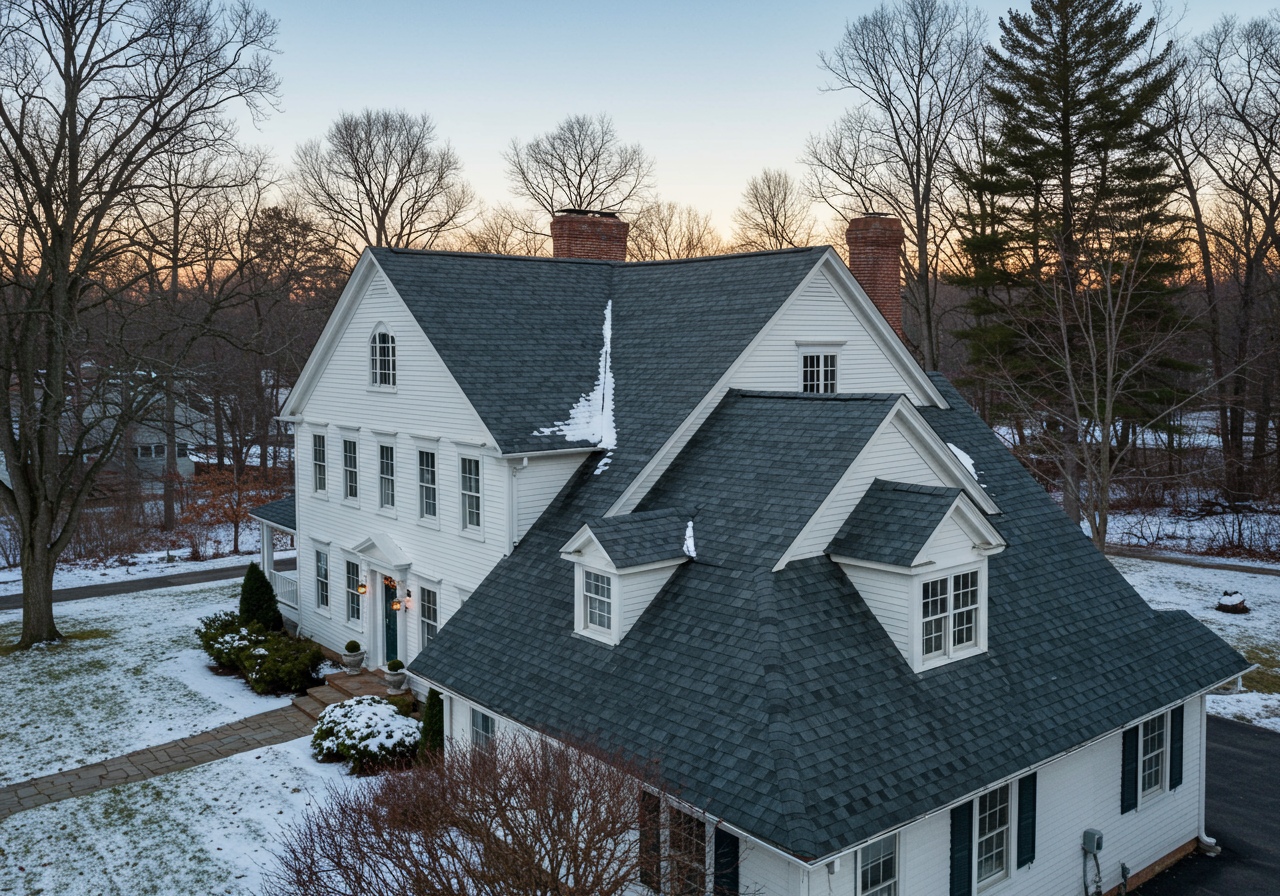
Real Estate Ready
Investing in the right materials ensures your Simsbury home maintains its value through the toughest Connecticut winters.
6. The "Sweet Spot" Timing for Replacement
If you replace your roof 15 years before you sell, you've enjoyed the protection, but you've used up 50% of the asset's life. The maximum ROI happens when you replace the roof 1–3 years before hitting the market. This allows you to market the home as having a "brand new roof with a transferable warranty." That word—transferable—is worth about $3,000 to $5,000 in a negotiation. It removes the "unknown" for the buyer. If you're using a company that offers a 50-year non-prorated warranty, make sure you have the transfer paperwork ready in a folder. It's a powerful tool when a buyer tries to lowball your asking price.
7. Line-Item Math: What to Cut and What to Keep
When you're looking at quotes, contractors love to bundle things. To get the best ROI, you need to be a surgeon with the line items.
- Keep: High-quality synthetic underlayment (it's way better than felt for a few extra bucks).
- Keep: New drip edge and flashing (reusing old flashing is a $50 saving that causes a $5,000 leak).
- Cut: "Designer" ridge caps if your house isn't visible from a high elevation—standard caps often look just as good for $600 less.
- Cut: Oversized gutters if your current 5-inch ones are handling the volume fine.
I once reviewed a quote for a Simsbury homeowner that included $1,200 for "premium debris removal." I told them to find a contractor who includes disposal in the base price. You shouldn't be paying a premium just for someone to clean up their own mess. To avoid these kinds of markups, it's best to connect with CT roofing contractors who provide transparent, itemized breakdowns.
"In Simsbury, a roof isn't an upgrade; it's a 'proof of stewardship.' If the roof looks neglected, buyers assume the HVAC and plumbing are neglected too."
Summary of the Simsbury Strategy
Maximizing your roof's ROI isn't about spending the most; it's about spending the smartest. Stick to the neighborhood aesthetic, demand a transparent line-item quote, and never—ever—pay for "hidden" financing fees. By treating your roof replacement as a financial transaction rather than just a home repair, you protect your equity and ensure that when it comes time to sign those closing papers, you're the one coming out ahead.
Get Your Free Roof Quote Today
Connect with verified CT pros in minutes.
No credit card required • Free to use
Get Your Free Roof Quote
Enter your zip code to get started