
Key Takeaways
- Traditional attic venting keeps your roof deck cold in winter, preventing ice dams but requiring proper intake/exhaust balance.
- Sealed 'hot roof' systems bring your attic inside the thermal envelope, ideal for homes with HVAC in the attic.
- Historic New London homes with complex rooflines are better suited for traditional venting upgrades.
- Proper insulation (R-49 to R-60) is critical regardless of which ventilation strategy you choose.
After that heavy snowfall we saw across New London County last week, I couldn't help but notice the telltale signs on our neighborhood roofs. While walking the dog past some of those beautiful old homes near the Coast Guard Academy, the "icicle index" was in full effect. Some houses looked like gingerbread cabins with perfect blankets of white, while others had three-foot daggers hanging from the eaves. It's a visual reminder that what's happening under your shingles is just as vital as the shingles themselves. If you've been wondering why your upstairs is sweltering while your heating bill climbs, or why your neighbor's roof stays clear while yours turns into an ice rink, you're likely caught between two very different schools of thought: traditional ventilation and the modern sealed "hot roof" approach.
Understanding this balance is part of the deep dives we offer in our roofing blog library, where we look past the aesthetics to the actual science of your home.
The Invisible War: Why Your New London Attic is Struggling
The core problem for most of us in the Southeast corner of Connecticut is the combination of high humidity from the Sound and our erratic winter temperature swings. When your attic isn't managed correctly, it becomes a battlefield. In the winter, heat escapes from your living room into the attic, warming the roof deck and melting the snow above. That water runs down to the cold gutters, freezes, and—boom—you have an ice dam that backs up under your shingles. In the summer, that same attic space can hit 140°F, literally baking your shingles from the inside out and shortening their 30-year lifespan to a mere 17 years.
I recently looked at a colonial over on Montauk Avenue where the homeowner was frustrated by "leaks" that weren't actually leaks at all. It was condensation. Because the attic was poorly insulated and had zero airflow, the warm air from the shower and kitchen was hitting the freezing underside of the roof deck and turning back into water. They were about to spend $12,000 on a new roof when all they really needed was a smarter ventilation strategy. It's easy to focus on the color of the slate or the texture of the wood shake, but if the "lungs" of the house aren't working, the skin won't last.
The Mold Factor
Traditional Passive Ventilation: Letting the Roof Breathe
For 90% of the homes in New London, the traditional "cold roof" system is the standard. This relies on the simple law of physics: hot air rises. You pull cool air in through the soffits (the underside of your eaves) and exhaust the hot air through a ridge vent at the very top. When it's done right, the temperature in your attic should be within 5°F to 8°F of the temperature outside. It sounds counterintuitive to want your attic cold in the winter, but that's exactly what prevents ice dams.
The beauty of this system is its simplicity. There are no motors to break and no chemicals to spray. However, I often see "ventilation sabotage" where homeowners (or well-meaning DIYers) pack fiberglass insulation all the way into the corners of the attic, inadvertently blocking the soffit vents. I always tell people to verify their contractor's approach to intake venting specifically. If they just install a ridge vent without ensuring the air can actually get in at the bottom, they've created a vacuum that can actually pull conditioned air out of your house.
Typical Lifespan & Effectiveness
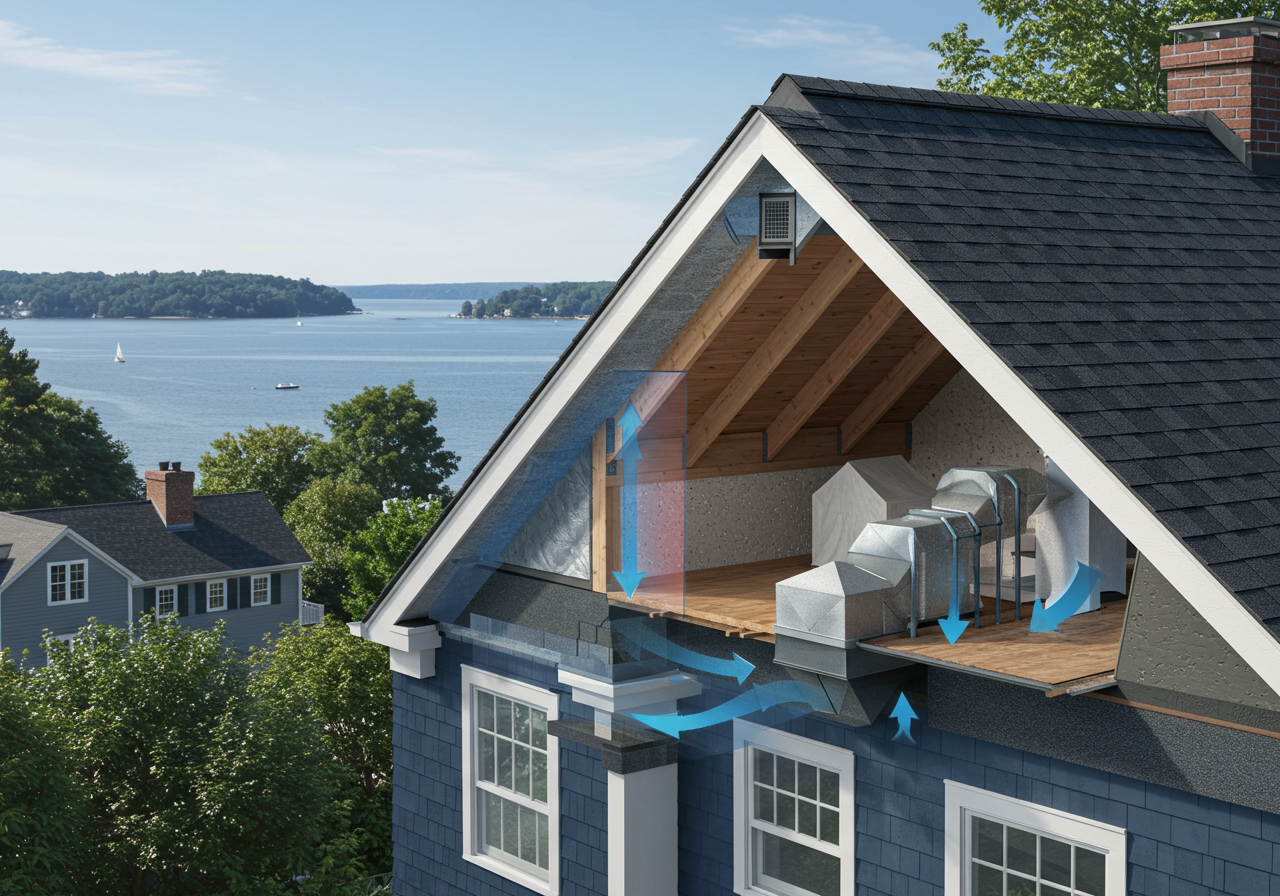
A properly ventilated attic with baffles and ridge vents
A residential attic in New London, CT showing proper ventilation setup
The Modern Alternative: The Sealed "Hot Roof" System
The "alternative" that's gaining steam in newer New London builds is the unvented, sealed attic. Instead of letting the attic breathe, you seal it off entirely from the outside world using spray foam insulation applied directly to the underside of the roof deck. This effectively brings your attic inside the thermal envelope of your home. Your attic stays roughly the same temperature as your bedroom.
This is a game-changer if you have your HVAC air handler or ductwork located in the attic. Why make your furnace work to push air through ducts sitting in a 140°F room in July? Research from the Department of Energy's insulation guide shows that bringing these systems into a "conditioned space" can slash cooling costs by up to 15%. But here's the catch: it's an all-or-nothing move. You can't half-seal an attic. If you leave even a small gap, you'll end up with concentrated moisture in one spot, which leads to rot faster than you can say "shingle failure."
"A sealed attic is like a high-performance cooler; a ventilated attic is like a breathable windbreaker. Both work, but you can't wear a windbreaker over a cooler and expect a good result."
The New London Verdict: Which Strategy Wins?
So, how do you choose? If you live in a historic home near Ocean Beach or in the downtown district, you likely have a complex roofline with dormers and hips that make spray foam incredibly difficult (and expensive) to install correctly. For these homes, upgrading to R-60 blown-in cellulose and ensuring your soffit baffles are clear is usually the smartest move for your wallet. Plus, traditional venting is easier to inspect during your yearly maintenance check.
On the flip side, if you're planning a major renovation or building new in New London, the sealed system offers incredible storage potential. Imagine an attic that isn't a dusty, spider-filled sauna, but a clean, climate-controlled space. Just keep in mind that Connecticut's building requirements often dictate specific fire-rating barriers for spray foam, so your contractor needs to be on their game with local codes. Don't just take my word for it— see what other CT homeowners experienced when they switched to high-efficiency insulation systems.
Get Your Free Roof Quote
Enter your zip code to get started
In the end, your roof is a conversation with the New London skyline. Whether you choose the breathable path of traditional vents or the high-tech seal of spray foam, the goal is the same: a dry, efficient, and long-lasting home that stands up to whatever the Sound throws our way.