Last Tuesday's sudden deluge over the Mystic River was a wake-up call for anyone living between Noank and Old Mystic. I watched the runoff pouring over the edges of a colonial on Pearl Street, not because the downpour was historic, but because the gutters were already packed with early-season debris and helicopter seeds. If your drainage is failing in a June thunderstorm, it doesn't stand a chance when the October leaf drop actually begins. This isn't just about avoiding a messy yard; it's about protecting the structural integrity of your home before the Groton-New London Airport weather station starts recording those first freezing nights.
Key Takeaways
- Mystic's heavy oak canopy can triple gutter debris weight after coastal mist.
- Salt air causes pitting corrosion on gutter brackets years before visible rust.
- Clogged gutters are the foundation for ice dams during freeze-thaw cycles.
- Proactive fall prep costs a fraction of emergency fascia and roof repairs.
1. The Heavy Debris Load of New London County Oaks
Mystic is beautiful because of its old-growth canopy, but those massive white oaks are a nightmare for your roof's drainage system. Unlike the lighter maple leaves found further north in Hartford, oak leaves are thick, acidic, and slow to decompose. They don't just sit in your gutters; they mat down and create a waterproof seal over your downspouts.
I've seen dozens of cases where the sheer weight of wet oak leaves—which can triple in weight after a typical coastal mist—actually pulls the gutter spikes right out of the fascia board. This isn't a theoretical problem. When that wood becomes exposed, rot sets in within a single season. But if you handle these minor gutter and roof repairs early, you're looking at a fraction of the cost compared to a full fascia replacement. I always tell my neighbors to look up at their trees in late June; if those branches are overhanging your shingles, you're already behind the curve.
2. Why Salt Air Accelerates Gutter Failure in Mystic
If you can smell the salt air from your front porch, your roofing system is under constant chemical attack. Mystic's proximity to the Sound means our moisture isn't just water; it's a corrosive brine. This is particularly hard on the "hidden hangers" used in modern seamless gutters. While aluminum doesn't rust like steel, the salt air causes a process called pitting corrosion that can weaken the metal brackets holding your system to your house.
I recently inspected a home near the Seaport where the gutters looked fine from the ground, but the brackets had become brittle from years of salt exposure. One heavy autumn rain would have sent the whole 40-foot run crashing to the flower beds. According to FEMA's guidelines for coastal home mitigation, securing these attachments is a primary defense against high-wind events. Don't assume that because your gutters are only five years old, they're still structurally sound. The "Mystic tax" on metal components is very real.
3. The Hidden Connection Between Gutters and Ice Dams
Many Mystic homeowners think ice dams are purely a roofing or insulation issue. That's only half the story. The reality is that a clogged gutter acts as the foundation for an ice dam. When the June rains wash grit from your shingles into your gutters, it creates a dam. When winter hits, the snow melts on your warm roof, hits that frozen "sludge" in your gutter, and backs up under your shingles.
I've spent a lot of time looking at NOAA radar data from our recent winters, and we're seeing more "freeze-thaw" cycles than we did twenty years ago. This makes your gutter's ability to clear water instantly more important than ever. If you find that your attic is consistently too warm, the Department of Energy recommends specific insulation upgrades to prevent that initial snowmelt. But remember: even the best insulation can't save you if your gutters are acting like a frozen swimming pool attached to your eaves.
"In Mystic, we don't just worry about the volume of rain; we worry about the speed of drainage. A gutter that's 50% clogged is 100% useless during a New London County nor'easter."
4. Moss and Algae: The Silent Shingle Killers
Walk down any street in the Lord's Hill neighborhood and you'll see those dark streaks on the north-facing sides of roofs. That's Gloeocapsa magma, a type of cyanobacteria that thrives in Mystic's high humidity. It's not just an eyesore; it feeds on the limestone filler in your shingles. By the time fall arrives, this moss has spent the summer holding moisture against your roof.
But here is the catch: if you try to power wash that moss off in a panic, you'll strip the protective granules right off your shingles. I've seen homeowners turn a 15-year roof into a 5-year roof in a single afternoon with a rented pressure washer. The better move is a soft-wash treatment in the late summer. It stops the biological growth before the winter dampness allows it to take root even deeper. If the damage is already through the matting, you might be looking at a full roof replacement sooner than you planned, so get a professional eye on those green patches now.
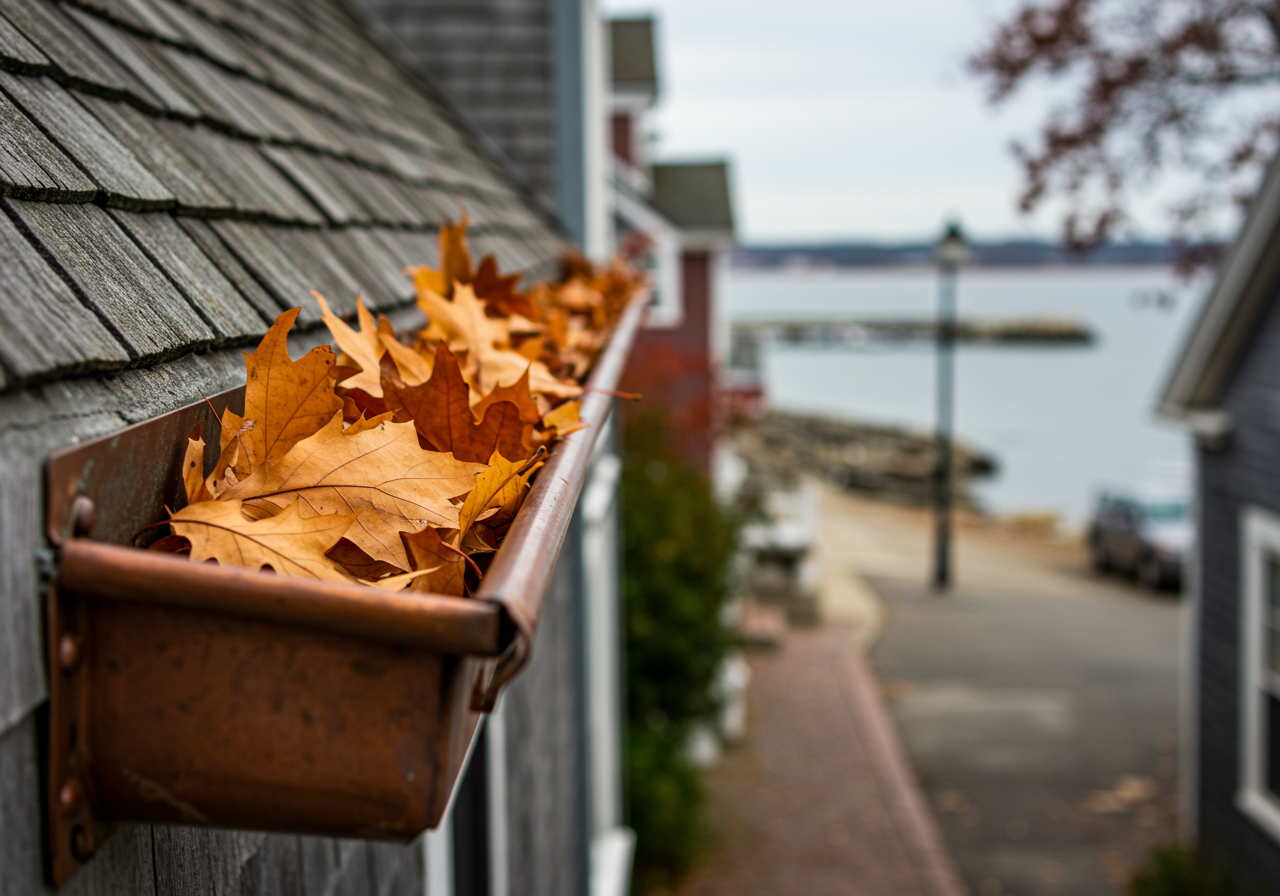
Mystic Fall Gutter and Roof Prep
Coastal humidity, oak canopy debris, and salt air combine to stress Mystic drainage systems before winter arrives.
5. Timing Your Maintenance Around the Mystic Calendar
I've lived in Connecticut long enough to know that "Fall" is a moving target. In Mystic, we often stay warmer later than our friends in Tolland or Litchfield, thanks to the Atlantic's thermal mass. This leads many people to wait until December to clean their gutters. That is a massive mistake. By December, the "Great Freeze" has often already happened, turning your wet gutter debris into a solid block of ice that can't be removed without damaging the metal.
And let's be honest, trying to find a contractor in Mystic during a November nor'easter is like trying to get a table at Sift on a Saturday morning—nearly impossible. I recommend the "Two-Phase" approach: a light clearing in late June to handle the spring seeds, and a deep clean in late October. If you're trying to figure out how to budget for these seasonal costs, using a local estimator tool can help you decide if it's cheaper to pay for maintenance now or repairs later.
Average Annual Costs: Mystic, CT
6. Sustainable Drainage and the Coastal Ecosystem
We have to be careful about what we wash off our roofs in Mystic. Everything that goes down your downspout eventually finds its way toward the Mystic River or the Sound. If you're using harsh chemical cleaners to prep your roof for fall, you're contributing to the nitrogen loading that harms our local shellfish beds.
I'm a big fan of "cool roofs" and eco-friendly drainage solutions. As the EPA notes in their research on heat islands, the right roofing material doesn't just save you money on AC—it also changes how water interacts with your home. When you're prepping for fall, consider installing rain barrels with overflow valves. It's a very "Mystic" way to handle the New London County rainfall while keeping your basement dry and our local waters clean.
Did You Know?
Mystic receives an average of 48 inches of rain per year, which is roughly 10% higher than the national average, placing extra stress on gutter seams.
7. The Final Pre-Winter Inspection Checklist
Before the first frost hits the pumpkin patches at B.F. Clyde's, you need a boots-on-the-ground assessment. I'm not talking about a quick glance from the driveway. You need to see the "hidden" zones: the valleys where two roof planes meet and the flashing around your chimney. These are the spots where leaves congregate and rot begins.
But don't just look for debris; look for "shingle shedding." If you see a pile of sand-like granules at the bottom of your downspouts, your shingles are reaching the end of their functional life. The sun's UV rays over the summer have baked the oils out of the asphalt, and the winter wind will be the final straw. I always keep a log of which sections of my roof get the most sun—those are usually the first to fail during a January gale.
Ladder Safety Warning
If you're feeling overwhelmed by the technical side of your roof's health, you aren't alone. Most Mystic homeowners are busy enough without climbing ladders. The trick is getting an honest look at the numbers before the clouds turn gray. You can get a matched quote from a verified local contractor who actually understands the specific climate challenges of the New London County coast. It beats spending your Saturday on a ladder, I promise.
Get Your Free Mystic Roof Quote Today
Connect with verified New London County pros in minutes.
No credit card required • Free to use
Get Your Free Roof Quote
Enter your zip code to get started
Frequently Asked Questions

About Noah Knight
Verified ExpertNoah Knight is a Connecticut Weather & Climate Specialist who helps homeowners understand how New England's unique weather patterns affect their roofing systems. He combines meteorological knowledge with practical home maintenance advice.